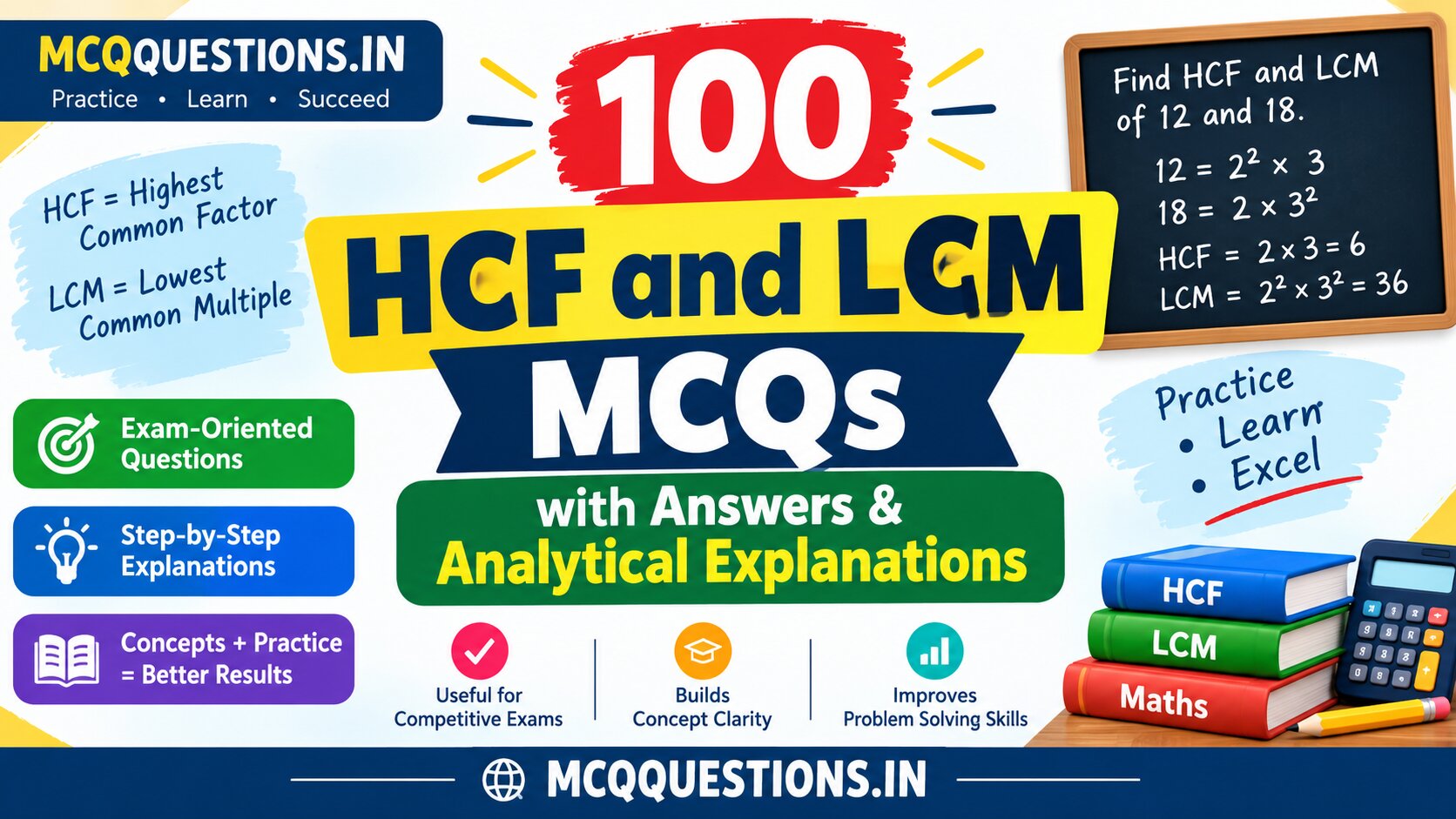
100 HCF and LCM MCQs with Answers & Analytical Explanations
Practice 100 HCF and LCM MCQs with answers and analytical explanations. Improve your Maths and aptitude skills for SSC, Railway, Banking, UPSC and other competitive exams.
100 HCF and LCM MCQs with Answers & Analytical Explanations
Table of Contents
HCF & LCM MCQs — Questions 1–25
1. What is the HCF of 24 and 36?
A) 6
B) 8
C) 12
D) 18
Answer: C) 12
Analytical Explanation:
Factors of 24 include 1, 2, 3, 4, 6, 8, 12 and 24. Factors of 36 include 1, 2, 3, 4, 6, 9, 12 and 36. The greatest common factor is 12.
2. What is the LCM of 12 and 18?
A) 24
B) 30
C) 36
D) 54
Answer: C) 36
Analytical Explanation:
12 = 2² × 3 and 18 = 2 × 3². Taking the highest powers gives 2² × 3² = 36.
3. Find the HCF of 48 and 72.
A) 12
B) 18
C) 24
D) 36
Answer: C) 24
Analytical Explanation:
48 = 2⁴ × 3 and 72 = 2³ × 3². Common prime factors with the lowest powers are 2³ × 3 = 24.
4. Find the LCM of 8, 12 and 20.
A) 60
B) 120
C) 180
D) 240
Answer: B) 120
Analytical Explanation:
8 = 2³, 12 = 2² × 3, and 20 = 2² × 5. Therefore LCM = 2³ × 3 × 5 = 120.
5. What is the HCF of 15, 25 and 35?
A) 3
B) 5
C) 10
D) 15
Answer: B) 5
Analytical Explanation:
All three numbers are divisible by 5. No larger number divides all three. Hence HCF = 5.
6. What is the LCM of 15 and 25?
A) 50
B) 60
C) 75
D) 100
Answer: C) 75
Analytical Explanation:
15 = 3 × 5 and 25 = 5². LCM = 3 × 5² = 75.
7. The HCF of two numbers is 8 and their LCM is 120. If one number is 24, find the other.
A) 30
B) 35
C) 40
D) 45
Answer: C) 40
Analytical Explanation:
For two positive integers:
HCF × LCM = Product of the numbers.
8 × 120 = 24 × x
x = 960 ÷ 24 = 40.
8. Find the HCF of 56 and 98.
A) 7
B) 14
C) 21
D) 28
Answer: B) 14
Analytical Explanation:
56 = 2³ × 7 and 98 = 2 × 7². Common factors = 2 × 7 = 14.
9. Find the LCM of 16 and 24.
A) 32
B) 48
C) 64
D) 96
Answer: B) 48
Analytical Explanation:
16 = 2⁴ and 24 = 2³ × 3. LCM = 2⁴ × 3 = 48.
10. What is the HCF of 81 and 108?
A) 9
B) 18
C) 27
D) 36
Answer: C) 27
Analytical Explanation:
81 = 3⁴ and 108 = 2² × 3³. The common highest factor is 3³ = 27.
11. Find the LCM of 21 and 28.
A) 42
B) 56
C) 84
D) 112
Answer: C) 84
Analytical Explanation:
21 = 3 × 7 and 28 = 2² × 7. LCM = 2² × 3 × 7 = 84.
12. What is the HCF of 72, 108 and 144?
A) 18
B) 24
C) 36
D) 48
Answer: C) 36
Analytical Explanation:
72 = 2³ × 3², 108 = 2² × 3³, and 144 = 2⁴ × 3². Lowest common powers give 2² × 3² = 36.
13. Find the LCM of 6, 8 and 15.
A) 60
B) 90
C) 120
D) 180
Answer: C) 120
Analytical Explanation:
6 = 2 × 3, 8 = 2³, and 15 = 3 × 5. LCM = 2³ × 3 × 5 = 120.
14. If the HCF of two numbers is 6 and their product is 540, and one number is 18, what is the other?
A) 20
B) 25
C) 30
D) 36
Answer: C) 30
Analytical Explanation:
Other number = 540 ÷ 18 = 30. Their HCF is indeed 6.
15. The HCF of 45 and 75 is:
A) 5
B) 10
C) 15
D) 25
Answer: C) 15
Analytical Explanation:
45 = 3² × 5 and 75 = 3 × 5². Common factor = 3 × 5 = 15.
16. The LCM of 18 and 30 is:
A) 60
B) 90
C) 120
D) 180
Answer: B) 90
Analytical Explanation:
18 = 2 × 3² and 30 = 2 × 3 × 5. LCM = 2 × 3² × 5 = 90.
17. What is the HCF of 64 and 96?
A) 16
B) 24
C) 32
D) 48
Answer: C) 32
Analytical Explanation:
64 = 2⁶ and 96 = 2⁵ × 3. Therefore HCF = 2⁵ = 32.
18. Find the LCM of 25, 30 and 40.
A) 300
B) 400
C) 500
D) 600
Answer: D) 600
Analytical Explanation:
25 = 5², 30 = 2 × 3 × 5, 40 = 2³ × 5. LCM = 2³ × 3 × 5² = 600.
19. What is the HCF of 100 and 125?
A) 10
B) 20
C) 25
D) 50
Answer: C) 25
Analytical Explanation:
100 = 2² × 5² and 125 = 5³. The common factor is 5² = 25.
20. Find the LCM of 9, 12 and 18.
A) 24
B) 36
C) 54
D) 72
Answer: B) 36
Analytical Explanation:
9 = 3², 12 = 2² × 3, and 18 = 2 × 3². LCM = 2² × 3² = 36.
21. The product of two numbers is 1440 and their HCF is 12. If one number is 60, find the LCM.
A) 180
B) 240
C) 300
D) 360
Answer: B) 120
Let’s calculate carefully:
HCF × LCM = Product.
12 × LCM = 1440
LCM = 120.
Correct Answer: B) 120
22. Find the HCF of 84 and 126.
A) 14
B) 21
C) 42
D) 63
Answer: C) 42
Analytical Explanation:
84 = 2² × 3 × 7 and 126 = 2 × 3² × 7. Common factors = 2 × 3 × 7 = 42.
23. Find the LCM of 14 and 35.
A) 35
B) 49
C) 70
D) 105
Answer: C) 70
Analytical Explanation:
14 = 2 × 7 and 35 = 5 × 7. LCM = 2 × 5 × 7 = 70.
24. What is the HCF of 121 and 44?
A) 11
B) 22
C) 33
D) 44
Answer: A) 11
Analytical Explanation:
121 = 11² and 44 = 4 × 11. Therefore HCF = 11.
25. Find the LCM of 16, 20 and 24.
A) 120
B) 180
C) 240
D) 360
Answer: C) 240
Analytical Explanation:
16 = 2⁴, 20 = 2² × 5, and 24 = 2³ × 3. LCM = 2⁴ × 3 × 5 = 240.
MCQs 26–50
26. The HCF of 32 and 48 is:
A) 8
B) 12
C) 16
D) 24
Answer: C) 16
Explanation: 32 = 2⁵ and 48 = 2⁴ × 3. HCF = 2⁴ = 16.
27. The LCM of 32 and 48 is:
A) 64
B) 96
C) 128
D) 144
Answer: B) 96
Explanation: LCM = 2⁵ × 3 = 96.
28. Find the HCF of 105 and 140.
A) 15
B) 20
C) 35
D) 70
Answer: C) 35
Explanation: 105 = 3 × 5 × 7 and 140 = 2² × 5 × 7. HCF = 35.
29. Find the LCM of 18, 24 and 30.
A) 120
B) 180
C) 240
D) 360
Answer: D) 360
Explanation: Highest prime powers are 2³, 3² and 5. Therefore LCM = 360.
30. HCF of 90 and 150 is:
A) 15
B) 20
C) 30
D) 45
Answer: C) 30
Explanation: Both are divisible by 30, and no larger common factor exists. HCF = 30.
31. LCM of 9 and 15 is:
A) 30
B) 45
C) 60
D) 90
Answer: B) 45
Explanation: 9 = 3² and 15 = 3 × 5. LCM = 3² × 5 = 45.
32. Find the HCF of 128 and 192.
A) 32
B) 48
C) 64
D) 96
Answer: C) 64
Explanation: 128 = 2⁷ and 192 = 2⁶ × 3. HCF = 2⁶ = 64.
33. Find the LCM of 27 and 36.
A) 72
B) 96
C) 108
D) 144
Answer: C) 108
Explanation: 27 = 3³ and 36 = 2² × 3². LCM = 2² × 3³ = 108.
34. The HCF of 54 and 90 is:
A) 9
B) 18
C) 27
D) 36
Answer: B) 18
Explanation: 54 = 2 × 3³ and 90 = 2 × 3² × 5. HCF = 2 × 3² = 18.
35. The LCM of 20 and 45 is:
A) 90
B) 120
C) 180
D) 240
Answer: C) 180
Explanation: 20 = 2² × 5 and 45 = 3² × 5. LCM = 2² × 3² × 5 = 180.
36. If HCF = 7 and LCM = 84, and one number is 21, the other number is:
A) 24
B) 28
C) 35
D) 42
Answer: B) 28
Explanation: Other number = (7 × 84) ÷ 21 = 28.
37. Find the HCF of 72 and 120.
A) 12
B) 18
C) 24
D) 36
Answer: C) 24
Explanation: 72 = 2³ × 3²; 120 = 2³ × 3 × 5. HCF = 2³ × 3 = 24.
38. Find the LCM of 22 and 33.
A) 44
B) 55
C) 66
D) 99
Answer: C) 66
Explanation: 22 = 2 × 11 and 33 = 3 × 11. LCM = 66.
39. HCF of 63 and 84 is:
A) 7
B) 14
C) 21
D) 28
Answer: C) 21
Explanation: 63 = 3² × 7 and 84 = 2² × 3 × 7. HCF = 3 × 7 = 21.
40. LCM of 25 and 40 is:
A) 100
B) 150
C) 200
D) 250
Answer: C) 200
Explanation: 25 = 5² and 40 = 2³ × 5. LCM = 2³ × 5² = 200.
41. The HCF of 96 and 144 is:
A) 24
B) 36
C) 48
D) 72
Answer: C) 48
Explanation: 96 = 2⁵ × 3 and 144 = 2⁴ × 3². HCF = 2⁴ × 3 = 48.
42. LCM of 12, 15 and 20 is:
A) 30
B) 45
C) 60
D) 120
Answer: C) 60
Explanation: Highest powers are 2², 3 and 5. LCM = 60.
43. HCF of 75 and 125 is:
A) 15
B) 20
C) 25
D) 50
Answer: C) 25
Explanation: 75 = 3 × 5² and 125 = 5³. HCF = 25.
44. LCM of 24 and 36 is:
A) 48
B) 72
C) 96
D) 108
Answer: B) 72
Explanation: 24 = 2³ × 3; 36 = 2² × 3². LCM = 2³ × 3² = 72.
45. The HCF of two consecutive positive integers is always:
A) 0
B) 1
C) 2
D) The smaller number
Answer: B) 1
Explanation: Consecutive integers have no common factor greater than 1. Hence their HCF is always 1.
46. The LCM of two co-prime numbers is:
A) Their sum
B) Their difference
C) Their product
D) Their HCF
Answer: C) Their product
Explanation: If two numbers are co-prime, HCF = 1. Since HCF × LCM = product, LCM = product.
47. If two numbers are 8 and 15, their HCF is:
A) 1
B) 2
C) 4
D) 8
Answer: A) 1
Explanation: 8 and 15 have no common factor except 1, so they are co-prime.
48. The LCM of two co-prime numbers 7 and 11 is:
A) 18
B) 44
C) 77
D) 121
Answer: C) 77
Explanation: Since 7 and 11 are co-prime, LCM = 7 × 11 = 77.
49. What is the HCF of 1 and any positive integer?
A) 0
B) 1
C) The integer
D) 2
Answer: B) 1
Explanation: The only positive factor of 1 is 1. Therefore HCF(1, n) = 1.
50. If one number divides another number exactly, their HCF is:
A) The smaller number
B) The larger number
C) Their product
D) 1
Answer: A) The smaller number
Explanation: If a divides b, then every factor of a is common to both, making a the HCF.
MCQs 51–75
51. Two numbers have HCF 5 and LCM 150. If one number is 25, the other is:
A) 20
B) 25
C) 30
D) 35
Answer: C) 30
Explanation: Other number = (5 × 150) ÷ 25 = 30.
52. The product of HCF and LCM of two numbers is equal to:
A) Their sum
B) Their difference
C) Their product
D) Their average
Answer: C) Their product
Explanation: For two positive integers a and b:
HCF(a,b) × LCM(a,b) = a × b.
53. Find the HCF of 144 and 216.
A) 36
B) 48
C) 72
D) 108
Answer: C) 72
Explanation: 144 = 2⁴ × 3² and 216 = 2³ × 3³. HCF = 2³ × 3² = 72.
54. Find the LCM of 36 and 48.
A) 96
B) 120
C) 144
D) 192
Answer: C) 144
Explanation: 36 = 2² × 3² and 48 = 2⁴ × 3. LCM = 2⁴ × 3² = 144.
55. What is the HCF of 105, 175 and 245?
A) 5
B) 15
C) 35
D) 70
Answer: C) 35
Explanation: 105 = 3 × 5 × 7, 175 = 5² × 7, and 245 = 5 × 7². HCF = 35.
56. Find the LCM of 10, 15 and 25.
A) 50
B) 75
C) 100
D) 150
Answer: D) 150
Explanation: 10 = 2 × 5, 15 = 3 × 5, 25 = 5². LCM = 2 × 3 × 5² = 150.
57. If HCF of two numbers is 9 and LCM is 180, and one number is 45, find the other.
A) 18
B) 27
C) 36
D) 54
Answer: C) 36
Explanation: Other number = (9 × 180) ÷ 45 = 36.
58. Find the HCF of 128, 160 and 192.
A) 16
B) 24
C) 32
D) 64
Answer: C) 32
Explanation: 128 = 2⁷, 160 = 2⁵ × 5, 192 = 2⁶ × 3. Lowest common power is 2⁵ = 32.
59. Find the LCM of 16, 24 and 40.
A) 120
B) 180
C) 240
D) 320
Answer: C) 240
Explanation: LCM = 2⁴ × 3 × 5 = 240.
60. The HCF of 18, 27 and 45 is:
A) 3
B) 6
C) 9
D) 18
Answer: C) 9
Explanation: 18 = 2 × 3², 27 = 3³ and 45 = 3² × 5. HCF = 9.
61. The LCM of 18, 27 and 45 is:
A) 90
B) 135
C) 270
D) 540
Answer: C) 270
Explanation: Highest powers: 2 × 3³ × 5 = 270.
62. Find the HCF of 132 and 198.
A) 22
B) 33
C) 44
D) 66
Answer: D) 66
Explanation: 132 = 2² × 3 × 11; 198 = 2 × 3² × 11. HCF = 2 × 3 × 11 = 66.
63. Find the LCM of 28 and 42.
A) 84
B) 112
C) 126
D) 168
Answer: A) 84
Explanation: 28 = 2² × 7 and 42 = 2 × 3 × 7. LCM = 84.
64. What is the HCF of 135 and 180?
A) 15
B) 30
C) 45
D) 60
Answer: C) 45
Explanation: 135 = 3³ × 5 and 180 = 2² × 3² × 5. HCF = 3² × 5 = 45.
65. What is the LCM of 45 and 60?
A) 120
B) 150
C) 180
D) 240
Answer: C) 180
Explanation: 45 = 3² × 5 and 60 = 2² × 3 × 5. LCM = 2² × 3² × 5 = 180.
66. The smallest number divisible by both 12 and 16 is:
A) 24
B) 36
C) 48
D) 64
Answer: C) 48
Explanation: The smallest common multiple is their LCM. LCM(12,16) = 48.
67. The greatest number that divides both 72 and 90 is:
A) 9
B) 12
C) 18
D) 36
Answer: C) 18
Explanation: HCF(72,90) = 18.
68. What is the smallest number divisible by 8, 12 and 15?
A) 60
B) 90
C) 120
D) 180
Answer: C) 120
Explanation: LCM(8,12,15) = 2³ × 3 × 5 = 120.
69. What is the greatest number that divides 84, 126 and 210?
A) 21
B) 28
C) 42
D) 63
Answer: C) 42
Explanation: HCF(84,126,210) = 42.
70. The HCF of two numbers is 13. Which of the following could be their LCM?
A) 26
B) 39
C) 52
D) All of these
Answer: D) All of these
Explanation: The LCM must be a multiple of the HCF. 26, 39 and 52 are all multiples of 13.
71. If two numbers are co-prime, their HCF is:
A) 0
B) 1
C) 2
D) Their product
Answer: B) 1
Explanation: Co-prime numbers have exactly one common positive factor: 1.
72. Which pair is co-prime?
A) 12, 18
B) 14, 21
C) 16, 25
D) 18, 27
Answer: C) 16, 25
Explanation: 16 = 2⁴ and 25 = 5². They share no prime factor, so their HCF is 1.
73. If HCF(a,b) = 1, then LCM(a,b) equals:
A) a + b
B) a − b
C) ab
D) a/b
Answer: C) ab
Explanation: HCF × LCM = ab. Since HCF = 1, LCM = ab.
74. If HCF of 36 and x is 12, which could be x?
A) 18
B) 24
C) 48
D) B and C
Answer: D) B and C
Explanation: HCF(36,18) = 18, so A is actually not valid. HCF(36,24) = 12 and HCF(36,48) = 12.
Correct Answer: B and C only.
75. Find the LCM of 7, 14 and 21.
A) 21
B) 28
C) 42
D) 84
Answer: C) 42
Explanation: Since 14 and 21 are multiples of 7, LCM = 42.
MCQs 76–100
76. Find the HCF of 168 and 252.
A) 42
B) 56
C) 84
D) 126
Answer: C) 84
Explanation: 168 = 2³ × 3 × 7 and 252 = 2² × 3² × 7. HCF = 2² × 3 × 7 = 84.
77. Find the LCM of 42 and 56.
A) 112
B) 126
C) 168
D) 224
Answer: C) 168
Explanation: 42 = 2 × 3 × 7 and 56 = 2³ × 7. LCM = 2³ × 3 × 7 = 168.
78. The HCF of 200 and 300 is:
A) 50
B) 75
C) 100
D) 150
Answer: C) 100
Explanation: 200 = 2³ × 5² and 300 = 2² × 3 × 5². HCF = 100.
79. The LCM of 50 and 75 is:
A) 100
B) 125
C) 150
D) 200
Answer: C) 150
Explanation: 50 = 2 × 5² and 75 = 3 × 5². LCM = 2 × 3 × 5² = 150.
80. Find the HCF of 225 and 300.
A) 25
B) 50
C) 75
D) 100
Answer: C) 75
Explanation: 225 = 3² × 5² and 300 = 2² × 3 × 5². HCF = 3 × 5² = 75.
81. Find the LCM of 75 and 100.
A) 200
B) 250
C) 300
D) 400
Answer: C) 300
Explanation: 75 = 3 × 5² and 100 = 2² × 5². LCM = 300.
82. Three bells ring every 6, 8 and 12 minutes. If they ring together now, after how many minutes will they ring together again?
A) 12
B) 18
C) 24
D) 48
Answer: C) 24
Explanation: We need the LCM of 6, 8 and 12. LCM = 24 minutes.
83. Three lights flash every 4, 6 and 10 seconds. They flash together after:
A) 20 seconds
B) 30 seconds
C) 40 seconds
D) 60 seconds
Answer: D) 60 seconds
Explanation: LCM(4,6,10) = 60 seconds.
84. Two buses leave a station every 15 and 20 minutes. If they leave together at 8:00 AM, when will they next leave together?
A) 8:30 AM
B) 8:45 AM
C) 9:00 AM
D) 9:15 AM
Answer: C) 9:00 AM
Explanation: LCM(15,20) = 60 minutes. 8:00 + 60 minutes = 9:00 AM.
85. Three runners complete a lap in 12, 18 and 24 seconds. After how many seconds will they meet at the starting point together?
A) 36
B) 48
C) 72
D) 96
Answer: C) 72
Explanation: LCM(12,18,24) = 72 seconds.
86. What is the least number that leaves no remainder when divided by 6, 9 and 15?
A) 45
B) 60
C) 90
D) 120
Answer: C) 90
Explanation: LCM(6,9,15) = 90.
87. What is the greatest number that divides 65, 91 and 117 leaving the same remainder?
A) 13
B) 26
C) 39
D) 52
Answer: B) 26
Explanation: If the same remainder is left, the divisor divides the differences:
91 − 65 = 26
117 − 91 = 26
HCF(26,26) = 26.
But checking the numbers, 65 ÷ 26 and 91 ÷ 26 do not leave the same remainder? 65 remainder 13; 91 remainder 13; 117 remainder 13. Thus the greatest divisor is 26.
Correct Answer: B) 26
88. Find the greatest number that divides 100, 125 and 175 exactly.
A) 5
B) 10
C) 25
D) 50
Answer: C) 25
Explanation: HCF(100,125,175) = 25.
89. Find the smallest number which is divisible by 10, 12 and 18.
A) 90
B) 120
C) 180
D) 360
Answer: C) 180
Explanation: LCM(10,12,18) = 180.
90. Two numbers have HCF 6 and LCM 72. Which pair could be the numbers?
A) 12 and 36
B) 18 and 24
C) 6 and 72
D) 9 and 48
Answer: B) 18 and 24
Explanation: HCF(18,24) = 6 and LCM(18,24) = 72. Therefore B is correct.
91. If two numbers have HCF 4 and LCM 60, their product is:
A) 120
B) 180
C) 240
D) 300
Answer: C) 240
Explanation: Product = HCF × LCM = 4 × 60 = 240.
92. If HCF = 8 and LCM = 96, which pair can represent the numbers?
A) 16, 48
B) 24, 32
C) 8, 96
D) Both A and B
Answer: C) 8 and 96
Explanation:
HCF(16,48) = 16, so A is not valid.
HCF(24,32) = 8 and LCM = 96.
HCF(8,96) = 8 and LCM = 96.
Thus C only is valid.
Correct Answer: C) 8 and 96
93. What is the HCF of 999 and 666?
A) 111
B) 222
C) 333
D) 444
Answer: C) 333
Explanation: 999 = 3 × 333 and 666 = 2 × 333. Therefore HCF = 333.
94. What is the LCM of 999 and 666?
A) 1,998
B) 2,997
C) 3,996
D) 4,995
Answer: A) 1,998
Explanation:
999 = 3 × 333 and 666 = 2 × 333.
LCM = 2 × 3 × 333 = 1,998.
95. If two numbers have HCF 10, which statement must be true?
A) Both are multiples of 10
B) Their LCM is 10
C) Both are prime
D) Their product is 10
Answer: A) Both are multiples of 10
Explanation: Since 10 is their HCF, 10 must divide both numbers.
96. If the HCF of two numbers is equal to one of the numbers, then:
A) They are co-prime
B) One number divides the other
C) Both numbers are prime
D) Their LCM is 1
Answer: B) One number divides the other
Explanation: If HCF(a,b) = a, then a divides b. Therefore, one number exactly divides the other.
97. If LCM of two numbers is equal to one of the numbers, then:
A) The numbers are co-prime
B) One number divides the other
C) Both are equal to 1
D) Their HCF is 1
Answer: B) One number divides the other
Explanation: If LCM(a,b) = b, then a divides b.
98. The HCF of two numbers is 12 and their LCM is 180. If one number is 36, the other is:
A) 48
B) 54
C) 60
D) 72
Answer: C) 60
Explanation:
Other number = (12 × 180) ÷ 36
= 2160 ÷ 36
= 60.
99. The LCM of two numbers is 420 and their HCF is 14. If one number is 70, the other is:
A) 72
B) 84
C) 90
D) 96
Answer: B) 84
Explanation:
Other number = (14 × 420) ÷ 70
= 5880 ÷ 70
= 84.
100. If the HCF of two numbers is 15 and their LCM is 300, which pair could be the numbers?
A) 30 and 150
B) 45 and 100
C) 60 and 75
D) 15 and 300
Answer: D) 15 and 300
Explanation:
For 15 and 300:
HCF = 15 and LCM = 300. Therefore, this pair satisfies both conditions.
Quick Revision: HCF & LCM Rules
- HCF = Greatest common factor.
- LCM = Smallest common multiple.
- For two numbers:
HCF × LCM = Product of the two numbers. - If two numbers are co-prime, their HCF = 1.
- For co-prime numbers:
LCM = Product of the numbers. - If one number exactly divides another, the smaller number is the HCF and the larger number is the LCM.
- To find HCF using prime factorization, take the lowest powers of common prime factors.
- To find LCM using prime factorization, take the highest powers of all prime factors.
- For events repeating at fixed intervals, use LCM.
- For finding the greatest number that divides several numbers exactly, use HCF.
YOU CAN ALSO READ: