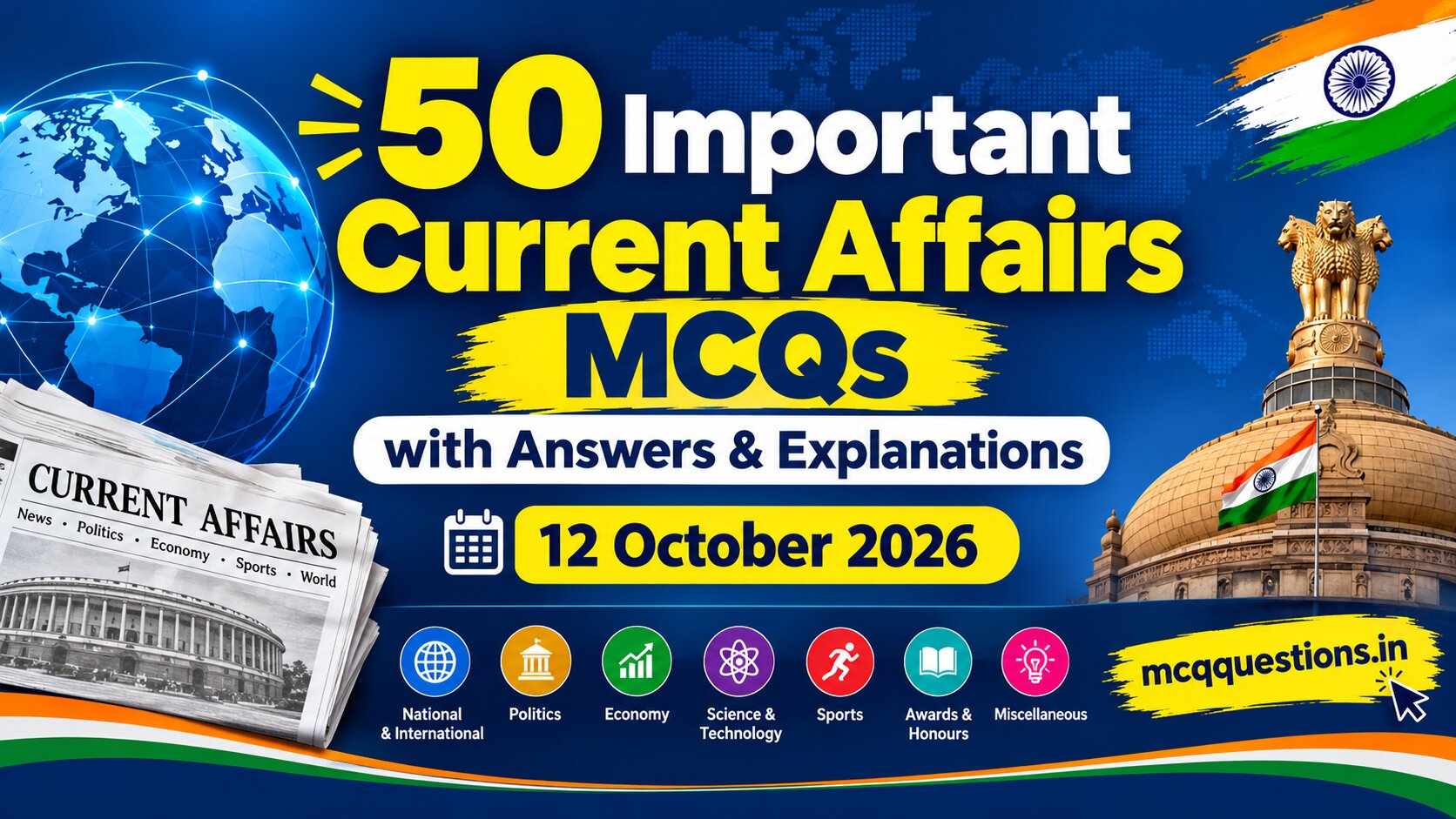
50 Important Current Affairs MCQs with Answers & Explanations – 12 October 2026
50 Important Current Affairs MCQs with Answers & Explanations – 12 October 2026
Daily Current Affairs | Competitive Exams | UPSC, SSC, Banking, Railway, State PSC | MCQQUESTIONS.IN
Welcome to the daily current affairs practice set for 12 October 2026. These multiple-choice questions are designed to help students prepare for competitive examinations through four-option questions, correct answers, and clear explanations.
Topics covered: National affairs, international relations, economy, science and technology, environment, sports, awards, important days, and general awareness.
Table of Contents
Section A: National Current Affairs
1. Which Indian constitutional institution is responsible for conducting elections to Parliament and State Legislatures?
A. Union Public Service Commission B. Election Commission of India C. Finance Commission D. NITI Aayog
Correct Answer: B. Election Commission of India
Explanation: The Election Commission of India is a constitutional body responsible for conducting elections to Parliament, State Legislatures, and the offices of the President and Vice-President of India.
2. Which court is the highest judicial authority in India?
A. High Court B. District Court C. Supreme Court of India D. Sessions Court
Correct Answer: C. Supreme Court of India
Explanation: The Supreme Court is India’s highest judicial authority. It protects constitutional rights, interprets the Constitution, and hears appeals in important legal matters.
3. Which constitutional article guarantees equality before the law in India?
A. Article 14 B. Article 19 C. Article 21 D. Article 32
Correct Answer: A. Article 14
Explanation: Article 14 guarantees equality before the law and equal protection of the laws to every person within India’s territory.
4. Which institution is India’s central bank?
A. State Bank of India B. Reserve Bank of India C. NABARD D. SEBI
Correct Answer: B. Reserve Bank of India
Explanation: The RBI manages monetary policy, issues most currency notes in India, regulates banks, and works to maintain financial stability.
5. Which organisation replaced the Planning Commission of India in 2015?
A. Finance Commission B. National Development Council C. NITI Aayog D. Economic Advisory Council
Correct Answer: C. NITI Aayog
Explanation: NITI Aayog was established on 1 January 2015 to promote cooperative federalism and provide policy advice to the central and state governments.
6. Which Indian organisation is primarily responsible for the country’s space programme?
A. DRDO B. ISRO C. CSIR D. BARC
Correct Answer: B. ISRO
Explanation: The Indian Space Research Organisation develops space technology and conducts satellite, launch vehicle, and planetary exploration missions.
7. What is the primary purpose of the Green Energy Corridor initiative in India?
A. Expand coal production B. Improve the transmission of renewable electricity C. Promote diesel-powered transport D. Increase petroleum imports
Correct Answer: B. Improve the transmission of renewable electricity
Explanation: Green Energy Corridors strengthen electricity transmission infrastructure so that renewable energy generated from sources such as wind and solar can be integrated into the power grid.
8. India’s Corporate Average Fuel Efficiency standards primarily seek to achieve what?
A. Increase vehicle weight B. Improve fuel efficiency and reduce emissions C. Eliminate public transport D. Increase petrol consumption
Correct Answer: B. Improve fuel efficiency and reduce emissions
Explanation: Corporate Average Fuel Efficiency (CAFE) standards set fleet-level fuel-consumption requirements for eligible passenger vehicles, helping reduce fuel use and associated carbon dioxide emissions. India’s CAFE-III framework is scheduled to apply from April 2027.
9. Which Indian institution is responsible for regulating the securities market?
A. SEBI B. RBI C. IRDAI D. FSSAI
Correct Answer: A. SEBI
Explanation: The Securities and Exchange Board of India regulates India’s securities market and works to protect investors and promote fair market practices.
10. What does Minimum Support Price (MSP) primarily aim to provide to farmers?
A. Guaranteed export contracts B. A government-announced price benchmark for specified crops C. Free agricultural machinery to every farmer D. Exemption from all agricultural taxes
Correct Answer: B. A government-announced price benchmark for specified crops
Explanation: MSP is announced for specified agricultural commodities to support farmers’ income and reduce the risk of distress sales. It does not automatically guarantee that every farmer’s entire crop will be purchased.
Section B: International Current Affairs
11. Which two institutions hold their 2026 Annual Meetings beginning on 12 October in Bangkok, Thailand?
A. WTO and UNESCO B. IMF and World Bank Group C. WHO and UNICEF D. NATO and OECD
Correct Answer: B. IMF and World Bank Group
Explanation: The 2026 Annual Meetings of the International Monetary Fund and World Bank Group begin in Bangkok on 12 October and run through 18 October. The meetings address global economic conditions, development financing, and financial stability.
12. What does IMF stand for?
A. International Monetary Fund B. International Market Federation C. Indian Monetary Forum D. International Management Foundation
Correct Answer: A. International Monetary Fund
Explanation: The IMF promotes international monetary cooperation, financial stability, and sustainable economic growth among its member countries.
13. Where is the headquarters of the World Bank?
A. Geneva, Switzerland B. Washington, D.C., United States C. Paris, France D. Vienna, Austria
Correct Answer: B. Washington, D.C., United States
Explanation: The World Bank’s headquarters are in Washington, D.C. It provides financial and technical assistance for development projects, poverty reduction, and infrastructure improvement.
14. Which organisation publishes the World Economic Outlook?
A. World Health Organization B. International Monetary Fund C. World Trade Organization D. UNESCO
Correct Answer: B. International Monetary Fund
Explanation: The IMF publishes the World Economic Outlook, which analyses global economic trends and provides forecasts for economic growth, inflation, and other indicators.
15. The Intergovernmental Panel on Climate Change (IPCC) primarily assesses what?
A. International trade tariffs B. Scientific evidence relating to climate change C. Global military expenditure D. International banking regulations
Correct Answer: B. Scientific evidence relating to climate change
Explanation: The IPCC assesses published scientific research on climate change, its impacts, future risks, and options for mitigation and adaptation. Its next assessment timeline is under discussion during meetings in Addis Ababa in October 2026.
16. Where is the IPCC meeting scheduled for 12–16 October 2026?
A. Nairobi, Kenya B. Addis Ababa, Ethiopia C. Bangkok, Thailand D. New Delhi, India
Correct Answer: B. Addis Ababa, Ethiopia
Explanation: Addis Ababa is hosting the IPCC plenary meeting focused on reaching agreement on the timeline for its next major climate assessment reports.
17. Which organisation is responsible for international public-health coordination?
A. WHO B. WTO C. ILO D. IMF
Correct Answer: A. WHO
Explanation: The World Health Organization coordinates international public-health work, develops health guidance, and supports countries in preventing and responding to disease outbreaks.
18. Where is the headquarters of the United Nations?
A. London B. New York City C. Rome D. Tokyo
Correct Answer: B. New York City
Explanation: The United Nations headquarters is located in New York City, United States. The organisation works on international peace, security, development, and human rights.
19. Which organisation is associated with international labour standards?
A. ILO B. IMF C. WTO D. IAEA
Correct Answer: A. ILO
Explanation: The International Labour Organization promotes decent work, labour rights, employment opportunities, and social protection.
20. The OECD Global Forum on Building Trust and Reinforcing Democracy is scheduled for 12–13 October 2026 in which city?
A. Madrid B. Paris C. Berlin D. Brussels
Correct Answer: B. Paris
Explanation: The Organisation for Economic Co-operation and Development is hosting this forum in Paris to discuss public trust, democratic governance, and effective public institutions.
Section C: Economy and Banking
21. What is the full form of GDP?
A. General Development Plan B. Gross Domestic Product C. Global Domestic Programme D. Gross Development Percentage
Correct Answer: B. Gross Domestic Product
Explanation: GDP measures the total monetary value of final goods and services produced within a country’s geographical boundaries during a specified period.
22. Which institution determines India’s monetary policy?
A. Election Commission of India B. Reserve Bank of India C. Ministry of Education D. Supreme Court of India
Correct Answer: B. Reserve Bank of India
Explanation: The RBI’s Monetary Policy Committee determines the policy interest rate and takes monetary-policy decisions to help maintain price stability while supporting economic growth.
23. What does UPI stand for?
A. Unified Payments Interface B. Universal Purchase Index C. United Payment Institution D. Unique Processing Instrument
Correct Answer: A. Unified Payments Interface
Explanation: UPI is an instant payment system developed by the National Payments Corporation of India. It facilitates digital money transfers between participating bank accounts.
24. Which organisation operates India’s UPI payment system?
A. SEBI B. NPCI C. NABARD D. SIDBI
Correct Answer: B. NPCI
Explanation: The National Payments Corporation of India operates UPI and several other retail payment systems in India.
25. What is inflation?
A. A sustained increase in the general price level B. A permanent decline in all prices C. An increase in the value of every currency D. A reduction in the money supply in every situation
Correct Answer: A. A sustained increase in the general price level
Explanation: Inflation means the general level of prices for goods and services rises over time, reducing the purchasing power of money.
26. Which organisation regulates insurance companies in India?
A. SEBI B. IRDAI C. RBI D. TRAI
Correct Answer: B. IRDAI
Explanation: The Insurance Regulatory and Development Authority of India regulates the insurance sector and works to protect policyholders’ interests.
27. What is the main role of NABARD?
A. Regulating stock exchanges B. Supporting agriculture and rural development finance C. Issuing all Indian currency notes D. Managing international diplomacy
Correct Answer: B. Supporting agriculture and rural development finance
Explanation: NABARD, the National Bank for Agriculture and Rural Development, supports rural credit, agricultural development, and rural infrastructure.
28. Which tax is generally classified as an indirect tax in India?
A. Personal income tax B. Corporate income tax C. Goods and Services Tax D. Wealth earned through salary
Correct Answer: C. Goods and Services Tax
Explanation: GST is an indirect tax applied to the supply of goods and services. The tax is collected through businesses and ultimately borne by consumers to varying degrees.
29. What is a fiscal deficit?
A. Government expenditure exceeding government receipts, excluding borrowings B. Exports exceeding imports C. A rise in household savings D. A fall in private consumption alone
Correct Answer: A. Government expenditure exceeding government receipts, excluding borrowings
Explanation: Fiscal deficit indicates how much the government needs to borrow to meet its expenditure when receipts other than borrowings are insufficient.
30. Which organisation publishes India’s official national accounts statistics, including GDP estimates?
A. National Statistical Office B. Election Commission of India C. National Green Tribunal D. University Grants Commission
Correct Answer: A. National Statistical Office
Explanation: The National Statistical Office, under the Ministry of Statistics and Programme Implementation, compiles and publishes major official economic statistics, including national income estimates.
Section D: Science, Technology and Environment
31. What does AI stand for?
A. Automated Internet B. Artificial Intelligence C. Advanced Integration D. Applied Information
Correct Answer: B. Artificial Intelligence
Explanation: Artificial intelligence refers to computer systems designed to perform tasks such as language processing, pattern recognition, prediction, and problem-solving.
32. Which technology is most directly associated with India’s Chandrayaan lunar exploration missions?
A. Deep-sea drilling B. Space exploration C. Nuclear power generation D. Agricultural irrigation
Correct Answer: B. Space exploration
Explanation: Chandrayaan is India’s lunar exploration programme, conducted by ISRO to study the Moon and improve scientific understanding of its surface and environment.
33. Which Indian mission achieved a soft landing near the Moon’s south polar region in August 2023?
A. Chandrayaan-1 B. Chandrayaan-2 C. Chandrayaan-3 D. Mangalyaan
Correct Answer: C. Chandrayaan-3
Explanation: Chandrayaan-3 successfully landed its Vikram lander on 23 August 2023. India became the fourth country to achieve a soft lunar landing.
34. What is the primary purpose of a satellite used for weather forecasting?
A. To manufacture medicines B. To observe atmospheric and weather conditions C. To regulate stock markets D. To generate agricultural seeds
Correct Answer: B. To observe atmospheric and weather conditions
Explanation: Weather satellites collect information about clouds, atmospheric systems, storms, and other conditions that help meteorologists prepare forecasts.
35. Which gas is the main contributor to human-caused global warming among the following options?
A. Oxygen B. Carbon dioxide C. Helium D. Neon
Correct Answer: B. Carbon dioxide
Explanation: Carbon dioxide is a major greenhouse gas emitted through fossil-fuel combustion, deforestation, and industrial processes. It traps heat in the atmosphere.
36. What is the primary objective of renewable energy?
A. To rely exclusively on coal B. To use naturally replenished energy sources C. To increase dependence on petroleum D. To eliminate electricity transmission
Correct Answer: B. To use naturally replenished energy sources
Explanation: Renewable energy comes from sources such as sunlight, wind, flowing water, and geothermal heat that are naturally replenished.
37. Which international agreement focuses on limiting global warming through national climate commitments?
A. Paris Agreement B. Geneva Convention C. Antarctic Treaty D. Ramsar Convention
Correct Answer: A. Paris Agreement
Explanation: The Paris Agreement, adopted in 2015 under the UN climate framework, aims to keep global warming well below 2°C above pre-industrial levels and pursue efforts to limit it to 1.5°C.
38. What does biodiversity mean?
A. The variety of living organisms B. The number of buildings in a city C. The amount of fossil fuel underground D. The total quantity of manufactured products
Correct Answer: A. The variety of living organisms
Explanation: Biodiversity includes the diversity of genes, species, and ecosystems. Protecting it helps maintain ecological balance and ecosystem services.
39. Which organisation is responsible for assessing and promoting nuclear safety standards internationally?
A. IAEA B. UNESCO C. WTO D. ILO
Correct Answer: A. IAEA
Explanation: The International Atomic Energy Agency promotes the safe, secure, and peaceful use of nuclear technology and develops international nuclear safety guidance.
40. What is the principal objective of the CAFE-III framework for Indian passenger vehicles?
A. To increase average fuel consumption B. To improve fleet-level fuel efficiency C. To ban every electric vehicle D. To regulate school examination standards
Correct Answer: B. To improve fleet-level fuel efficiency
Explanation: CAFE-III sets fleet-level fuel-efficiency targets for eligible passenger vehicles. The framework uses compliance mechanisms to encourage manufacturers to improve average fuel economy.
Section E: Important Days, Sports and General Awareness
41. World Arthritis Day is observed annually on which date?
A. 5 October B. 10 October C. 12 October D. 24 October
Correct Answer: C. 12 October
Explanation: World Arthritis Day raises awareness about arthritis and other rheumatic and musculoskeletal conditions, including the importance of early diagnosis and appropriate management.
42. Which Indian socialist leader’s death anniversary falls on 12 October?
A. Ram Manohar Lohia B. Sardar Vallabhbhai Patel C. Bal Gangadhar Tilak D. Dadabhai Naoroji
Correct Answer: A. Ram Manohar Lohia
Explanation: Ram Manohar Lohia was an Indian socialist political thinker and freedom fighter known for his advocacy of social equality and democratic values. His death anniversary is observed on 12 October.
43. The International Day of the Girl Child is observed on which date?
A. 8 October B. 11 October C. 15 October D. 20 October
Correct Answer: B. 11 October
Explanation: Established by the United Nations, the International Day of the Girl Child highlights girls’ rights and the barriers they face in education, healthcare, safety, and equal opportunity.
44. The International Day for Disaster Risk Reduction is observed on which date?
A. 12 October B. 13 October C. 14 October D. 16 October
Correct Answer: B. 13 October
Explanation: This UN-designated observance promotes disaster preparedness, risk reduction, and resilient communities. It falls on the day after the current affairs date covered here.
45. World Standards Day is observed annually on which date?
A. 10 October B. 12 October C. 14 October D. 18 October
Correct Answer: C. 14 October
Explanation: World Standards Day recognises the work of experts who develop international standards supporting quality, safety, efficiency, and cooperation.
46. World Students’ Day in India is associated with the birth anniversary of which former President?
A. Dr. Rajendra Prasad B. Dr. A. P. J. Abdul Kalam C. Dr. Sarvepalli Radhakrishnan D. Pranab Mukherjee
Correct Answer: B. Dr. A. P. J. Abdul Kalam
Explanation: Dr. A. P. J. Abdul Kalam was born on 15 October 1931. He was a renowned aerospace scientist and India’s 11th President, widely remembered for inspiring students.
47. Which Indian state is particularly associated with the celebration of Durga Puja on a large scale?
A. Punjab B. West Bengal C. Himachal Pradesh D. Goa
Correct Answer: B. West Bengal
Explanation: Durga Puja is one of West Bengal’s most prominent festivals, especially in Kolkata, where elaborate pandals, cultural programmes, and artistic displays attract large crowds.
48. Which sporting event is scheduled to be held in Japan in September 2026?
A. Asian Games B. Winter Olympics C. FIFA World Cup D. Commonwealth Games
Correct Answer: A. Asian Games
Explanation: The 2026 Asian Games are scheduled to take place in Aichi and Nagoya, Japan. The multi-sport event brings together athletes from across Asia.
49. What is the main purpose of the Olympic Games?
A. To conduct international trade negotiations B. To bring athletes together in international sporting competitions C. To regulate global banking D. To negotiate climate treaties
Correct Answer: B. To bring athletes together in international sporting competitions
Explanation: The Olympic Games are a major international multi-sport event organised under the Olympic Movement, promoting sporting excellence and international participation.
50. Which Indian organisation is responsible for promoting and developing cricket at the national level?
A. BCCI B. AIFF C. Hockey India D. Athletics Federation of India
Correct Answer: A. BCCI
Explanation: The Board of Control for Cricket in India administers and promotes cricket in India, including national teams and major domestic competitions.
Sources:
YOU CAN ALSO READ: