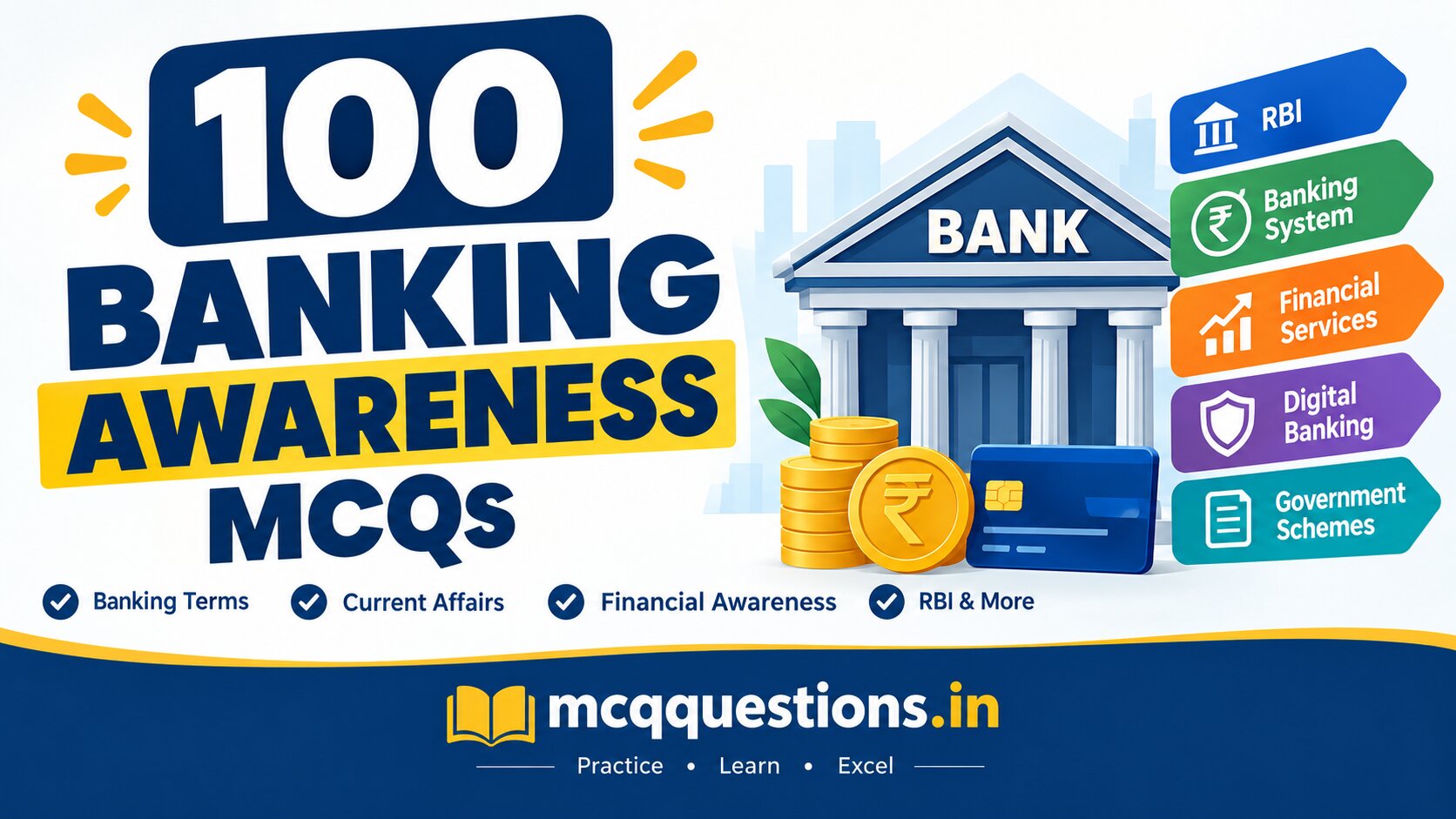
100 Banking Awareness MCQs
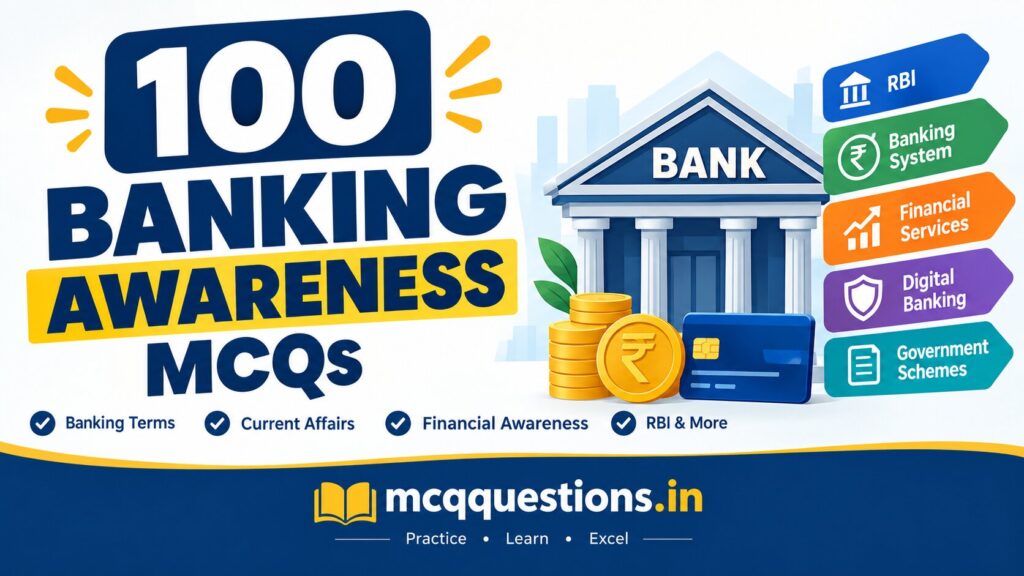
100 Banking Awareness MCQs
Here are 100 Banking Awareness MCQs suitable for Banking Exams, SSC, Railways, Insurance Exams, and other competitive examinations.
1–25: Banking Fundamentals
1. What is the central bank of India?
A) State Bank of India
B) Reserve Bank of India
C) Bank of India
D) NABARD
Answer: B) Reserve Bank of India
2. RBI was established in which year?
A) 1930
B) 1935
C) 1947
D) 1950
Answer: B) 1935
3. RBI was nationalized in which year?
A) 1947
B) 1948
C) 1949
D) 1951
Answer: C) 1949
4. The headquarters of RBI is located in:
A) New Delhi
B) Kolkata
C) Mumbai
D) Chennai
Answer: C) Mumbai
5. Which institution is known as the lender of last resort in India?
A) SBI
B) RBI
C) NABARD
D) SEBI
Answer: B) RBI
6. Which of the following is a commercial bank?
A) RBI
B) SBI
C) NABARD
D) SIDBI
Answer: B) SBI
7. What does ATM stand for?
A) Automatic Transfer Machine
B) Automated Teller Machine
C) Automated Transaction Method
D) Account Transfer Machine
Answer: B) Automated Teller Machine
8. What does KYC stand for?
A) Know Your Customer
B) Keep Your Customer
C) Know Your Credit
D) Know Your Cash
Answer: A) Know Your Customer
9. Which account is generally used for frequent business transactions?
A) Savings Account
B) Current Account
C) Fixed Deposit Account
D) Recurring Deposit Account
Answer: B) Current Account
10. Which bank account is primarily designed for individual savings?
A) Current Account
B) Savings Account
C) Cash Credit Account
D) Loan Account
Answer: B) Savings Account
11. A fixed deposit is also commonly known as:
A) Demand Deposit
B) Time Deposit
C) Current Deposit
D) Call Deposit
Answer: B) Time Deposit
12. Which deposit allows customers to deposit a fixed amount regularly?
A) Fixed Deposit
B) Recurring Deposit
C) Current Deposit
D) Demand Deposit
Answer: B) Recurring Deposit
13. What is the full form of IFSC?
A) Indian Financial System Code
B) Indian Finance Service Code
C) International Financial System Code
D) Indian Fund Settlement Code
Answer: A) Indian Financial System Code
14. IFSC is primarily used for:
A) Identifying bank branches in electronic fund transfers
B) Issuing passports
C) Calculating income tax
D) Printing currency
Answer: A) Identifying bank branches in electronic fund transfers
15. What does MICR stand for?
A) Magnetic Ink Character Recognition
B) Magnetic Indian Cash Register
C) Money Identification Code Reader
D) Magnetic Information Credit Record
Answer: A) Magnetic Ink Character Recognition
16. MICR technology is mainly associated with:
A) Cheque processing
B) ATM withdrawals
C) Internet banking
D) Credit cards
Answer: A) Cheque processing
17. NEFT stands for:
A) National Electronic Funds Transfer
B) National Exchange Fund Transfer
C) New Electronic Financial Transfer
D) National Economic Fund Transaction
Answer: A) National Electronic Funds Transfer
18. RTGS stands for:
A) Real Time Gross Settlement
B) Reserve Transfer Gross System
C) Real Transfer Government Settlement
D) Rapid Transaction Gross Settlement
Answer: A) Real Time Gross Settlement
19. IMPS stands for:
A) Immediate Payment Service
B) Instant Money Processing System
C) Indian Mobile Payment Service
D) Immediate Money Processing Service
Answer: A) Immediate Payment Service
20. UPI stands for:
A) Unified Payment Interface
B) Unified Payments Interface
C) Universal Payment India
D) United Payment Interface
Answer: B) Unified Payments Interface
21. Which organization operates the UPI system?
A) RBI directly
B) NPCI
C) SEBI
D) NABARD
Answer: B) NPCI
22. NPCI stands for:
A) National Payments Corporation of India
B) National Processing Corporation of India
C) National Payment Council of India
D) New Payments Corporation of India
Answer: A) National Payments Corporation of India
23. Which payment system enables instant bank-to-bank transfers using mobile phones?
A) UPI
B) MICR
C) SWIFT
D) ECS
Answer: A) UPI
24. What does PIN stand for in banking?
A) Personal Identification Number
B) Personal Internet Number
C) Payment Identification Name
D) Private Identification Network
Answer: A) Personal Identification Number
25. What is a cheque?
A) A negotiable instrument
B) A currency note
C) A loan agreement
D) A fixed deposit certificate
Answer: A) A negotiable instrument
26–50: RBI, Monetary Policy & Banking Institutions
26. Which body is responsible for monetary policy in India?
A) SEBI
B) RBI’s Monetary Policy Committee
C) Ministry of Corporate Affairs
D) NABARD
Answer: B) RBI’s Monetary Policy Committee
27. How many members are there in India’s Monetary Policy Committee (MPC)?
A) 4
B) 5
C) 6
D) 7
Answer: C) 6
28. Repo rate is the rate at which:
A) Banks lend to customers
B) RBI lends money to commercial banks against eligible securities
C) Customers lend to banks
D) Banks lend to RBI
Answer: B) RBI lends money to commercial banks against eligible securities
29. Reverse repo refers to the rate at which:
A) RBI borrows from commercial banks
B) Banks borrow from customers
C) Customers borrow from RBI
D) Government borrows from banks
Answer: A) RBI borrows from commercial banks
30. CRR stands for:
A) Cash Reserve Ratio
B) Credit Reserve Rate
C) Cash Regulation Ratio
D) Central Reserve Rate
Answer: A) Cash Reserve Ratio
31. Banks maintain CRR primarily with:
A) SEBI
B) RBI
C) NABARD
D) Ministry of Finance
Answer: B) RBI
32. SLR stands for:
A) Statutory Liquidity Ratio
B) Standard Lending Rate
C) Statutory Lending Reserve
D) Savings Liquidity Ratio
Answer: A) Statutory Liquidity Ratio
33. SLR requires banks to maintain a portion of their liabilities in:
A) Only foreign currency
B) Specified liquid assets
C) Only company shares
D) Only cash with customers
Answer: B) Specified liquid assets
34. Which institution regulates the securities market in India?
A) RBI
B) SEBI
C) NABARD
D) SIDBI
Answer: B) SEBI
35. SEBI stands for:
A) Securities and Exchange Board of India
B) Securities Exchange Bank of India
C) Stock Exchange Board of India
D) Securities Economic Board of India
Answer: A) Securities and Exchange Board of India
36. NABARD primarily focuses on:
A) Agriculture and rural development
B) Stock markets
C) Foreign trade
D) Insurance
Answer: A) Agriculture and rural development
37. NABARD stands for:
A) National Bank for Agriculture and Rural Development
B) National Board for Agricultural and Rural Development
C) National Bank for Agricultural Research and Development
D) National Banking Authority for Rural Development
Answer: A) National Bank for Agriculture and Rural Development
38. SIDBI primarily supports:
A) Large multinational corporations
B) Micro, Small and Medium Enterprises
C) Foreign governments
D) Stock exchanges
Answer: B) Micro, Small and Medium Enterprises
39. SIDBI stands for:
A) Small Industries Development Bank of India
B) State Industries Development Bank of India
C) Small Investment Development Bank of India
D) Small Indian Development Banking Institution
Answer: A) Small Industries Development Bank of India
40. EXIM Bank primarily deals with:
A) Export and import finance
B) Agricultural loans
C) Housing loans
D) Personal loans
Answer: A) Export and import finance
41. Which institution is primarily responsible for regulating insurance in India?
A) RBI
B) IRDAI
C) SEBI
D) NABARD
Answer: B) IRDAI
42. IRDAI stands for:
A) Insurance Regulatory and Development Authority of India
B) Indian Regulatory Development Authority of Insurance
C) Insurance Reserve and Development Authority of India
D) Indian Risk Development Authority of Insurance
Answer: A) Insurance Regulatory and Development Authority of India
43. Which institution regulates pension funds in India?
A) PFRDA
B) SEBI
C) RBI
D) NABARD
Answer: A) PFRDA
44. PFRDA stands for:
A) Pension Fund Regulatory and Development Authority
B) Public Fund Regulation and Development Authority
C) Pension Finance Regulatory Development Agency
D) Public Finance Regulation and Deposit Authority
Answer: A) Pension Fund Regulatory and Development Authority
45. Which institution is responsible for currency management in India?
A) SBI
B) RBI
C) SEBI
D) NABARD
Answer: B) RBI
46. The ₹1 currency note is issued by:
A) RBI
B) Government of India
C) SBI
D) Ministry of Commerce
Answer: B) Government of India
47. Other currency notes in India are generally issued by:
A) RBI
B) SBI
C) Ministry of Finance
D) SEBI
Answer: A) RBI
48. Who has the authority to issue coins in India?
A) RBI
B) Government of India
C) SBI
D) SEBI
Answer: B) Government of India
49. Which bank is commonly known as India’s largest public sector bank?
A) Bank of Baroda
B) Punjab National Bank
C) State Bank of India
D) Canara Bank
Answer: C) State Bank of India
50. SBI was formed in its present statutory form in:
A) 1949
B) 1955
C) 1969
D) 1980
Answer: B) 1955
51–75: Loans, Credit & Financial Terms
51. What does NPA stand for?
A) Net Performing Asset
B) Non-Performing Asset
C) National Performing Account
D) Non-Payment Asset
Answer: B) Non-Performing Asset
52. An NPA generally refers to a loan or advance that:
A) Is fully repaid
B) Has stopped generating income for the bank according to applicable regulatory norms
C) Has a low interest rate
D) Is newly sanctioned
Answer: B) Has stopped generating income for the bank according to applicable regulatory norms
53. What is a secured loan?
A) A loan without documentation
B) A loan backed by collateral/security
C) A loan without interest
D) A loan only to government employees
Answer: B) A loan backed by collateral/security
54. An unsecured loan is a loan that:
A) Requires no repayment
B) Is not backed by specific collateral
C) Is given only by RBI
D) Is always interest-free
Answer: B) Is not backed by specific collateral
55. EMI stands for:
A) Equated Monthly Instalment
B) Equal Money Interest
C) Estimated Monthly Income
D) Equated Money Investment
Answer: A) Equated Monthly Instalment
56. Which loan is specifically designed for purchasing a house?
A) Education loan
B) Home loan
C) Working capital loan
D) Gold loan
Answer: B) Home loan
57. A loan against pledged gold is commonly called:
A) Gold loan
B) Housing loan
C) Term loan
D) Education loan
Answer: A) Gold loan
58. Which loan is designed to finance higher education?
A) Gold loan
B) Education loan
C) Vehicle loan
D) Cash credit
Answer: B) Education loan
59. What is collateral?
A) A bank’s profit
B) An asset pledged as security for a loan
C) A type of bank account
D) A type of currency
Answer: B) An asset pledged as security for a loan
60. What is a mortgage?
A) Transfer of ownership of currency
B) Security interest in immovable property for a loan
C) A type of savings account
D) A payment system
Answer: B) Security interest in immovable property for a loan
61. What is hypothecation?
A) Pledging movable assets as security while possession generally remains with the borrower
B) Closing a bank account
C) Transferring cash to RBI
D) Opening a fixed deposit
Answer: A) Pledging movable assets as security while possession generally remains with the borrower
62. What is a bank overdraft?
A) A facility allowing eligible customers to withdraw beyond the available account balance, subject to limits
B) A fixed deposit
C) A type of insurance
D) A government grant
Answer: A) A facility allowing eligible customers to withdraw beyond the available account balance, subject to limits
63. Cash Credit is generally used for:
A) Meeting working-capital requirements
B) Buying government bonds only
C) Paying school fees only
D) Currency printing
Answer: A) Meeting working-capital requirements
64. What is working capital?
A) Funds used for day-to-day business operations
B) Long-term fixed assets only
C) Government tax revenue
D) Bank reserve money only
Answer: A) Funds used for day-to-day business operations
65. What is a term loan?
A) A loan repayable over a specified period
B) A demand deposit
C) A current account
D) A type of cheque
Answer: A) A loan repayable over a specified period
66. What is credit risk?
A) Risk that a borrower may fail to meet repayment obligations
B) Risk of currency printing
C) Risk of ATM damage only
D) Risk of inflation only
Answer: A) Risk that a borrower may fail to meet repayment obligations
67. What is liquidity risk?
A) Risk of being unable to meet financial obligations when due
B) Risk of rising stock prices
C) Risk of excess rainfall
D) Risk of higher exports
Answer: A) Risk of being unable to meet financial obligations when due
68. What does CIBIL primarily provide?
A) Credit information and credit scores/reports
B) Currency notes
C) Insurance policies
D) Stock exchange services
Answer: A) Credit information and credit scores/reports
69. A higher credit score generally indicates:
A) A stronger credit history
B) No credit history in every case
C) Guaranteed loan approval
D) Guaranteed zero interest
Answer: A) A stronger credit history
70. What is a credit card?
A) A payment card that provides a line of credit
B) A debit-only card
C) A savings account
D) A fixed deposit certificate
Answer: A) A payment card that provides a line of credit
71. What is a debit card primarily linked to?
A) The user’s bank account
B) RBI’s account
C) Government budget
D) Stock exchange account
Answer: A) The user’s bank account
72. Which card generally allows spending from an approved credit limit?
A) Debit card
B) Credit card
C) ATM-only card
D) PAN card
Answer: B) Credit card
73. What is a bank draft?
A) A payment instrument issued by a bank
B) A loan agreement
C) A credit score
D) A tax document
Answer: A) A payment instrument issued by a bank
74. What is a demand deposit?
A) Deposit withdrawable on demand, subject to applicable terms
B) Deposit locked permanently
C) Government bond
D) Insurance premium
Answer: A) Deposit withdrawable on demand, subject to applicable terms
75. Which of the following is normally a demand deposit?
A) Savings deposit
B) Long-term bond
C) Fixed maturity bond
D) Government security
Answer: A) Savings deposit
76–100: Digital Banking, Financial Inclusion & General Awareness
76. What does DBT stand for?
A) Direct Benefit Transfer
B) Digital Banking Transaction
C) Direct Banking Technology
D) Deposit Benefit Transfer
Answer: A) Direct Benefit Transfer
77. The main objective of DBT is to:
A) Transfer eligible government benefits directly to beneficiaries’ bank accounts
B) Increase ATM charges
C) Issue credit cards
D) Regulate stock markets
Answer: A) Transfer eligible government benefits directly to beneficiaries’ bank accounts
78. PMJDY stands for:
A) Pradhan Mantri Jan-Dhan Yojana
B) Prime Minister Joint Deposit Yojana
C) Pradhan Mantri Joint Development Yojana
D) Public Money Jan-Dhan Yojana
Answer: A) Pradhan Mantri Jan-Dhan Yojana
79. PMJDY primarily aims to promote:
A) Financial inclusion
B) Stock trading
C) Foreign investment
D) Export promotion
Answer: A) Financial inclusion
80. Financial inclusion means:
A) Providing appropriate financial services to underserved sections of society
B) Only opening accounts for wealthy people
C) Increasing stock prices
D) Eliminating all taxes
Answer: A) Providing appropriate financial services to underserved sections of society
81. What is a Business Correspondent (BC) in banking?
A) An authorized agent who helps banks provide certain services to customers
B) A bank auditor
C) A stockbroker
D) A government minister
Answer: A) An authorized agent who helps banks provide certain services to customers
82. What is a small finance bank primarily intended to promote?
A) Financial inclusion and services to underserved segments
B) Only international banking
C) Only stock trading
D) Currency printing
Answer: A) Financial inclusion and services to underserved segments
83. Payments banks are primarily designed to:
A) Provide specified banking and payment services subject to regulatory restrictions
B) Provide unlimited corporate loans
C) Issue shares on stock exchanges
D) Print currency
Answer: A) Provide specified banking and payment services subject to regulatory restrictions
84. Which of the following is a digital payment method?
A) UPI
B) Cheque only
C) Demand draft only
D) Cash withdrawal slip
Answer: A) UPI
85. What is QR in QR code?
A) Quick Response
B) Quick Record
C) Quality Response
D) Query Record
Answer: A) Quick Response
86. What is phishing?
A) A fraudulent attempt to obtain sensitive information by impersonation or deceptive communication
B) A type of bank deposit
C) A legal loan recovery process
D) A type of investment
Answer: A) A fraudulent attempt to obtain sensitive information by impersonation or deceptive communication
87. What is OTP?
A) One-Time Password
B) Online Transfer Protocol
C) One Transaction Process
D) Official Transfer Password
Answer: A) One-Time Password
88. Why should an OTP generally not be shared with others?
A) It can be used to authenticate certain transactions or actions
B) It increases bank interest
C) It changes the account number
D) It reduces taxes
Answer: A) It can be used to authenticate certain transactions or actions
89. What is internet banking?
A) Banking services provided through the internet
B) Banking only through ATMs
C) Banking only through cheques
D) Currency exchange at airports
Answer: A) Banking services provided through the internet
90. What is mobile banking?
A) Banking services accessed through a mobile device
B) Banking only through a bank branch
C) Currency printing through mobile phones
D) Stock exchange ownership
Answer: A) Banking services accessed through a mobile device
91. What does SWIFT stand for?
A) Society for Worldwide Interbank Financial Telecommunication
B) System for World Internet Financial Transactions
C) Society for World Investment Fund Transfer
D) Secure Worldwide Internet Finance Technology
Answer: A) Society for Worldwide Interbank Financial Telecommunication
92. SWIFT is primarily used for:
A) Secure financial messaging between institutions
B) Printing currency
C) Issuing Aadhaar cards
D) Managing domestic tax returns
Answer: A) Secure financial messaging between institutions
93. What is inflation?
A) A sustained rise in the general price level of goods and services
B) A fall in all prices
C) A rise in bank deposits only
D) A fall in money supply only
Answer: A) A sustained rise in the general price level of goods and services
94. GDP stands for:
A) Gross Domestic Product
B) General Domestic Price
C) Gross Development Production
D) Government Domestic Product
Answer: A) Gross Domestic Product
95. What does GDP measure?
A) The monetary value of final goods and services produced within an economy over a specified period
B) Only government income
C) Only bank deposits
D) Only exports
Answer: A) The monetary value of final goods and services produced within an economy over a specified period
96. What is fiscal policy mainly concerned with?
A) Government taxation and expenditure
B) Bank branch management
C) ATM operations
D) Credit card issuance
Answer: A) Government taxation and expenditure
97. Monetary policy mainly deals with:
A) Money supply, interest rates and credit conditions
B) Government recruitment
C) Road construction
D) Foreign tourism
Answer: A) Money supply, interest rates and credit conditions
98. Which organization operates India’s retail payment systems such as UPI?
A) NPCI
B) SEBI
C) IRDAI
D) PFRDA
Answer: A) NPCI
99. What is bank reconciliation?
A) Comparing and matching bank records with an organization’s accounting records
B) Closing all bank accounts
C) Issuing a new currency
D) Applying for a loan
Answer: A) Comparing and matching bank records with an organization’s accounting records
100. Which of the following is NOT a function of a commercial bank?
A) Accepting deposits
B) Providing loans
C) Facilitating payments
D) Issuing India’s currency notes as the central issuing authority
Answer: D) Issuing India’s currency notes as the central issuing authority