100 English Grammar MCQ on Parts of Speech with Explanations
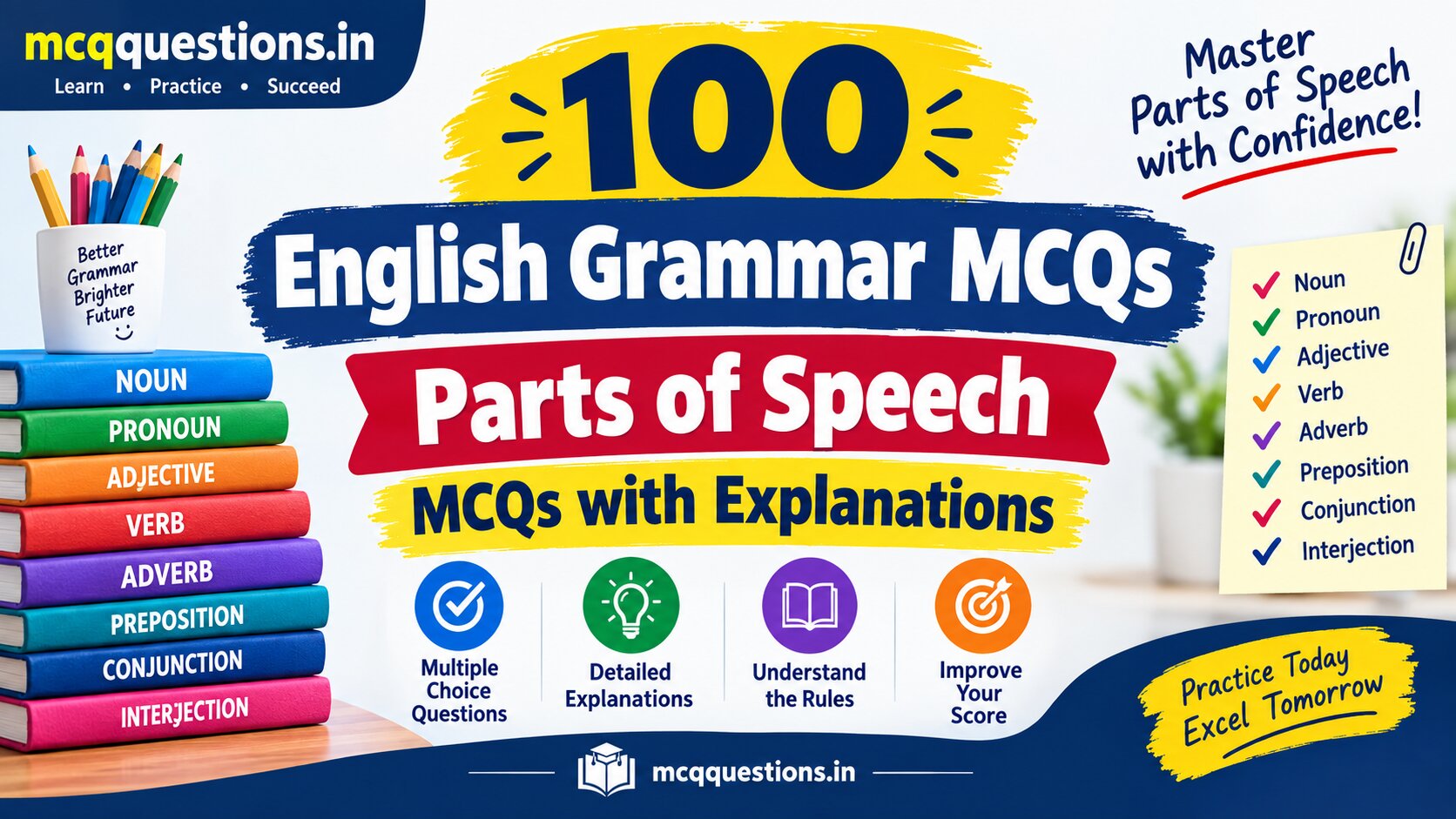
100 Parts of Speech MCQs with Analytical Explanations
Practice 100 English Grammar MCQs on Parts of Speech with answers and explanations. Improve your knowledge of nouns, pronouns, verbs, adjectives, adverbs, prepositions, conjunctions, and interjections for competitive exams.
Table of Contents
Questions 1–25
1. Which part of speech is the word “beautiful” in the sentence: She has a beautiful dress.
A) Noun
B) Adjective
C) Adverb
D) Verb
Answer: B) Adjective
Analytical Explanation: “Beautiful” describes the noun “dress.” Words that describe or qualify nouns are adjectives. Here, it tells us what kind of dress she has.
2. Which part of speech is “quickly” in: He ran quickly.
A) Adjective
B) Noun
C) Adverb
D) Preposition
Answer: C) Adverb
Analytical Explanation: “Quickly” tells us how the action “ran” was performed. Since it modifies a verb, it functions as an adverb.
3. Which word is a noun?
A) Honest
B) Honesty
C) Honestly
D) Honestify
Answer: B) Honesty
Analytical Explanation: “Honesty” names an abstract quality or idea. Therefore, it is an abstract noun. “Honest” is an adjective, while “honestly” is an adverb.
4. Which part of speech is “and”?
A) Preposition
B) Conjunction
C) Interjection
D) Adverb
Answer: B) Conjunction
Analytical Explanation: “And” connects words, phrases, or clauses. Its connecting function makes it a conjunction.
5. Identify the part of speech of “Wow!”
A) Noun
B) Verb
C) Interjection
D) Adjective
Answer: C) Interjection
Analytical Explanation: “Wow!” expresses a sudden feeling or reaction. Words used to express sudden emotions are called interjections.
6. Which word is a pronoun?
A) Ram
B) He
C) Running
D) Beautiful
Answer: B) He
Analytical Explanation: “He” is used in place of a person’s name or noun. Therefore, it is a personal pronoun.
7. Identify the part of speech of “under” in: The cat is under the table.
A) Adverb
B) Conjunction
C) Preposition
D) Adjective
Answer: C) Preposition
Analytical Explanation: “Under” establishes the relationship between “cat” and “table” by showing position. Therefore, it functions as a preposition.
8. Which word is a verb?
A) Happiness
B) Happy
C) Happily
D) Dance
Answer: D) Dance
Analytical Explanation: “Dance” can express an action. In the given choices, it is the word that functions as a verb.
9. In The boy kicked the ball, “boy” is a:
A) Verb
B) Noun
C) Adjective
D) Adverb
Answer: B) Noun
Analytical Explanation: “Boy” names a person and acts as the subject of the sentence. A word naming a person, place, thing, or idea is a noun.
10. In She sings sweetly, “sweetly” is a:
A) Noun
B) Verb
C) Adverb
D) Pronoun
Answer: C) Adverb
Analytical Explanation: “Sweetly” describes the manner in which she sings. Because it modifies the verb “sings,” it is an adverb.
11. Which of the following is an adjective?
A) Slowly
B) Beauty
C) Clever
D) Run
Answer: C) Clever
Analytical Explanation: “Clever” describes a quality of a person or thing. Therefore, it is an adjective.
12. Which of these is a conjunction?
A) But
B) Beautiful
C) Between
D) Sadly
Answer: A) But
Analytical Explanation: “But” connects contrasting words, phrases, or clauses. Therefore, it functions as a conjunction.
13. In John and Mary are friends, “and” is a:
A) Pronoun
B) Conjunction
C) Preposition
D) Verb
Answer: B) Conjunction
Analytical Explanation: “And” joins the two nouns “John” and “Mary.” This connecting role identifies it as a conjunction.
14. Which word is an interjection?
A) Alas
B) Always
C) Almost
D) Around
Answer: A) Alas
Analytical Explanation: “Alas” expresses sorrow or regret. Since it expresses a sudden emotion, it is an interjection.
15. In They are playing football, “They” is a:
A) Noun
B) Pronoun
C) Adjective
D) Verb
Answer: B) Pronoun
Analytical Explanation: “They” replaces the names of the people who are playing. It is therefore a personal pronoun.
16. In The sun shines brightly, “shines” is a:
A) Noun
B) Adverb
C) Verb
D) Adjective
Answer: C) Verb
Analytical Explanation: “Shines” expresses the action or state performed by the subject “sun.” Therefore, it is a verb.
17. Which word is a preposition?
A) On
B) Or
C) Very
D) Happy
Answer: A) On
Analytical Explanation: “On” commonly shows the relationship of position or location between nouns. Therefore, it is a preposition.
18. Which word is an adverb?
A) Loud
B) Loudly
C) Loudness
D) Louden
Answer: B) Loudly
Analytical Explanation: “Loudly” describes how an action is performed. The “-ly” form here functions as an adverb.
19. Which word is a noun?
A) School
B) Quickly
C) Run
D) Beautiful
Answer: A) School
Analytical Explanation: “School” names a place or institution. Therefore, it is a noun.
20. In She is very intelligent, “very” is a:
A) Adjective
B) Adverb
C) Noun
D) Pronoun
Answer: B) Adverb
Analytical Explanation: “Very” intensifies the adjective “intelligent.” Since it modifies an adjective, it is an adverb.
21. In The red car is expensive, “red” is a:
A) Noun
B) Verb
C) Adjective
D) Adverb
Answer: C) Adjective
Analytical Explanation: “Red” describes the noun “car” by identifying its color. Therefore, it is an adjective.
22. Which word is a pronoun?
A) Them
B) Teacher
C) Teach
D) Teaching
Answer: A) Them
Analytical Explanation: “Them” is used in place of specific people or things and functions as an object pronoun.
23. In He walked across the road, “across” is a:
A) Preposition
B) Adjective
C) Pronoun
D) Interjection
Answer: A) Preposition
Analytical Explanation: “Across” establishes a relationship between the action “walked” and the noun phrase “the road.” It shows movement from one side to another.
24. Which word is a verb?
A) Write
B) Writer
C) Writing-room
D) Written
Answer: A) Write
Analytical Explanation: “Write” is the base form of a verb expressing an action. “Writer” is a noun referring to a person who writes.
25. In Oh! I forgot my book, “Oh!” is a:
A) Adverb
B) Interjection
C) Noun
D) Conjunction
Answer: B) Interjection
Analytical Explanation: “Oh!” expresses a sudden reaction or realization. Such emotional expressions are interjections.
Questions 26–50
26. Which part of speech names a person, place, thing, or idea?
A) Verb
B) Noun
C) Adverb
D) Conjunction
Answer: B) Noun
Analytical Explanation: A noun is a naming word. It can identify a person, place, thing, animal, or abstract idea.
27. Which part of speech replaces a noun?
A) Pronoun
B) Adjective
C) Preposition
D) Interjection
Answer: A) Pronoun
Analytical Explanation: Pronouns are used instead of nouns or noun phrases to avoid unnecessary repetition. For example, “Ravi is here” can become “He is here.”
28. Which part of speech describes a noun?
A) Adverb
B) Adjective
C) Verb
D) Conjunction
Answer: B) Adjective
Analytical Explanation: An adjective provides information about a noun, such as its quality, size, color, number, or condition.
29. Which part of speech modifies a verb?
A) Adverb
B) Noun
C) Pronoun
D) Preposition
Answer: A) Adverb
Analytical Explanation: Adverbs commonly tell us how, when, where, or to what extent an action occurs. Thus, they can modify verbs.
30. Which part of speech shows the relationship between words?
A) Interjection
B) Preposition
C) Noun
D) Verb
Answer: B) Preposition
Analytical Explanation: Prepositions establish relationships involving location, direction, time, position, or other connections.
31. Which part of speech joins words or clauses?
A) Conjunction
B) Adjective
C) Pronoun
D) Noun
Answer: A) Conjunction
Analytical Explanation: Conjunctions connect words, phrases, or clauses. Examples include “and,” “but,” “or,” and “because.”
32. Which part of speech expresses sudden emotion?
A) Verb
B) Adverb
C) Interjection
D) Preposition
Answer: C) Interjection
Analytical Explanation: Interjections directly express emotions or sudden reactions, such as surprise, joy, pain, or sorrow.
33. In The little girl smiled, “little” is a:
A) Adjective
B) Adverb
C) Noun
D) Verb
Answer: A) Adjective
Analytical Explanation: “Little” describes the noun “girl.” Therefore, it functions as an adjective.
34. In He speaks English fluently, “fluently” is a:
A) Adjective
B) Adverb
C) Noun
D) Pronoun
Answer: B) Adverb
Analytical Explanation: “Fluently” tells us how he speaks. It modifies the verb “speaks,” so it is an adverb.
35. In Ravi bought a book, “book” is a:
A) Noun
B) Verb
C) Adjective
D) Adverb
Answer: A) Noun
Analytical Explanation: “Book” names a thing and serves as the object of the verb “bought.” Therefore, it is a noun.
36. In We went to Delhi, “We” is a:
A) Noun
B) Pronoun
C) Verb
D) Adjective
Answer: B) Pronoun
Analytical Explanation: “We” represents the people who performed the action. It is a first-person plural personal pronoun.
37. In The book is on the table, “on” is a:
A) Conjunction
B) Preposition
C) Adverb
D) Pronoun
Answer: B) Preposition
Analytical Explanation: “On” shows the positional relationship between “book” and “table.” Therefore, it is a preposition.
38. In I wanted tea but got coffee, “but” is a:
A) Adverb
B) Preposition
C) Conjunction
D) Noun
Answer: C) Conjunction
Analytical Explanation: “But” connects two contrasting ideas: wanting tea and getting coffee. Therefore, it is a conjunction.
39. In Hurray! We won the match, “Hurray!” is a:
A) Interjection
B) Adjective
C) Verb
D) Noun
Answer: A) Interjection
Analytical Explanation: “Hurray!” expresses happiness or excitement about winning. Therefore, it is an interjection.
40. Which word is a noun?
A) Wisdom
B) Wise
C) Wisely
D) Wisen
Answer: A) Wisdom
Analytical Explanation: “Wisdom” names an abstract quality or concept. Therefore, it is an abstract noun.
41. Which word is an adjective?
A) Danger
B) Dangerously
C) Dangerous
D) Endanger
Answer: C) Dangerous
Analytical Explanation: “Dangerous” describes a person, place, situation, or thing. Therefore, it is an adjective.
42. Which word is an adverb?
A) Careful
B) Care
C) Carefully
D) Caring
Answer: C) Carefully
Analytical Explanation: “Carefully” describes the manner in which an action is performed. It therefore functions as an adverb.
43. Which word is a pronoun?
A) They
B) Their
C) Them
D) All of these
Answer: D) All of these
Analytical Explanation: “They” is a subject pronoun, “them” is an object pronoun, and “their” is a possessive determiner. In the source’s broad classification, all three are grouped under pronouns.
44. Which word is a conjunction?
A) Because
B) Beside
C) Beautiful
D) Beforehand
Answer: A) Because
Analytical Explanation: “Because” introduces a reason or subordinate clause. Therefore, it functions as a subordinating conjunction.
45. Which word is a preposition?
A) Between
B) Beautifully
C) Although
D) Quickly
Answer: A) Between
Analytical Explanation: “Between” expresses a relationship involving two or more entities, especially position or separation. Therefore, it is a preposition.
46. In The dog barked loudly, “dog” is a:
A) Noun
B) Adjective
C) Verb
D) Adverb
Answer: A) Noun
Analytical Explanation: “Dog” names an animal and serves as the subject of the sentence. Hence, it is a noun.
47. In She wore a beautiful dress, “beautiful” is a:
A) Noun
B) Adjective
C) Verb
D) Adverb
Answer: B) Adjective
Analytical Explanation: “Beautiful” describes the noun “dress.” Its descriptive function makes it an adjective.
48. In He answered correctly, “correctly” is a:
A) Adjective
B) Noun
C) Adverb
D) Pronoun
Answer: C) Adverb
Analytical Explanation: “Correctly” describes how he answered. Because it modifies the verb “answered,” it is an adverb.
49. In They helped us, “us” is a:
A) Pronoun
B) Noun
C) Verb
D) Adjective
Answer: A) Pronoun
Analytical Explanation: “Us” represents the people receiving the action of “helped.” It is therefore an object pronoun.
50. In The children are playing, “playing” is a:
A) Noun
B) Verb
C) Adjective
D) Adverb
Answer: B) Verb
Analytical Explanation: “Playing” forms part of the verb phrase “are playing” and expresses the action being performed by the children.
Questions 51–75
51. Which word is a common noun?
A) India
B) Monday
C) Teacher
D) Ravi
Answer: C) Teacher
Analytical Explanation: “Teacher” is a general name for a person who teaches. It does not identify one particular individual, so it is a common noun.
52. Which word is a proper noun?
A) City
B) Country
C) India
D) River
Answer: C) India
Analytical Explanation: “India” is the specific name of a country. Specific names of people, places, countries, and organizations are proper nouns.
53. Which word is an abstract noun?
A) Table
B) Honesty
C) Chair
D) Pencil
Answer: B) Honesty
Analytical Explanation: “Honesty” names a quality or concept that cannot be physically touched. Therefore, it is an abstract noun.
54. Which word is a collective noun?
A) Team
B) Player
C) Play
D) Playing
Answer: A) Team
Analytical Explanation: “Team” refers to a group considered as a unit. Therefore, it is a collective noun.
55. Which word is a possessive pronoun?
A) Mine
B) Me
C) I
D) Myself
Answer: A) Mine
Analytical Explanation: “Mine” indicates ownership and can stand independently in a sentence, such as “The book is mine.” Therefore, it is a possessive pronoun.
56. Which word is a reflexive pronoun?
A) Him
B) Himself
C) His
D) He
Answer: B) Himself
Analytical Explanation: “Himself” refers back to the male subject of a sentence. Pronouns ending in “-self” or “-selves” commonly function reflexively.
57. Which word is a demonstrative pronoun?
A) This
B) Who
C) Someone
D) Myself
Answer: A) This
Analytical Explanation: “This” can point to or identify a particular person, thing, or idea. It is therefore a demonstrative pronoun when used independently.
58. Which word is an interrogative pronoun?
A) Who
B) They
C) These
D) Himself
Answer: A) Who
Analytical Explanation: “Who” is used to ask about a person. Pronouns used to form questions include “who,” “whom,” “whose,” “which,” and “what.”
59. Which word is an indefinite pronoun?
A) Someone
B) Rahul
C) This
D) Which
Answer: A) Someone
Analytical Explanation: “Someone” refers to an unspecified person rather than a particular individual. Therefore, it is an indefinite pronoun.
60. In This is my pen, “my” is a:
A) Possessive determiner
B) Verb
C) Adverb
D) Conjunction
Answer: A) Possessive determiner
Analytical Explanation: “My” indicates possession and directly modifies the noun “pen.” Because it accompanies a noun, it functions as a possessive determiner.
61. In He is a brave soldier, “brave” is a:
A) Noun
B) Adjective
C) Adverb
D) Verb
Answer: B) Adjective
Analytical Explanation: “Brave” describes the quality of the noun “soldier.” Therefore, it is an adjective.
62. In She danced gracefully, “gracefully” is a:
A) Adjective
B) Adverb
C) Noun
D) Pronoun
Answer: B) Adverb
Analytical Explanation: “Gracefully” tells us how she danced. Since it modifies the verb “danced,” it is an adverb.
63. Which word is a linking verb?
A) Is
B) Quickly
C) Beautiful
D) Under
Answer: A) Is
Analytical Explanation: “Is” links a subject with information describing or identifying it rather than expressing a physical action. It is therefore a linking verb.
64. Which word is an auxiliary verb?
A) Have
B) Happy
C) Happiness
D) Happily
Answer: A) Have
Analytical Explanation: “Have” can function as a helping verb, as in “They have finished.” Auxiliary verbs help form tense, voice, mood, or other verb constructions.
65. In She can swim, “can” is a:
A) Modal verb
B) Noun
C) Adjective
D) Adverb
Answer: A) Modal verb
Analytical Explanation: “Can” expresses ability or possibility and helps the main verb “swim.” It is therefore a modal auxiliary verb.
66. In He ran into the room, “into” is a:
A) Conjunction
B) Preposition
C) Adverb
D) Pronoun
Answer: B) Preposition
Analytical Explanation: “Into” shows movement from outside to inside and establishes a relationship between “ran” and “the room.”
67. Which is a coordinating conjunction?
A) And
B) Although
C) Because
D) Unless
Answer: A) And
Analytical Explanation: “And” joins elements of equal grammatical importance. Therefore, it is a coordinating conjunction.
68. Which is a subordinating conjunction?
A) And
B) But
C) Because
D) Or
Answer: C) Because
Analytical Explanation: “Because” introduces a dependent clause that gives a reason. This makes it a subordinating conjunction.
69. Which is a correlative conjunction?
A) Either…or
B) And
C) But
D) Because
Answer: A) Either…or
Analytical Explanation: “Either…or” works as a pair to connect alternatives. Such paired conjunctions are called correlative conjunctions.
70. In Alas! He is dead, “Alas!” expresses:
A) Joy
B) Sorrow
C) Anger
D) Surprise
Answer: B) Sorrow
Analytical Explanation: “Alas!” traditionally expresses grief, sorrow, or regret. The context of death reinforces the expression of sorrow.
71. In Hurrah! We have won, “Hurrah!” expresses:
A) Joy
B) Sorrow
C) Fear
D) Pain
Answer: A) Joy
Analytical Explanation: “Hurrah!” is an expression of celebration or happiness. The context “We have won” indicates joy.
72. In Oh! What a beautiful scene, “Oh!” is a:
A) Preposition
B) Interjection
C) Noun
D) Conjunction
Answer: B) Interjection
Analytical Explanation: “Oh!” expresses a sudden emotional reaction to the scene. Therefore, it is an interjection.
73. In The boy is very clever, “very” modifies:
A) Boy
B) Is
C) Clever
D) The
Answer: C) Clever
Analytical Explanation: “Very” intensifies the adjective “clever.” It tells us the degree of cleverness, so it modifies “clever.”
74. In She speaks softly, “softly” modifies:
A) She
B) Speaks
C) None
D) Both She and speaks
Answer: B) Speaks
Analytical Explanation: “Softly” tells us the manner in which she speaks. Therefore, it modifies the verb “speaks.”
75. In He is extremely tired, “extremely” is a:
A) Noun
B) Adverb
C) Adjective
D) Verb
Answer: B) Adverb
Analytical Explanation: “Extremely” modifies the adjective “tired” by showing its degree. Therefore, it is an adverb of degree.
Questions 76–100
76. In The old man walked slowly, “old” is a:
A) Adverb
B) Adjective
C) Noun
D) Verb
Answer: B) Adjective
Analytical Explanation: “Old” describes the noun “man” by indicating his age or condition. Therefore, it is an adjective.
77. In The old man walked slowly, “slowly” is a:
A) Adjective
B) Noun
C) Adverb
D) Pronoun
Answer: C) Adverb
Analytical Explanation: “Slowly” describes how the man walked. Since it modifies the verb “walked,” it is an adverb.
78. In She went to school, “to” is a:
A) Preposition
B) Conjunction
C) Adjective
D) Interjection
Answer: A) Preposition
Analytical Explanation: “To” connects the verb “went” with the destination “school,” showing direction or destination.
79. In I stayed home because it rained, “because” is a:
A) Preposition
B) Conjunction
C) Adverb
D) Pronoun
Answer: B) Conjunction
Analytical Explanation: “Because” connects the main clause with the dependent clause “it rained” and introduces the reason for staying home.
80. In Neither Ram nor Shyam came, “nor” is a:
A) Correlative conjunction
B) Preposition
C) Adverb
D) Noun
Answer: A) Correlative conjunction
Analytical Explanation: “Nor” works together with “neither” to present a negative alternative. The pair “neither…nor” is a correlative conjunction.
81. Which sentence contains an adjective?
A) He runs quickly.
B) She has a blue bag.
C) They arrived yesterday.
D) He sings loudly.
Answer: B) She has a blue bag.
Analytical Explanation: “Blue” describes the noun “bag.” Therefore, this sentence contains an adjective.
82. Which sentence contains an adverb?
A) She is kind.
B) He is a teacher.
C) He works carefully.
D) This is a book.
Answer: C) He works carefully.
Analytical Explanation: “Carefully” describes how he works. It modifies the verb “works,” so it is an adverb.
83. Which sentence contains a preposition?
A) He is happy.
B) The book is beside the lamp.
C) She sings well.
D) They laughed.
Answer: B) The book is beside the lamp.
Analytical Explanation: “Beside” establishes a positional relationship between “book” and “lamp.” Therefore, it is a preposition.
84. Which sentence contains a conjunction?
A) He is tall.
B) I like tea and coffee.
C) She runs quickly.
D) They are happy.
Answer: B) I like tea and coffee.
Analytical Explanation: “And” connects the two nouns “tea” and “coffee.” Therefore, the sentence contains a conjunction.
85. Which sentence contains an interjection?
A) He plays cricket.
B) Wow! That is amazing.
C) She reads books.
D) They went home.
Answer: B) Wow! That is amazing.
Analytical Explanation: “Wow!” expresses a sudden reaction of surprise or admiration. Therefore, it is an interjection.
86. Which word can function as both a noun and a verb?
A) Book
B) Beautiful
C) Quickly
D) Very
Answer: A) Book
Analytical Explanation: “Book” can be a noun, as in “I read a book,” and a verb, as in “I book a ticket.” Its grammatical category depends on how it is used.
87. In I book a ticket online, “book” is a:
A) Noun
B) Verb
C) Adjective
D) Adverb
Answer: B) Verb
Analytical Explanation: Here, “book” expresses the action of reserving a ticket. Therefore, it functions as a verb.
88. In This is a good book, “book” is a:
A) Verb
B) Noun
C) Adverb
D) Preposition
Answer: B) Noun
Analytical Explanation: “Book” names a thing and is modified by the adjective “good.” Therefore, it is a noun.
89. In Fast cars are expensive, “fast” is a:
A) Adjective
B) Noun
C) Verb
D) Pronoun
Answer: A) Adjective
Analytical Explanation: “Fast” describes the noun “cars.” Therefore, it functions as an adjective.
90. In The car moves fast, “fast” is a:
A) Noun
B) Adjective
C) Adverb
D) Pronoun
Answer: C) Adverb
Analytical Explanation: Here, “fast” describes how the car moves. Since it modifies the verb “moves,” it functions as an adverb.
91. In I saw a light, “light” is a:
A) Noun
B) Verb
C) Adverb
D) Conjunction
Answer: A) Noun
Analytical Explanation: “Light” names a thing that was seen and acts as the object of “saw.” Therefore, it is a noun.
92. In Please light the candle, “light” is a:
A) Noun
B) Verb
C) Adjective
D) Pronoun
Answer: B) Verb
Analytical Explanation: “Light” expresses the action requested in the sentence. Therefore, it functions as a verb.
93. In She is a fast runner, “fast” is a:
A) Adjective
B) Adverb
C) Noun
D) Verb
Answer: A) Adjective
Analytical Explanation: “Fast” describes the noun “runner.” Therefore, it functions as an adjective.
94. In He runs fast, “fast” is a:
A) Noun
B) Adverb
C) Adjective
D) Preposition
Answer: B) Adverb
Analytical Explanation: “Fast” tells us how he runs. Because it modifies the verb “runs,” it functions as an adverb.
95. Which sentence contains a pronoun?
A) Rahul plays cricket.
B) He plays cricket.
C) The boy plays cricket.
D) The player plays cricket.
Answer: B) He plays cricket.
Analytical Explanation: “He” replaces the name of a male person and functions as the subject. Therefore, it is a pronoun.
96. Which sentence contains a proper noun?
A) The boy is here.
B) My friend is here.
C) Ravi is here.
D) The student is here.
Answer: C) Ravi is here.
Analytical Explanation: “Ravi” is the specific name of a person. Specific names are proper nouns and are normally capitalized.
97. Which sentence contains an abstract noun?
A) The dog is sleeping.
B) Honesty is a great virtue.
C) The boy has a pen.
D) The car is red.
Answer: B) Honesty is a great virtue.
Analytical Explanation: “Honesty” names an intangible quality rather than a physical object. Therefore, it is an abstract noun.
98. Which sentence contains a collective noun?
A) The team won the match.
B) The player ran fast.
C) The boy smiled.
D) The teacher spoke.
Answer: A) The team won the match.
Analytical Explanation: “Team” represents a group of individuals considered as one unit. Therefore, it is a collective noun.
99. In Although he was tired, he continued working, “Although” is a:
A) Adjective
B) Subordinating conjunction
C) Preposition
D) Interjection
Answer: B) Subordinating conjunction
Analytical Explanation: “Although” introduces the dependent clause “he was tired” and connects it to the main clause. It expresses contrast and therefore functions as a subordinating conjunction.
100. How many traditional major parts of speech are commonly taught in English grammar?
A) Five
B) Six
C) Eight
D) Ten
Answer: C) Eight
Analytical Explanation: The traditional classification commonly taught in English grammar includes eight major parts of speech: noun, pronoun, verb, adjective, adverb, preposition, conjunction, and interjection.
Quick Revision: Eight Major Parts of Speech
| Part of Speech | Main Function | Example |
| Noun | Names a person, place, thing, or idea | teacher, India, honesty |
| Pronoun | Replaces a noun | he, they, them |
| Verb | Expresses action or state | run, write, is |
| Adjective | Describes a noun/pronoun | beautiful, brave, red |
| Adverb | Modifies a verb, adjective, or adverb | quickly, very, carefully |
| Preposition | Shows relationship | under, on, between |
| Conjunction | Connects words/clauses | and, but, because |
| Interjection | Expresses sudden emotion/reaction | Wow!, Alas!, Hurrah! |
Exam Strategy
To identify the part of speech, do not depend only on the word’s spelling. Examine its function in the sentence.
For example:
- Fast car → “fast” describes car → Adjective
- Runs fast → “fast” describes runs → Adverb
- A book → “book” names a thing → Noun
- I book a ticket → “book” expresses an action → Verb
The same word can therefore perform different grammatical functions depending on its position and use in a sentence.
Also READ: