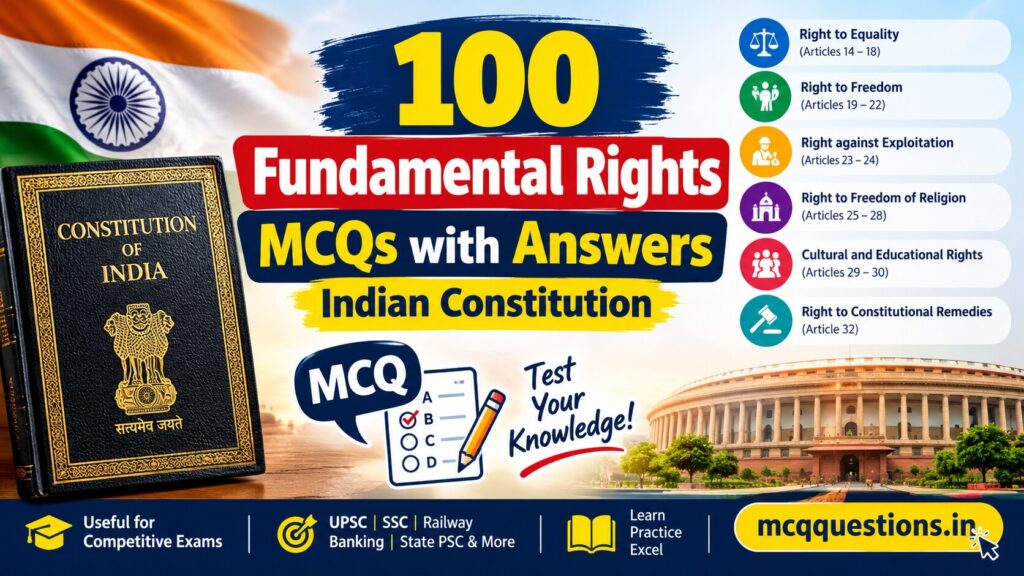
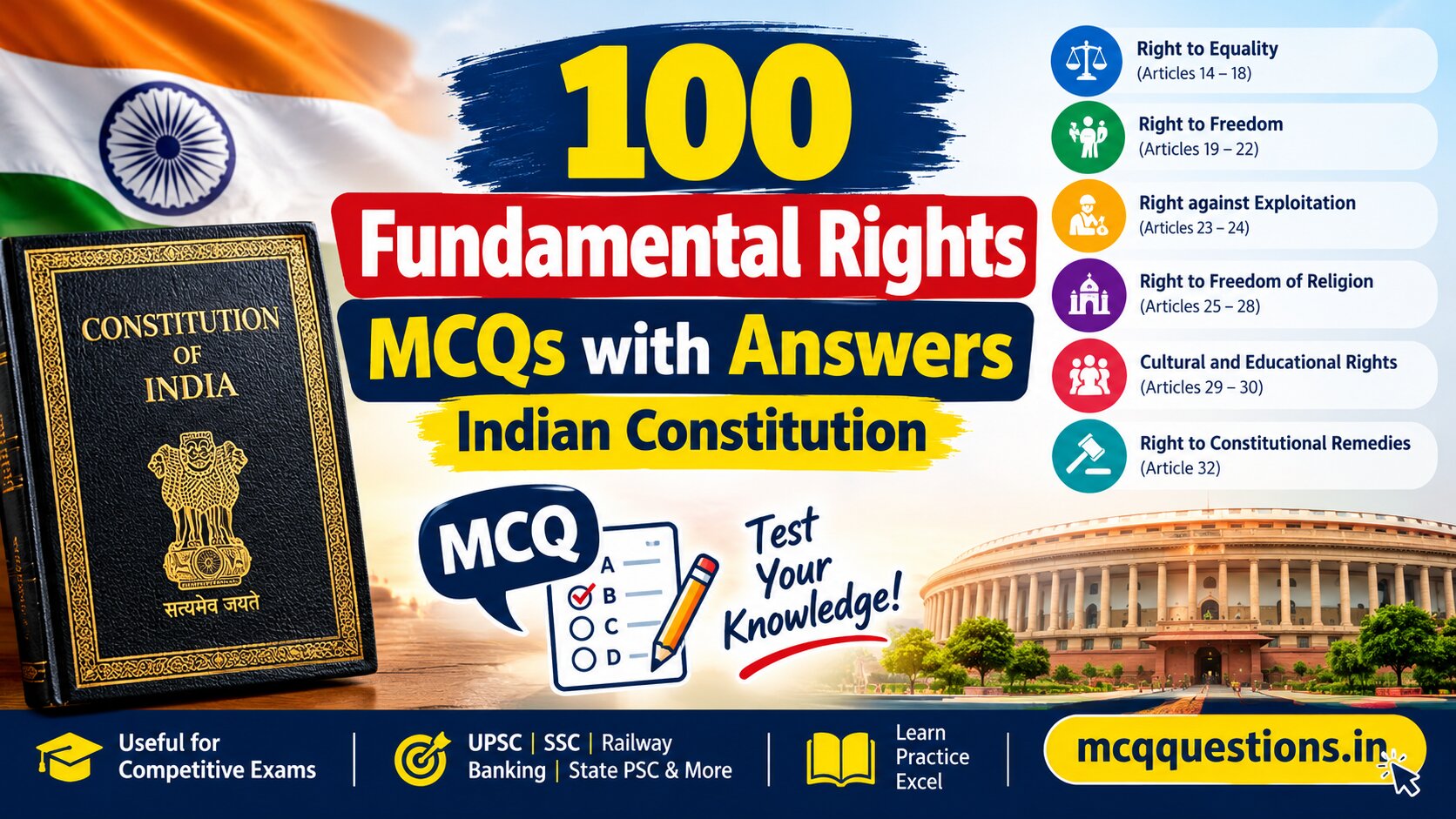
100 Fundamental Rights MCQs with Answers | Indian Constitution
100 Fundamental Rights MCQs With Answers and Analytical Explanations
1. Fundamental Rights are contained in which Part of the Indian Constitution?
A. Part I
B. Part II
C. Part III
D. Part IV
Correct Answer: C. Part III
Analytical Explanation: Part III of the Constitution, covering Articles 12–35, contains the Fundamental Rights and the basic framework for their protection.
2. Fundamental Rights in the Indian Constitution are provided under which Articles?
A. Articles 1–11
B. Articles 12–35
C. Articles 36–51
D. Articles 52–78
Correct Answer: B. Articles 12–35
Analytical Explanation: Articles 12–35 form Part III. Article 12 explains the meaning of “State” for this Part, while Article 13 addresses laws inconsistent with Fundamental Rights.
3. The idea of Fundamental Rights in the Indian Constitution was inspired primarily by the Constitution of:
A. UK
B. USA
C. Ireland
D. Canada
Correct Answer: B. USA
Analytical Explanation: The US Bill of Rights and the American constitutional tradition were major influences on the Fundamental Rights provisions in India.
4. How many Fundamental Rights are currently guaranteed by the Indian Constitution?
A. 5
B. 6
C. 7
D. 8
Correct Answer: B. 6
Analytical Explanation: The Constitution currently recognises six broad categories of Fundamental Rights. The Right to Property was removed from this list by the 44th Amendment.
5. Which Fundamental Right was removed from the list of Fundamental Rights by the 44th Amendment?
A. Right to Equality
B. Right to Freedom
C. Right to Property
D. Right against Exploitation
Correct Answer: C. Right to Property
Analytical Explanation: The 44th Constitutional Amendment Act, 1978 removed the Right to Property from Part III as a Fundamental Right.
6. Right to Property is now a:
A. Fundamental Right
B. Constitutional/legal right under Article 300A
C. Natural Right
D. Directive Principle
Correct Answer: B. Constitutional/legal right under Article 300A
Analytical Explanation: Article 300A provides that no person shall be deprived of property except by authority of law. It is a constitutional right, but not a Fundamental Right in Part III.
7. Article 12 defines:
A. State
B. Equality
C. Liberty
D. Citizenship
Correct Answer: A. State
Analytical Explanation: Article 12 defines “State” for the purposes of Part III, including the Government and Parliament of India, State governments and legislatures, and local or other authorities within its scope.
8. Article 13 deals primarily with:
A. Protection of minorities
B. Laws inconsistent with Fundamental Rights
C. Freedom of religion
D. Right to education
Correct Answer: B. Laws inconsistent with Fundamental Rights
Analytical Explanation: Article 13 provides that laws inconsistent with Fundamental Rights are void to the extent of the inconsistency, subject to the Article’s terms.
9. Which Article guarantees equality before law and equal protection of laws?
A. Article 14
B. Article 15
C. Article 16
D. Article 17
Correct Answer: A. Article 14
Analytical Explanation: Article 14 guarantees both equality before the law and equal protection of the laws to any person within India’s territory.
10. The concept of “equality before law” is borrowed from:
A. USA
B. UK
C. Ireland
D. Australia
Correct Answer: B. UK
Analytical Explanation: “Equality before law” is associated with the British constitutional tradition and means that no person is above the law.
11. “Equal protection of laws” is associated with the Constitution of:
A. USA
B. UK
C. Canada
D. France
Correct Answer: A. USA
Analytical Explanation: “Equal protection of the laws” is associated with the US Constitution and permits like cases to be treated alike while allowing constitutionally valid distinctions.
12. Article 14 permits:
A. Absolute equality
B. Reasonable classification
C. Class legislation
D. Political discrimination
Correct Answer: B. Reasonable classification
Analytical Explanation: Article 14 does not require identical treatment in every situation. Reasonable classification is permitted when it meets constitutional tests, including intelligible differentia and a rational relation to the objective.
13. Article 15 prohibits discrimination on grounds only of:
A. Religion, race, caste, sex, place of birth
B. Religion, language, income, sex
C. Caste, residence, education, religion
D. Race, wealth, language, sex
Correct Answer: A. Religion, race, caste, sex, place of birth
Analytical Explanation: Article 15 prohibits State discrimination against citizens on grounds only of religion, race, caste, sex, or place of birth.
14. Article 15 applies specifically to discrimination by:
A. Private individuals only
B. The State
C. Foreign governments
D. Political parties only
Correct Answer: B. The State
Analytical Explanation: Article 15 primarily restricts discrimination by the State. Article 15(2) also addresses specified forms of discrimination in access to public places by citizens and others, as set out in the text.
15. Article 16 guarantees equality of opportunity in:
A. Education
B. Public employment
C. Private employment
D. Trade
Correct Answer: B. Public employment
Analytical Explanation: Article 16 guarantees equality of opportunity for all citizens in matters relating to employment or appointment to an office under the State.
16. Reservation in public employment for backward classes is enabled by:
A. Article 14
B. Article 15
C. Article 16
D. Article 17
Correct Answer: C. Article 16
Analytical Explanation: Article 16 contains provisions that permit reservation in public employment for specified backward classes, subject to constitutional conditions.
17. Untouchability is abolished under:
A. Article 15
B. Article 16
C. Article 17
D. Article 18
Correct Answer: C. Article 17
Analytical Explanation: Article 17 abolishes untouchability and forbids its practice in any form. Enforcement of a disability arising from untouchability is an offence punishable by law.
18. Article 17 declares:
A. Titles abolished
B. Untouchability abolished
C. Forced labour abolished
D. Child labour abolished
Correct Answer: B. Untouchability abolished
Analytical Explanation: Article 17 specifically addresses untouchability; abolition of titles is dealt with separately under Article 18.
19. Which Act was enacted to enforce the constitutional abolition of untouchability?
A. Protection of Civil Rights Act, 1955
B. Human Rights Act, 1993
C. Equal Rights Act, 1960
D. Social Justice Act, 1975
Correct Answer: A. Protection of Civil Rights Act, 1955
Analytical Explanation: The Protection of Civil Rights Act, 1955 provides legal measures to enforce the abolition of untouchability and punish related practices.
20. Article 18 deals with:
A. Freedom of speech
B. Abolition of titles
C. Religious freedom
D. Equality of opportunity
Correct Answer: B. Abolition of titles
Analytical Explanation: Article 18 abolishes titles, with specified exceptions, and restricts the State’s ability to confer or accept titles in the ways described by the Article.
21. Which of the following is permitted under Article 18?
A. Hereditary titles
B. Military distinctions
C. Titles of nobility
D. Political titles
Correct Answer: B. Military distinctions
Analytical Explanation: Article 18 does not prohibit military or academic distinctions. These are recognised exceptions to the general prohibition on titles.
22. The Right to Freedom is mainly covered under:
A. Articles 14–18
B. Articles 19–22
C. Articles 23–24
D. Articles 25–28
Correct Answer: B. Articles 19–22
Analytical Explanation: The Right to Freedom is commonly grouped under Articles 19–22, including freedoms under Article 19 and protections relating to criminal conviction, life and liberty, and arrest and detention.
23. Article 19 originally provided how many freedoms?
A. 5
B. 6
C. 7
D. 8
Correct Answer: C. 7
Analytical Explanation: Originally, Article 19 listed seven freedoms. The freedom to acquire, hold and dispose of property was later removed from Article 19(1) by the 44th Amendment.
24. How many freedoms are currently guaranteed under Article 19?
A. 5
B. 6
C. 7
D. 8
Correct Answer: B. 6
Analytical Explanation: Article 19 currently protects six freedoms for citizens, including speech and expression, peaceful assembly, association, movement, residence, and profession or business.
25. Which freedom was removed from Article 19?
A. Freedom of speech
B. Freedom of movement
C. Freedom to acquire property
D. Freedom of association
Correct Answer: C. Freedom to acquire property
Analytical Explanation: The former Article 19(1)(f) freedom to acquire, hold and dispose of property was removed as a Fundamental Right; property protection now appears in Article 300A.
26. Freedom of speech and expression is guaranteed under:
A. Article 19(1)(a)
B. Article 20(1)
C. Article 21
D. Article 22
Correct Answer: A. Article 19(1)(a)
Analytical Explanation: Article 19(1)(a) protects citizens’ freedom of speech and expression, subject to the reasonable restrictions permitted by Article 19(2).
27. Freedom to assemble peacefully and without arms is guaranteed under:
A. Article 19(1)(a)
B. Article 19(1)(b)
C. Article 19(1)(c)
D. Article 19(1)(d)
Correct Answer: B. Article 19(1)(b)
Analytical Explanation: Article 19(1)(b) protects citizens’ right to assemble peaceably and without arms, subject to constitutional restrictions.
28. Freedom to form associations or unions is guaranteed under:
A. Article 19(1)(a)
B. Article 19(1)(b)
C. Article 19(1)(c)
D. Article 19(1)(g)
Correct Answer: C. Article 19(1)(c)
Analytical Explanation: Article 19(1)(c) protects citizens’ right to form associations, unions, or cooperative societies, subject to applicable constitutional limits.
29. Freedom to move freely throughout India is guaranteed under:
A. Article 19(1)(c)
B. Article 19(1)(d)
C. Article 19(1)(e)
D. Article 21
Correct Answer: B. Article 19(1)(d)
Analytical Explanation: Article 19(1)(d) protects citizens’ freedom to move freely throughout the territory of India, subject to reasonable restrictions allowed by the Constitution.
30. Freedom to reside and settle anywhere in India is guaranteed under:
A. Article 19(1)(d)
B. Article 19(1)(e)
C. Article 19(1)(f)
D. Article 19(1)(g)
Correct Answer: B. Article 19(1)(e)
Analytical Explanation: Article 19(1)(e) protects citizens’ right to reside and settle in any part of India, subject to constitutionally permitted restrictions.
31. Freedom to practise any profession or carry on any occupation, trade or business is under:
A. Article 19(1)(d)
B. Article 19(1)(e)
C. Article 19(1)(f)
D. Article 19(1)(g)
Correct Answer: D. Article 19(1)(g)
Analytical Explanation: Article 19(1)(g) protects citizens’ right to practise a profession or carry on an occupation, trade, or business, subject to reasonable restrictions and regulatory provisions.
32. Article 19 rights are available to:
A. Citizens only
B. All persons
C. Foreigners only
D. Corporations only
Correct Answer: A. Citizens only
Analytical Explanation: Article 19 rights are expressly guaranteed to citizens, rather than to every person regardless of nationality.
33. Which Fundamental Right is available to both citizens and foreigners, subject to constitutional provisions?
A. Article 19
B. Article 20
C. Article 21
D. Both B and C
Correct Answer: D. Both B and C
Analytical Explanation: Articles 20 and 21 use the term “person” and protect citizens and non-citizens alike, subject to their specific wording. Article 19, by contrast, is for citizens.
34. Article 20 provides protection in respect of:
A. Conviction for offences
B. Religious freedom
C. Education
D. Public employment
Correct Answer: A. Conviction for offences
Analytical Explanation: Article 20 provides safeguards in respect of conviction for offences, including protection against retrospective criminal penalties, double jeopardy, and compelled self-incrimination.
35. Ex-post-facto criminal legislation is prohibited under:
A. Article 19
B. Article 20(1)
C. Article 21
D. Article 22
Correct Answer: B. Article 20(1)
Analytical Explanation: Article 20(1) prohibits retrospective criminal conviction under a law that criminalises an act when it was not an offence at the time, and bars a penalty greater than the one applicable then.
36. The principle that a person cannot be prosecuted and punished for the same offence more than once is:
A. Rule of law
B. Double jeopardy
C. Judicial review
D. Habeas corpus
Correct Answer: B. Double jeopardy
Analytical Explanation: Double jeopardy is the principle against being prosecuted and punished more than once for the same offence in the manner prohibited by the Constitution.
37. Protection against double jeopardy is provided under:
A. Article 20(1)
B. Article 20(2)
C. Article 20(3)
D. Article 21
Correct Answer: B. Article 20(2)
Analytical Explanation: Article 20(2) states that no person shall be prosecuted and punished for the same offence more than once.
38. Protection against self-incrimination is provided under:
A. Article 19
B. Article 20(2)
C. Article 20(3)
D. Article 22
Correct Answer: C. Article 20(3)
Analytical Explanation: Article 20(3) protects an accused person from being compelled to be a witness against themselves.
39. Article 21 protects:
A. Life and personal liberty
B. Property only
C. Religious rights only
D. Voting rights
Correct Answer: A. Life and personal liberty
Analytical Explanation: Article 21 protects the life and personal liberty of every person, except according to procedure established by law.
40. Article 21 states that no person shall be deprived of life or personal liberty except according to:
A. Natural justice
B. Procedure established by law
C. Parliamentary convention
D. Judicial precedent
Correct Answer: B. Procedure established by law
Analytical Explanation: Article 21 requires deprivation of life or personal liberty to follow a procedure established by law. Judicial interpretation also requires such procedure to meet standards of fairness and non-arbitrariness.
41. Which Supreme Court case significantly expanded the interpretation of Article 21?
A. Golaknath v. State of Punjab
B. Maneka Gandhi v. Union of India
C. Shankari Prasad v. Union of India
D. Minerva Mills v. Union of India
Correct Answer: B. Maneka Gandhi v. Union of India
Analytical Explanation: In Maneka Gandhi v. Union of India (1978), the Supreme Court interpreted Article 21 broadly and linked the procedure requirement with fairness, reasonableness, and non-arbitrariness.
42. The Right to Privacy has been recognized as a Fundamental Right under:
A. Article 14 only
B. Article 19 only
C. Article 21
D. Article 32 only
Correct Answer: C. Article 21
Analytical Explanation: The right to privacy is recognised as a Fundamental Right as part of the protections flowing from Part III, particularly Article 21, read with other rights.
43. The Supreme Court recognized privacy as a Fundamental Right in:
A. Kesavananda Bharati case
B. K.S. Puttaswamy case
C. Minerva Mills case
D. S.R. Bommai case
Correct Answer: B. K.S. Puttaswamy case
Analytical Explanation: In the 2017 K.S. Puttaswamy judgment, a nine-judge bench of the Supreme Court affirmed privacy as a constitutionally protected Fundamental Right.
44. Article 21A provides the Right to:
A. Work
B. Education
C. Food
D. Property
Correct Answer: B. Education
Analytical Explanation: Article 21A requires the State to provide free and compulsory education to children in the 6–14 age group in the manner determined by law.
45. Article 21A covers children in which age group?
A. 3–6 years
B. 6–14 years
C. 14–18 years
D. 5–15 years
Correct Answer: B. 6–14 years
Analytical Explanation: The age range stated in Article 21A is six to fourteen years.
46. Article 21A was inserted by which Constitutional Amendment?
A. 42nd Amendment
B. 44th Amendment
C. 73rd Amendment
D. 86th Amendment
Correct Answer: D. 86th Amendment
Analytical Explanation: The 86th Constitutional Amendment Act, 2002 inserted Article 21A and made related changes concerning children’s education.
47. Article 22 primarily deals with:
A. Protection against arrest and detention
B. Religious freedom
C. Equality
D. Education
Correct Answer: A. Protection against arrest and detention
Analytical Explanation: Article 22 sets out safeguards concerning arrest and detention, while also providing special rules and exceptions for preventive detention.
48. A person arrested must generally be produced before the nearest magistrate within:
A. 12 hours
B. 24 hours
C. 48 hours
D. 72 hours
Correct Answer: B. 24 hours
Analytical Explanation: Under Article 22(2), an arrested and detained person must generally be produced before the nearest magistrate within 24 hours, excluding the time necessary for the journey from the place of arrest to the court.
49. The 24-hour period for producing an arrested person before a magistrate excludes:
A. Lunch breaks
B. Court holidays only
C. The time necessary for the journey from the place of arrest to the court
D. Police investigation time
Correct Answer: C. The time necessary for the journey from the place of arrest to the court
Analytical Explanation: The constitutional 24-hour calculation excludes the time necessary for the journey from the place of arrest to the magistrate’s court.
50. Which Article deals with preventive detention?
A. Article 19
B. Article 20
C. Article 21
D. Article 22
Correct Answer: D. Article 22
Analytical Explanation: Article 22 includes provisions on preventive detention, including safeguards and conditions laid down in the Constitution.
51. Right against Exploitation is guaranteed under:
A. Articles 19–22
B. Articles 23–24
C. Articles 25–28
D. Articles 29–30
Correct Answer: B. Articles 23–24
Analytical Explanation: Articles 23 and 24 form the core of the Right against Exploitation.
52. Article 23 prohibits:
A. Child education
B. Traffic in human beings and forced labour
C. Religious conversion
D. Political discrimination
Correct Answer: B. Traffic in human beings and forced labour
Analytical Explanation: Article 23 prohibits traffic in human beings, begar, and other similar forms of forced labour, subject to the constitutional text’s provisions.
53. “Begar” is prohibited under:
A. Article 21
B. Article 22
C. Article 23
D. Article 24
Correct Answer: C. Article 23
Analytical Explanation: “Begar” means labour or service exacted without payment or against the person’s will, and is expressly prohibited by Article 23.
54. Article 23 is available against:
A. State action only
B. Private individuals only
C. Both State and private individuals
D. Foreign governments only
Correct Answer: C. Both State and private individuals
Analytical Explanation: Article 23 applies against both the State and private individuals; the prohibition is not limited to government action.
55. Article 24 prohibits employment of children below 14 years in:
A. All occupations
B. Factories, mines and hazardous employment
C. Government offices only
D. Agriculture only
Correct Answer: B. Factories, mines and hazardous employment
Analytical Explanation: Article 24 prohibits employment of children below fourteen years in factories, mines, and other hazardous employment as specified by the constitutional provision.
56. Freedom of Religion is covered under:
A. Articles 23–24
B. Articles 25–28
C. Articles 29–30
D. Articles 32–35
Correct Answer: B. Articles 25–28
Analytical Explanation: Articles 25–28 concern freedom of religion, including individual religious freedom, denominational rights, and rules about religious instruction and taxation.
57. Article 25 guarantees:
A. Freedom of conscience and free profession, practice and propagation of religion
B. Freedom of speech
C. Freedom of association
D. Cultural rights
Correct Answer: A. Freedom of conscience and free profession, practice and propagation of religion
Analytical Explanation: Article 25 protects freedom of conscience and the right freely to profess, practise, and propagate religion, subject to constitutional limits.
58. Freedom of religion under Article 25 is subject to:
A. Public order
B. Morality
C. Health
D. All of the above
Correct Answer: D. All of the above
Analytical Explanation: Article 25 expressly makes religious freedom subject to public order, morality, and health, as well as the other provisions of Part III.
59. Article 26 deals with:
A. Religious denominations’ rights
B. Minority education
C. Religious taxation
D. Religious conversion
Correct Answer: A. Religious denominations’ rights
Analytical Explanation: Article 26 protects the rights of religious denominations or sections thereof to manage religious affairs and institutions, within the limits stated in the Article.
60. Under Article 26, a religious denomination can:
A. Manage its own affairs in matters of religion
B. Make criminal laws
C. Establish a separate government
D. Suspend constitutional rights
Correct Answer: A. Manage its own affairs in matters of religion
Analytical Explanation: Article 26 includes the right of a religious denomination to manage its own affairs in matters of religion, subject to public order, morality, and health.
61. Article 27 prohibits:
A. Religious education
B. Taxation specifically appropriated for promotion of a particular religion
C. Religious practice
D. Religious institutions
Correct Answer: B. Taxation specifically appropriated for promotion of a particular religion
Analytical Explanation: Article 27 bars compelling a person to pay taxes whose proceeds are specifically appropriated for payment of expenses for the promotion or maintenance of a particular religion or religious denomination.
62. Article 28 deals with:
A. Religious instruction in educational institutions
B. Religious conversion
C. Religious taxation
D. Minority representation
Correct Answer: A. Religious instruction in educational institutions
Analytical Explanation: Article 28 regulates religious instruction and worship in certain educational institutions, distinguishing institutions wholly maintained by State funds from other categories.
63. Religious instruction cannot be provided in educational institutions:
A. Wholly maintained out of State funds
B. Privately funded schools
C. Religious institutions
D. Minority institutions
Correct Answer: A. Wholly maintained out of State funds
Analytical Explanation: Article 28(1) prohibits religious instruction in an educational institution wholly maintained out of State funds, subject to the constitutional exception for institutions administered by the State but established under an endowment or trust requiring such instruction.
64. Cultural and Educational Rights are guaranteed under:
A. Articles 25–28
B. Articles 29–30
C. Articles 31–32
D. Articles 33–35
Correct Answer: B. Articles 29–30
Analytical Explanation: Articles 29 and 30 protect cultural and educational interests, including the preservation of language, script, and culture and minority educational institutions.
65. Article 29 primarily protects:
A. Language, script and culture
B. Property
C. Employment
D. Religious taxation
Correct Answer: A. Language, script and culture
Analytical Explanation: Article 29(1) protects the right of any section of citizens with a distinct language, script, or culture to conserve it.
66. Article 29(1) is available to:
A. Minorities only
B. Any section of citizens having a distinct language, script or culture
C. Foreigners only
D. Religious denominations only
Correct Answer: B. Any section of citizens having a distinct language, script or culture
Analytical Explanation: Article 29(1) is not limited to minorities; it applies to any section of citizens meeting the provision’s description.
67. Article 30 deals with the rights of:
A. Women
B. Minorities to establish and administer educational institutions
C. Workers
D. Children
Correct Answer: B. Minorities to establish and administer educational institutions
Analytical Explanation: Article 30 protects the right of religious and linguistic minorities to establish and administer educational institutions of their choice.
68. Article 30 protects minorities based on:
A. Religion or language
B. Caste only
C. Economic status
D. Region only
Correct Answer: A. Religion or language
Analytical Explanation: For Article 30, minority status is based on religion or language.
69. Which Article provides the Right to Constitutional Remedies?
A. Article 30
B. Article 31
C. Article 32
D. Article 35
Correct Answer: C. Article 32
Analytical Explanation: Article 32 guarantees the right to move the Supreme Court for enforcement of Fundamental Rights and empowers it to issue appropriate directions, orders, or writs.
70. Dr. B.R. Ambedkar described which Article as the “heart and soul” of the Constitution?
A. Article 14
B. Article 19
C. Article 21
D. Article 32
Correct Answer: D. Article 32
Analytical Explanation: Dr. B.R. Ambedkar called Article 32 the Constitution’s “heart and soul” because it provides a remedy for enforcing Fundamental Rights.
71. Article 32 empowers the Supreme Court to issue:
A. Ordinances
B. Writs
C. Money Bills
D. Regulations
Correct Answer: B. Writs
Analytical Explanation: Article 32 empowers the Supreme Court to issue directions, orders, and writs—including habeas corpus, mandamus, prohibition, quo warranto, and certiorari—for enforcement of Fundamental Rights.
72. How many types of writs can the Supreme Court issue under Article 32?
A. 3
B. 4
C. 5
D. 6
Correct Answer: C. 5
Analytical Explanation: The five traditional writs are habeas corpus, mandamus, prohibition, certiorari, and quo warranto.
73. Which writ literally means “you may have the body”?
A. Mandamus
B. Habeas Corpus
C. Certiorari
D. Prohibition
Correct Answer: B. Habeas Corpus
Analytical Explanation: Habeas corpus is traditionally translated as “you may have the body” and requires the legality of a person’s detention to be examined.
74. Habeas Corpus is primarily used to:
A. Release a person from unlawful detention
B. Transfer a case
C. Stop legislation
D. Appoint a public official
Correct Answer: A. Release a person from unlawful detention
Analytical Explanation: Habeas corpus is used to challenge unlawful detention and can lead to release when detention has no lawful basis.
75. Which writ means “we command”?
A. Mandamus
B. Habeas Corpus
C. Quo Warranto
D. Certiorari
Correct Answer: A. Mandamus
Analytical Explanation: Mandamus means “we command” and is a court order directing a public authority to perform a legal public duty.
76. Mandamus is issued to:
A. Command a public authority to perform a public duty
B. Release an illegally detained person
C. Question a person’s legal authority to hold office
D. Transfer a criminal case
Correct Answer: A. Command a public authority to perform a public duty
Analytical Explanation: Mandamus compels performance of a public or statutory duty where the legal requirements for the writ are met; it is not generally used to dictate purely discretionary decisions.
77. Which writ means “by what authority”?
A. Prohibition
B. Certiorari
C. Quo Warranto
D. Mandamus
Correct Answer: C. Quo Warranto
Analytical Explanation: Quo warranto means “by what authority” and questions the legal authority by which a person holds a public office.
78. Quo Warranto is used to:
A. Challenge illegal detention
B. Challenge a person’s right to hold a public office
C. Stop a lower court proceeding
D. Transfer a case
Correct Answer: B. Challenge a person’s right to hold a public office
Analytical Explanation: Quo warranto tests whether a person has lawful authority to occupy a public office, helping prevent unlawful usurpation of office.
79. Which writ is generally issued to prevent a lower court or tribunal from exceeding its jurisdiction?
A. Prohibition
B. Mandamus
C. Habeas Corpus
D. Quo Warranto
Correct Answer: A. Prohibition
Analytical Explanation: Prohibition is generally issued by a superior court to stop a lower court or tribunal from continuing a proceeding beyond its jurisdiction.
80. Certiorari is generally used to:
A. Prevent a future proceeding
B. Quash an order of a lower court or tribunal
C. Appoint a public officer
D. Release a detained person
Correct Answer: B. Quash an order of a lower court or tribunal
Analytical Explanation: Certiorari is generally used by a superior court to quash an order or decision of a lower court or tribunal where the legal grounds for intervention exist.
81. Which writ can be issued against a private individual?
A. Habeas Corpus
B. Mandamus
C. Quo Warranto
D. Prohibition
Correct Answer: A. Habeas Corpus
Analytical Explanation: Habeas corpus may be issued in appropriate cases involving unlawful detention by a private individual, as well as detention by public authorities.
82. The power of High Courts to issue writs is provided under:
A. Article 32
B. Article 136
C. Article 226
D. Article 368
Correct Answer: C. Article 226
Analytical Explanation: Article 226 gives High Courts power to issue writs for enforcement of Fundamental Rights and “for any other purpose” within their jurisdiction.
83. Compared with Article 32, Article 226 empowers High Courts to issue writs:
A. Only for Fundamental Rights
B. For Fundamental Rights and for other purposes
C. Only against private individuals
D. Only during emergencies
Correct Answer: B. For Fundamental Rights and for other purposes
Analytical Explanation: Article 226 is broader in subject matter than Article 32 because High Courts may issue writs not only for Fundamental Rights but also for other legal rights, subject to jurisdictional limits.
84. Article 32 is itself:
A. A Fundamental Right
B. A Directive Principle
C. A Fundamental Duty
D. An ordinary legal right
Correct Answer: A. A Fundamental Right
Analytical Explanation: Article 32 itself is included among the Fundamental Rights and guarantees access to the Supreme Court for their enforcement.
85. Which court has wider writ jurisdiction?
A. Supreme Court under Article 32
B. High Court under Article 226
C. District Court
D. Parliament
Correct Answer: B. High Court under Article 226
Analytical Explanation: High Courts have wider subject-matter writ jurisdiction under Article 226 because it extends to Fundamental Rights and other legal purposes; Article 32 is specifically for Fundamental Rights enforcement.
86. Article 33 empowers Parliament to modify Fundamental Rights in their application to:
A. Armed forces
B. Police forces
C. Intelligence organizations
D. All of the above, as specified by the Constitution
Correct Answer: D. All of the above, as specified by the Constitution
Analytical Explanation: Article 33 empowers Parliament to determine the extent to which Fundamental Rights may be restricted or abrogated for specified forces and services, including armed forces and forces charged with maintaining public order, and intelligence-related organisations as constitutionally specified.
87. Article 34 relates to:
A. Martial law
B. Emergency financial provisions
C. Religious freedom
D. Education
Correct Answer: A. Martial law
Analytical Explanation: Article 34 concerns restrictions on Fundamental Rights while martial law is in force in any area and Parliament’s power to indemnify acts done in connection with martial law, as provided by the Constitution.
88. Article 35 gives Parliament power to make laws regarding:
A. Certain specified matters relating to Fundamental Rights
B. State budgets
C. Panchayats only
D. International treaties only
Correct Answer: A. Certain specified matters relating to Fundamental Rights
Analytical Explanation: Article 35 gives Parliament exclusive power to make laws on certain specified matters connected with Part III, including matters where the Constitution expressly assigns lawmaking power to Parliament.
89. Which Fundamental Rights are available only to citizens?
A. Articles 15, 16, 19, 29 and 30
B. Articles 14, 20 and 21
C. Articles 23 and 24 only
D. Articles 25 and 26 only
Correct Answer: A. Articles 15, 16, 19, 29 and 30
Analytical Explanation: Several rights are specifically framed for citizens, including Articles 15, 16 and 19. Article 29(1) refers to citizens; Article 30 separately protects religious and linguistic minorities’ educational rights. The option reflects the source document’s intended grouping.
90. Which of the following is NOT a Fundamental Right today?
A. Right to Equality
B. Right to Property
C. Right to Freedom
D. Right against Exploitation
Correct Answer: B. Right to Property
Analytical Explanation: The Right to Property is no longer a Fundamental Right. Article 300A protects it as a constitutional right.
91. During a National Emergency, which Fundamental Rights cannot be suspended under Article 359?
A. Articles 14 and 19
B. Articles 20 and 21
C. Articles 25 and 26
D. Articles 29 and 30
Correct Answer: B. Articles 20 and 21
Analytical Explanation: Article 359 permits suspension of the right to move courts for enforcement of specified Fundamental Rights during an Emergency, but Articles 20 and 21 are expressly protected from such suspension.
92. Article 19 is automatically suspended only when an Emergency is declared on the ground of:
A. Armed rebellion
B. War or external aggression
C. Financial instability
D. Internal disturbance
Correct Answer: B. War or external aggression
Analytical Explanation: Under Article 358, Article 19’s provisions are affected automatically only when a National Emergency is declared on the grounds of war or external aggression, subject to the constitutional conditions.
93. Which amendment changed the grounds for suspension of Article 19 during an Emergency?
A. 42nd Amendment
B. 44th Amendment
C. 52nd Amendment
D. 86th Amendment
Correct Answer: B. 44th Amendment
Analytical Explanation: The 44th Amendment changed the emergency-related rule so Article 19 is automatically affected only for an Emergency based on war or external aggression, not armed rebellion.
94. Fundamental Rights are:
A. Absolute in all circumstances
B. Subject to reasonable restrictions in specified cases
C. Merely moral rights
D. Available only during elections
Correct Answer: B. Subject to reasonable restrictions in specified cases
Analytical Explanation: Many Fundamental Rights are subject to restrictions or qualifications expressly allowed by the Constitution; they are not unlimited in every circumstance.
95. Which Fundamental Right protects against discrimination in access to shops, public restaurants, hotels and places of public entertainment?
A. Article 14
B. Article 15(2)
C. Article 16
D. Article 17
Correct Answer: B. Article 15(2)
Analytical Explanation: Article 15(2) prohibits specified forms of discrimination on the listed grounds in access to shops, public restaurants, hotels, and places of public entertainment, as well as certain public facilities.
96. Special provisions for women and children can be made under:
A. Article 14
B. Article 15(3)
C. Article 16(1)
D. Article 17
Correct Answer: B. Article 15(3)
Analytical Explanation: Article 15(3) expressly permits the State to make special provisions for women and children.
97. Special provisions for socially and educationally backward classes are permitted under:
A. Article 15
B. Article 17
C. Article 18
D. Article 20
Correct Answer: A. Article 15
Analytical Explanation: Article 15(4) and related clauses permit special provisions for socially and educationally backward classes and for Scheduled Castes and Scheduled Tribes, subject to the constitutional text.
98. Which Fundamental Right is directly associated with the principle of “constitutional remedies”?
A. Article 14
B. Article 19
C. Article 21
D. Article 32
Correct Answer: D. Article 32
Analytical Explanation: Article 32 is the constitutional remedy provision that allows a person to approach the Supreme Court for enforcement of Fundamental Rights.
99. Which of the following pairs is correctly matched?
A. Article 17 — Abolition of Untouchability
B. Article 21 — Freedom of Religion
C. Article 24 — Abolition of Titles
D. Article 32 — Right to Property
Correct Answer: A. Article 17 — Abolition of Untouchability
Analytical Explanation: Article 17 abolishes untouchability. The other pairings are incorrect: Article 21 concerns life and personal liberty, Article 24 concerns child employment in specified settings, and Article 32 concerns constitutional remedies.
100. Which sequence correctly represents the major categories of Fundamental Rights currently recognized?
A. Equality, Freedom, Exploitation, Religion, Cultural & Educational Rights, Constitutional Remedies
B. Equality, Property, Religion, Education, Employment, Remedies
C. Liberty, Property, Religion, Trade, Education, Voting
D. Equality, Justice, Property, Religion, Education, Duties
Correct Answer: A. Equality, Freedom, Exploitation, Religion, Cultural & Educational Rights, Constitutional Remedies
Analytical Explanation: The six broad categories are Right to Equality, Right to Freedom, Right against Exploitation, Right to Freedom of Religion, Cultural and Educational Rights, and Right to Constitutional Remedies.