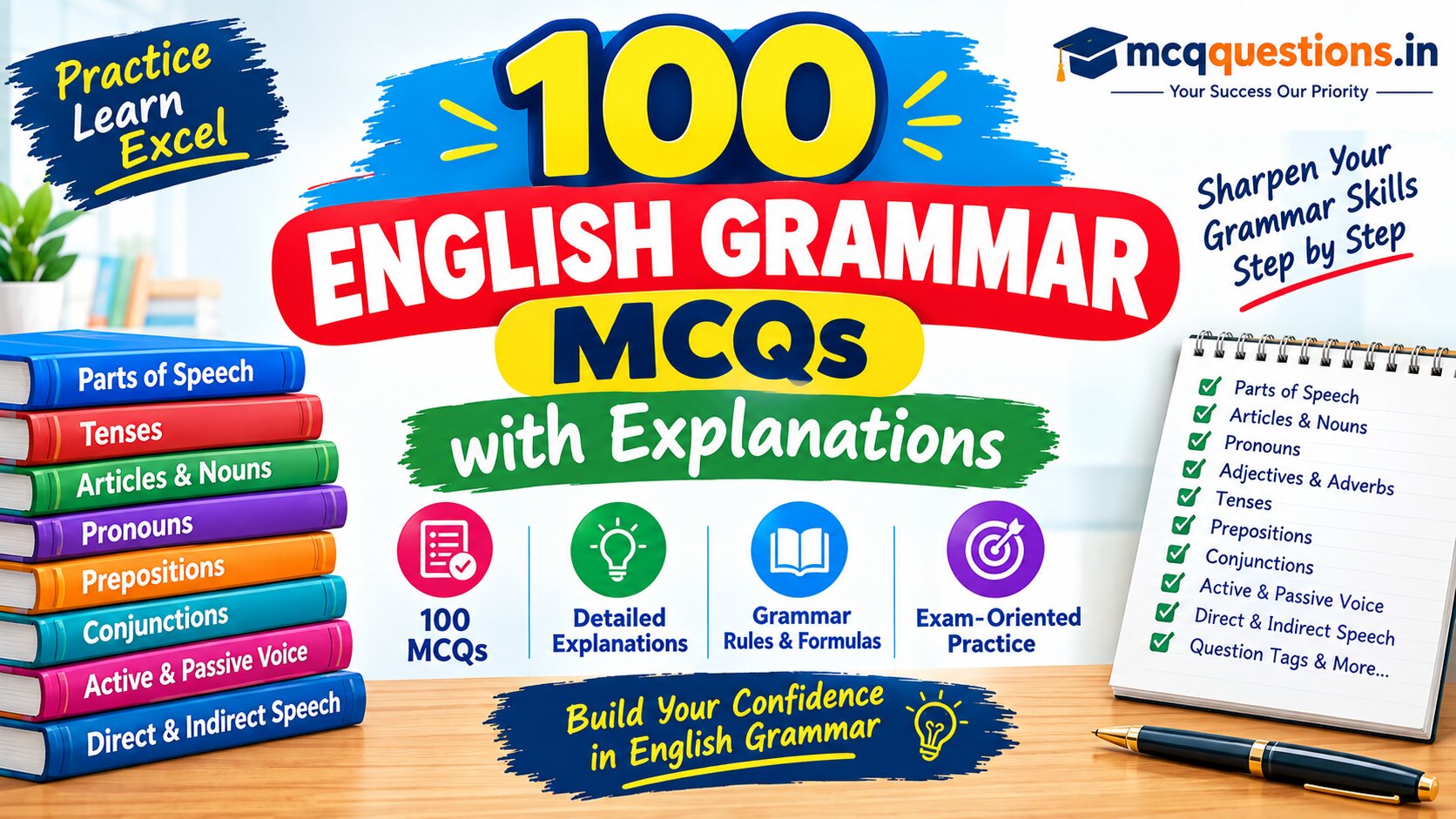
100 English Grammar MCQs
Questions, Answers & Analytical Explanations of Rules/Formulas
Table of Contents
Quick Revision Formula & Rule Sheet
- Simple Present = Subject + V1; he/she/it + V1-s/es.
- Present Continuous = am/is/are + V-ing.
- Simple Past = Subject + V2.
- Past Continuous = was/were + V-ing.
- Present Perfect = has/have + V3.
- Past Perfect = had + V3.
- Future Simple = will + V1.
- Future Continuous = will be + V-ing.
- Future Perfect = will have + V3.
- Present Perfect Continuous = has/have been + V-ing.
- Passive Voice = Object + appropriate BE + V3 (+ by + agent).
- Indirect Command = reporting verb + object + to + V1.
- Yes/No Indirect Question = asked + object + if/whether + statement order.
- Question Tag = positive statement → negative tag; negative statement → positive tag.
- Since = starting point; For = duration.
- Fewer = countable plural; Less = uncountable.
- Prefer A to B; Senior to; Good at.
- Second Conditional = If + subject + were, … would + V1.
1–20: Parts of Speech, Articles & Nouns
1. Which word is a noun in the sentence “The boy is reading a book”?
A) is
B) reading
C) boy
D) a
Correct Answer: C) boy
Analytical Explanation — Noun rule: a noun names a person, place, thing, or idea. “Boy” names a person.
2. Which of the following is a pronoun?
A) Quickly
B) Beautiful
C) He
D) Run
Correct Answer: C) He
Analytical Explanation — Pronoun rule: a pronoun replaces a noun. “He” can replace a person’s name.
3. Which word is an adjective? “She has a beautiful dress.”
A) She
B) has
C) beautiful
D) dress
Correct Answer: C) beautiful
Analytical Explanation — Adjective rule: an adjective describes a noun. “Beautiful” describes “dress.”
4. Which word is an adverb? “He runs quickly.”
A) He
B) runs
C) quickly
D) None
Correct Answer: C) quickly
Analytical Explanation — Adverb rule: an adverb modifies a verb. “Quickly” tells how he runs.
5. Which word is a verb?
A) Happiness
B) Beautiful
C) Write
D) Slowly
Correct Answer: C) Write
Analytical Explanation — Verb rule: a verb expresses an action or state. “Write” expresses an action.
6. Choose the correct article: “He is ___ honest man.”
A) a
B) an
C) the
D) no article
Correct Answer: B) an
Analytical Explanation — Article rule: choose by sound. “Honest” begins with a vowel sound because h is silent, so use “an.”
7. She bought ___ umbrella yesterday.
A) a
B) an
C) the
D) no article
Correct Answer: B) an
Analytical Explanation — “Umbrella” begins with a vowel sound, so use “an.”
8. I saw ___ elephant at the zoo.
A) a
B) an
C) the
D) no article
Correct Answer: B) an
Analytical Explanation — “Elephant” begins with a vowel sound, so use “an.”
9. He is ___ university student.
A) a
B) an
C) the
D) no article
Correct Answer: A) a
Analytical Explanation — “University” begins with the consonant /y/ sound, so use “a,” not “an.”
10. ___ sun rises in the east.
A) A
B) An
C) The
D) No article
Correct Answer: C) The
Analytical Explanation — Use “the” for something unique or specifically identified. “The sun” is the standard expression.
11. What is the plural of “child”?
A) Childs
B) Children
C) Childes
D) Childrens
Correct Answer: B) Children
Analytical Explanation — Irregular plural: child → children; it is not formed by adding -s.
12. What is the plural of “mouse”?
A) Mouses
B) Mouse
C) Mice
D) Meese
Correct Answer: C) Mice
Analytical Explanation — Irregular plural: mouse → mice.
13. What is the feminine form of “king”?
A) Lady
B) Queen
C) Woman
D) Princess
Correct Answer: B) Queen
Analytical Explanation — The conventional feminine counterpart of king is queen.
14. Which is a collective noun?
A) Team
B) Boy
C) Chair
D) Book
Correct Answer: A) Team
Analytical Explanation — A collective noun names a group as a unit; “team” does this.
15. Which is an abstract noun?
A) Table
B) Honesty
C) Pen
D) Dog
Correct Answer: B) Honesty
Analytical Explanation — An abstract noun names a quality, idea, or state. “Honesty” is a quality.
16. Which is a proper noun?
A) City
B) Country
C) India
D) River
Correct Answer: C) India
Analytical Explanation — A proper noun is a specific name and is normally capitalized. “India” is a country name.
17. Which is a common noun?
A) Delhi
B) Ram
C) Mountain
D) Monday
Correct Answer: C) Mountain
Analytical Explanation — A common noun is a general class name. “Mountain” is general.
18. Choose the correct possessive form: “This is ___ book.”
A) Ramesh
B) Rameshes
C) Ramesh’s
D) Rameshs
Correct Answer: C) Ramesh’s
Analytical Explanation — Possessive rule: singular noun + ’s shows possession: Ramesh’s book.
19. Which word is a conjunction?
A) And
B) Very
C) Beautiful
D) Run
Correct Answer: A) And
Analytical Explanation — A conjunction joins words, phrases, or clauses. “And” joins elements.
20. Which word is a preposition?
A) Under
B) Quickly
C) Sing
D) Happy
Correct Answer: A) Under
Analytical Explanation — A preposition shows a relationship such as place or position. “Under” shows position.
21–40: Tenses
21. She ___ to school every day.
A) go
B) goes
C) going
D) gone
Correct Answer: B) goes
Analytical Explanation — Simple present: subject + V1; with he/she/it, add -s/-es. She → goes.
22. They ___ cricket yesterday.
A) play
B) plays
C) played
D) playing
Correct Answer: C) played
Analytical Explanation — Simple past: subject + V2. “Yesterday” signals a completed past action.
23. I ___ my homework now.
A) do
B) did
C) am doing
D) have done
Correct Answer: C) am doing
Analytical Explanation — Present continuous: am/is/are + V-ing. “Now” signals an action in progress.
24. He ___ already finished his work.
A) has
B) have
C) had
D) is
Correct Answer: A) has
Analytical Explanation — Present perfect: has/have + V3. With “he,” use has.
25. We ___ dinner when he arrived.
A) have
B) were having
C) are having
D) had
Correct Answer: B) were having
Analytical Explanation — Past continuous: was/were + V-ing. The action was in progress when another past event occurred.
26. By next year, she ___ her course.
A) completes
B) completed
C) will have completed
D) completing
Correct Answer: C) will have completed
Analytical Explanation — Future perfect: will have + V3. “By next year” indicates completion before a future deadline.
27. I ___ him two days ago.
A) meet
B) met
C) have met
D) meeting
Correct Answer: B) met
Analytical Explanation — Simple past is used with a definite completed past time such as “two days ago.”
28. He ___ in Delhi since 2020.
A) lives
B) lived
C) has lived
D) is living
Correct Answer: C) has lived
Analytical Explanation — Present perfect: has/have + V3. “Since 2020” gives a starting point continuing to the present.
29. The train ___ before we reached the station.
A) leaves
B) left
C) had left
D) has left
Correct Answer: C) had left
Analytical Explanation — Past perfect: had + V3. The train left before we reached, so the earlier action takes past perfect.
30. Look! The baby ___.
A) cries
B) cried
C) is crying
D) has cried
Correct Answer: C) is crying
Analytical Explanation — Present continuous: am/is/are + V-ing. “Look!” signals an action happening now.
31. Tomorrow, I ___ my grandmother.
A) visit
B) visited
C) will visit
D) have visited
Correct Answer: C) will visit
Analytical Explanation — Future simple: will + V1. “Tomorrow” points to the future.
32. She ___ English for five years.
A) studies
B) studied
C) has been studying
D) study
Correct Answer: C) has been studying
Analytical Explanation — Present perfect continuous: has/have been + V-ing. “For five years” emphasizes duration continuing to the present.
33. When I entered the room, they ___.
A) sleep
B) slept
C) were sleeping
D) have slept
Correct Answer: C) were sleeping
Analytical Explanation — Past continuous: was/were + V-ing. The sleeping was in progress when I entered.
34. He ___ the letter before I arrived.
A) writes
B) wrote
C) had written
D) writing
Correct Answer: C) had written
Analytical Explanation — Past perfect: had + V3. Writing happened before another past action.
35. I ___ never seen such a beautiful place.
A) have
B) has
C) had
D) am
Correct Answer: A) have
Analytical Explanation — Present perfect: has/have + V3. With “I,” use have.
36. They ___ football at 5 p.m. tomorrow.
A) will be playing
B) played
C) play
D) have played
Correct Answer: A) will be playing
Analytical Explanation — Future continuous: will be + V-ing. A specified future time calls for this form.
37. She ___ breakfast before going to work.
A) eats
B) ate
C) had eaten
D) eating
Correct Answer: C) had eaten
Analytical Explanation — Past perfect is used for the earlier past action in the intended sequence: had eaten.
38. We ___ this movie before.
A) see
B) saw
C) have seen
D) seeing
Correct Answer: C) have seen
Analytical Explanation — Present perfect: has/have + V3. “Have seen” describes experience without a definite completed past time.
39. He ___ his car last Sunday.
A) washes
B) washed
C) has washed
D) washing
Correct Answer: B) washed
Analytical Explanation — Simple past is used with “last Sunday,” a definite completed past time.
40. By 8 p.m., they ___ the project.
A) finish
B) finished
C) will have finished
D) finishing
Correct Answer: C) will have finished
Analytical Explanation — Future perfect: will have + V3. “By 8 p.m.” marks a future completion point.
41–60: Subject–Verb Agreement & Pronouns
41. The boy ___ playing football.
A) are
B) is
C) am
D) be
Correct Answer: B) is
Analytical Explanation — A singular subject takes a singular verb. The boy → is.
42. The boys ___ playing football.
A) is
B) am
C) are
D) was
Correct Answer: C) are
Analytical Explanation — A plural subject takes a plural verb. The boys → are.
43. Neither Ram nor Shyam ___ present.
A) are
B) were
C) is
D) have
Correct Answer: C) is
Analytical Explanation — With neither…nor, exam grammar commonly makes the verb agree with the nearer subject. Shyam is singular → is.
44. Each of the students ___ a book.
A) have
B) has
C) are having
D) were
Correct Answer: B) has
Analytical Explanation — Each is grammatically singular even before a plural noun: each student has.
45. The news ___ true.
A) are
B) were
C) is
D) have
Correct Answer: C) is
Analytical Explanation — “News” is grammatically singular in standard English, so it takes “is.”
46. Mathematics ___ my favorite subject.
A) are
B) is
C) were
D) have
Correct Answer: B) is
Analytical Explanation — Academic subject names such as Mathematics are normally singular: Mathematics is.
47. The children ___ happy.
A) is
B) was
C) are
D) has
Correct Answer: C) are
Analytical Explanation — Children is plural, so use “are.”
48. My father and mother ___ teachers.
A) is
B) are
C) was
D) has
Correct Answer: B) are
Analytical Explanation — Two subjects joined by “and” normally take a plural verb: father and mother are.
49. Everyone ___ invited to the party.
A) are
B) were
C) is
D) have
Correct Answer: C) is
Analytical Explanation — Everyone is grammatically singular, so use “is.”
50. One of my friends ___ in Mumbai.
A) live
B) lives
C) living
D) are living
Correct Answer: B) lives
Analytical Explanation — One of + plural noun takes a singular verb because the head is “one.”
51. Ravi and ___ went to the market.
A) me
B) I
C) myself
D) mine
Correct Answer: B) I
Analytical Explanation — Use the subject pronoun I, not me, as the subject: Ravi and I.
52. This book belongs to ___.
A) I
B) me
C) my
D) mine
Correct Answer: B) me
Analytical Explanation — After the preposition “to,” use the object form “me.”
53. This is ___ pen.
A) me
B) mine
C) my
D) I
Correct Answer: C) my
Analytical Explanation — A possessive adjective comes before a noun: my pen.
54. The red car is ___.
A) my
B) me
C) mine
D) I
Correct Answer: C) mine
Analytical Explanation — A possessive pronoun stands independently: The car is mine.
55. She hurt ___ while cooking.
A) himself
B) herself
C) itself
D) themselves
Correct Answer: B) herself
Analytical Explanation — When subject and object refer to the same female person, use herself.
56. The cat cleaned ___ with its tongue.
A) himself
B) herself
C) itself
D) themselves
Correct Answer: C) itself
Analytical Explanation — For a singular non-human subject, the reflexive form is itself.
57. Who is at the door? It is ___.
A) he
B) him
C) his
D) himself
Correct Answer: B) him
Analytical Explanation — The source sentence uses the object-form pronoun “him” in “It is him.”
58. The teacher asked Rahul and ___ to stay.
A) I
B) me
C) my
D) mine
Correct Answer: B) me
Analytical Explanation — The verb “asked” takes an object, so the object pronoun “me” is used.
59. ___ is your favorite subject?
A) Who
B) Whom
C) What
D) Whose
Correct Answer: C) What
Analytical Explanation — What asks about a thing/information; who asks about a person; whose asks about possession.
60. ___ book is this?
A) Who
B) Whom
C) Whose
D) Which
Correct Answer: C) Whose
Analytical Explanation — Whose is the possessive interrogative used to ask about ownership.
61–80: Prepositions, Conjunctions & Modals
61. The book is ___ the table.
A) in
B) on
C) at
D) by
Correct Answer: B) on
Analytical Explanation — On is used for contact with a surface: on the table.
62. He lives ___ Delhi.
A) at
B) on
C) in
D) by
Correct Answer: C) in
Analytical Explanation — In is used with cities and countries: in Delhi.
63. She arrived ___ 7 o’clock.
A) in
B) on
C) at
D) by
Correct Answer: C) at
Analytical Explanation — At is used with an exact clock time: at 7 o’clock.
64. I will meet you ___ Monday.
A) at
B) on
C) in
D) by
Correct Answer: B) on
Analytical Explanation — On is used with days and dates: on Monday.
65. He has been working here ___ 2020.
A) for
B) since
C) from
D) by
Correct Answer: B) since
Analytical Explanation — Since = starting point; for = duration. 2020 is a starting point.
66. She has lived here ___ five years.
A) since
B) from
C) for
D) at
Correct Answer: C) for
Analytical Explanation — Since = starting point; for = duration. Five years is a duration.
67. The cat is hiding ___ the bed.
A) under
B) between
C) over
D) into
Correct Answer: A) under
Analytical Explanation — Under indicates a position below something.
68. He walked ___ the bridge.
A) across
B) between
C) under
D) beside
Correct Answer: A) across
Analytical Explanation — Across indicates movement from one side to the other.
69. I stayed home ___ it was raining.
A) but
B) because
C) or
D) and
Correct Answer: B) because
Analytical Explanation — Because introduces a reason or cause.
70. Hurry up, ___ you will miss the bus.
A) and
B) but
C) or
D) because
Correct Answer: C) or
Analytical Explanation — Or presents an alternative or consequence.
71. She is poor ___ honest.
A) and
B) but
C) because
D) or
Correct Answer: B) but
Analytical Explanation — But expresses contrast.
72. You ___ obey your parents.
A) should
B) might
C) could
D) would
Correct Answer: A) should
Analytical Explanation — Should expresses advice, recommendation, or expected duty.
73. ___ I come in, sir?
A) Must
B) May
C) Should
D) Would
Correct Answer: B) May
Analytical Explanation — May is used to ask for permission politely.
74. We ___ respect our elders.
A) should
B) might
C) can
D) would
Correct Answer: A) should
Analytical Explanation — Should expresses what is advisable or expected.
75. He ___ swim when he was five.
A) can
B) could
C) may
D) must
Correct Answer: B) could
Analytical Explanation — Could expresses past ability.
76. You ___ not smoke here.
A) can
B) may
C) must
D) could
Correct Answer: C) must
Analytical Explanation — Must not expresses prohibition.
77. It ___ rain tonight.
A) might
B) must
C) should
D) ought
Correct Answer: A) might
Analytical Explanation — Might expresses possibility, not certainty.
78. ___ you please help me?
A) Would
B) Must
C) Shall
D) Need
Correct Answer: A) Would
Analytical Explanation — Would you please…? is a standard polite-request structure.
79. You ___ finish your work before leaving.
A) ought to
B) might
C) could
D) would
Correct Answer: A) ought to
Analytical Explanation — Ought to expresses duty or what is advisable.
80. Students ___ wear uniforms at this school.
A) have to
B) might
C) could
D) would
Correct Answer: A) have to
Analytical Explanation — Have to expresses an external rule or requirement.
81–100: Active/Passive Voice, Direct/Indirect Speech & Miscellaneous
81. Choose the passive voice: “Ram writes a letter.”
A) A letter was written by Ram.
B) A letter is written by Ram.
C) A letter has written by Ram.
D) A letter wrote Ram.
Correct Answer: B) A letter is written by Ram.
Analytical Explanation — Passive simple present: object + am/is/are + V3 (+ by + agent). Writes → is written.
82. “She cooked the food.” The passive voice is:
A) The food is cooked by her.
B) The food was cooked by her.
C) The food has cooked by her.
D) The food cooks by her.
Correct Answer: B) The food was cooked by her.
Analytical Explanation — Passive simple past: object + was/were + V3. Cooked → was cooked.
83. “They will build a house.” The passive voice is:
A) A house will be built by them.
B) A house was built by them.
C) A house is built by them.
D) A house has been built by them.
Correct Answer: A) A house will be built by them.
Analytical Explanation — Passive simple future: object + will be + V3. Build → will be built.
84. “The teacher praised the student.” The passive voice is:
A) The student praises the teacher.
B) The student was praised by the teacher.
C) The student is praised by the teacher.
D) The student has praised the teacher.
Correct Answer: B) The student was praised by the teacher.
Analytical Explanation — Passive simple past: object + was/were + V3. Praised → was praised.
85. “Open the door,” he said. The indirect speech is:
A) He said that open the door.
B) He ordered me to open the door.
C) He said me open the door.
D) He told that open door.
Correct Answer: B) He ordered me to open the door.
Analytical Explanation — Imperative indirect speech: reporting verb + object + to + V1. A command becomes ordered me to open.
86. He said, “I am tired.” The indirect speech is:
A) He said that I am tired.
B) He said that he was tired.
C) He says he was tired.
D) He said that he is tired.
Correct Answer: B) He said that he was tired.
Analytical Explanation — After a past reporting verb, present forms commonly backshift: am → was; pronouns also change.
87. She said, “I have finished my work.”
A) She said that she had finished her work.
B) She said that I finished my work.
C) She says that she finished her work.
D) She said that she has finish her work.
Correct Answer: A) She said that she had finished her work.
Analytical Explanation — Present perfect commonly backshifts to past perfect: have finished → had finished; pronouns change with context.
88. He said to me, “Are you ready?”
A) He asked me if I was ready.
B) He said me if I am ready.
C) He asked that are you ready.
D) He told me I was ready.
Correct Answer: A) He asked me if I was ready.
Analytical Explanation — Yes/no indirect question: asked + object + if/whether + statement order.
89. Choose the correct sentence.
A) He don’t like tea.
B) He doesn’t likes tea.
C) He doesn’t like tea.
D) He not like tea.
Correct Answer: C) He doesn’t like tea.
Analytical Explanation — After does/doesn’t, the main verb stays in base form: doesn’t like.
90. Choose the correct sentence.
A) She is senior than me.
B) She is senior to me.
C) She is senior from me.
D) She senior than I.
Correct Answer: B) She is senior to me.
Analytical Explanation — Standard comparison pattern: senior to, not senior than.
91. Choose the correct sentence.
A) I prefer tea than coffee.
B) I prefer tea to coffee.
C) I prefer tea from coffee.
D) I prefer tea over than coffee.
Correct Answer: B) I prefer tea to coffee.
Analytical Explanation — Standard preference pattern: prefer A to B.
92. Choose the correct sentence.
A) He is good in mathematics.
B) He is good at mathematics.
C) He is good on mathematics.
D) He is good with mathematics.
Correct Answer: B) He is good at mathematics.
Analytical Explanation — Standard collocation for ability/skill: good at.
93. Choose the correct sentence.
A) Neither of the answers are correct.
B) Neither of the answers is correct.
C) Neither answers is correct.
D) Neither answer are correct.
Correct Answer: B) Neither of the answers is correct.
Analytical Explanation — Neither is treated as singular in standard exam grammar: neither … is.
94. Choose the correct comparative form.
A) This book is more better.
B) This book is better.
C) This book is best than that.
D) This book is gooder.
Correct Answer: B) This book is better.
Analytical Explanation — Comparative of good is better. Avoid double comparison such as more better.
95. Choose the correct superlative form.
A) He is the taller boy in the class.
B) He is the tallest boy in the class.
C) He is tallest than all.
D) He is more tallest.
Correct Answer: B) He is the tallest boy in the class.
Analytical Explanation — Superlative for comparison within a group: the tallest. Avoid more tallest.
96. Choose the correct sentence.
A) She has less books than me.
B) She has fewer books than me.
C) She has few books than me.
D) She has lesser books than me.
Correct Answer: B) She has fewer books than me.
Analytical Explanation — Fewer is used with countable plural nouns; books are countable.
97. Choose the correctly spelled word.
A) Accomodation
B) Accommodation
C) Acommodation
D) Accommadation
Correct Answer: B) Accommodation
Analytical Explanation — Correct spelling: accommodation, with double c and double m.
98. Choose the correct question tag: “You are coming, ___?”
A) are you
B) aren’t you
C) don’t you
D) isn’t it
Correct Answer: B) aren’t you
Analytical Explanation — Positive statement → negative tag. The auxiliary are becomes aren’t.
99. Choose the correct question tag: “He doesn’t play cricket, ___?”
A) does he
B) doesn’t he
C) is he
D) did he
Correct Answer: A) does he
Analytical Explanation — Negative statement → positive tag. Doesn’t becomes does.
100. Choose the grammatically correct sentence.
A) If I was you, I would study harder.
B) If I were you, I would study harder.
C) If I am you, I would study harder.
D) If I be you, I would study harder.
Correct Answer: B) If I were you, I would study harder.
Analytical Explanation — Second conditional: If + subject + were, … would + V1. It describes an unreal/hypothetical present situation.
ALSO READ:
