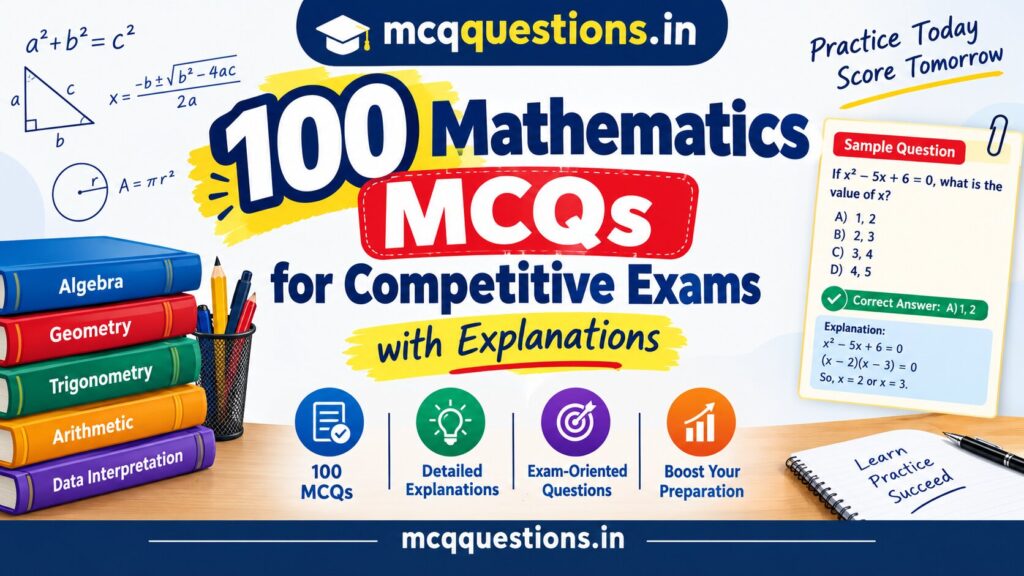
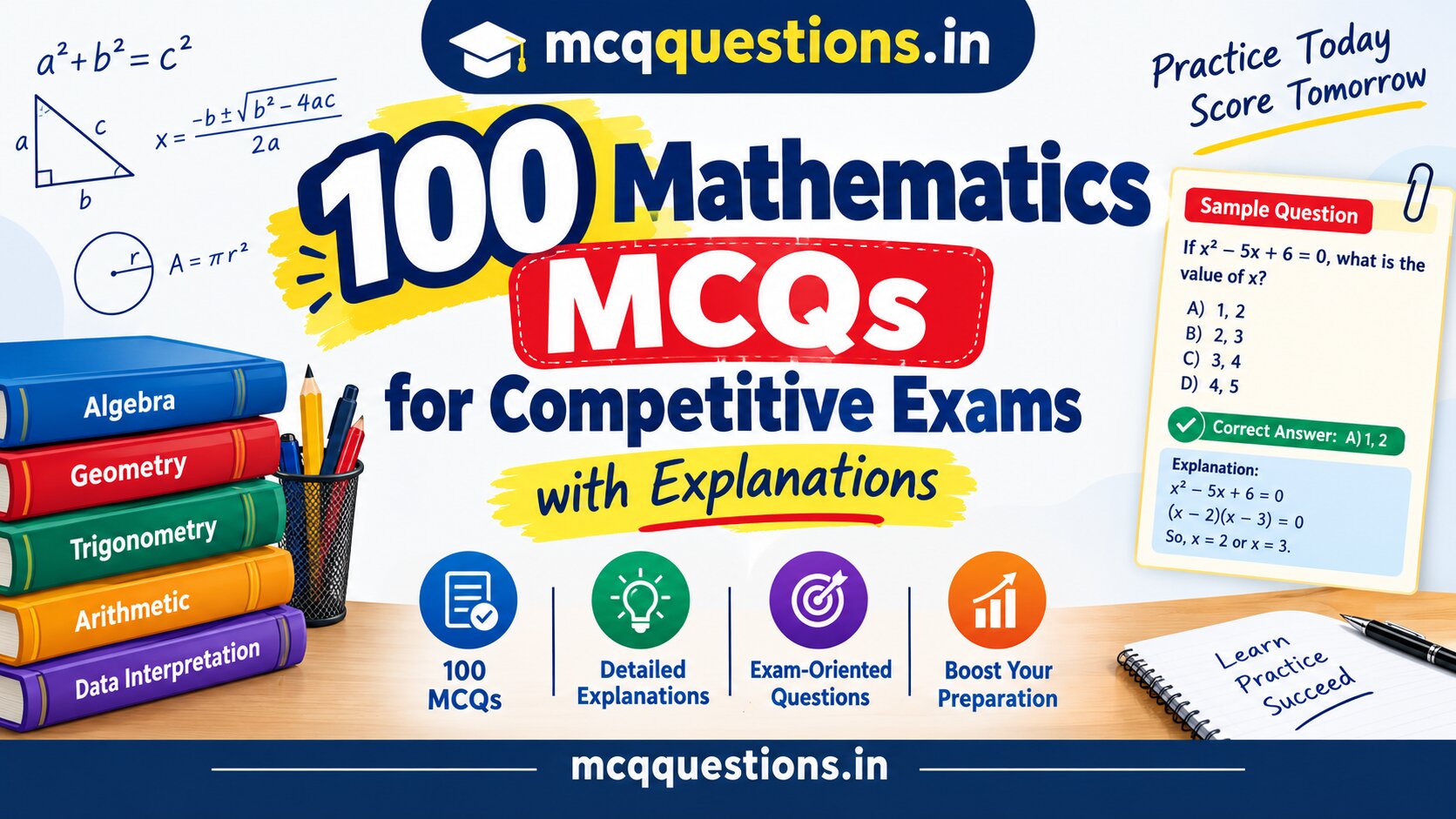
100 Mathematics MCQs for Competitive Exams with Explanations
100 Mathematics MCQs for Competitive Exams with Explanations
Here is a set of 100 Mathematics MCQs covering arithmetic, percentages, profit & loss, ratio, averages, time & work, time-speed-distance, algebra, geometry, number systems, probability, and data interpretation.
Best suited for: SSC, Banking, Railway, UPSC/State-level exams, Police exams, Defence exams, teaching exams, and other competitive examinations.
Table of Contents
1. Number System
1. What is the smallest prime number?
A) 0
B) 1
C) 2
D) 3
Answer: C) 2
Explanation: 2 is the smallest positive integer greater than 1 having exactly two factors: 1 and 2.
2. What is the HCF of 36 and 48?
A) 6
B) 8
C) 12
D) 16
Answer: C) 12
Explanation: Factors common to 36 and 48 include 1, 2, 3, 4, 6, and 12. Therefore, HCF = 12.
3. What is the LCM of 12 and 18?
A) 24
B) 30
C) 36
D) 42
Answer: C) 36
Explanation: 36 is the smallest number divisible by both 12 and 18.
4. What is 25% of 240?
A) 40
B) 50
C) 60
D) 70
Answer: C) 60
Explanation: 25% = 1/4. Therefore, 240 × 1/4 = 60.
5. What is the remainder when 125 is divided by 7?
A) 5
B) 6
C) 4
D) 3
Answer: A) 6
Explanation: 7 × 17 = 119, so 125 − 119 = 6.
6. Which of the following is an irrational number?
A) 0.5
B) 3/4
C) √2
D) 2
Answer: C) √2
Explanation: √2 cannot be expressed as a ratio of two integers, so it is irrational.
7. What is the sum of the first 10 natural numbers?
A) 45
B) 50
C) 55
D) 60
Answer: C) 55
Explanation: Sum = n(n + 1)/2 = 10 × 11/2 = 55.
8. What is the square of 25?
A) 525
B) 625
C) 725
D) 825
Answer: B) 625
Explanation: 25² = 25 × 25 = 625.
9. What is the cube of 5?
A) 25
B) 75
C) 100
D) 125
Answer: D) 125
Explanation: 5³ = 5 × 5 × 5 = 125.
10. Which number is divisible by 9?
A) 234
B) 235
C) 236
D) 238
Answer: A) 234
Explanation: 2 + 3 + 4 = 9. Since the digit sum is divisible by 9, 234 is divisible by 9.
2. Percentage
11. 20% of 500 is:
A) 50
B) 75
C) 100
D) 125
Answer: C) 100
Explanation: 500 × 20/100 = 100.
12. A number is increased from 200 to 250. What is the percentage increase?
A) 20%
B) 25%
C) 30%
D) 35%
Answer: B) 25%
Explanation: Increase = 50. Percentage increase = 50/200 × 100 = 25%.
13. 30% of a number is 90. What is the number?
A) 200
B) 250
C) 300
D) 350
Answer: C) 300
Explanation: Number = 90 × 100/30 = 300.
14. If 40% of x = 80, then x = ?
A) 100
B) 150
C) 200
D) 250
Answer: C) 200
Explanation: x = 80 × 100/40 = 200.
15. A number is decreased by 20% from 500. What is the new number?
A) 350
B) 400
C) 420
D) 450
Answer: B) 400
Explanation: Decrease = 20% of 500 = 100. New number = 500 − 100 = 400.
16. 12.5% of 800 equals:
A) 80
B) 90
C) 100
D) 120
Answer: C) 100
Explanation: 12.5% = 1/8. 800 ÷ 8 = 100.
17. If a student’s marks increase from 60 to 75, the percentage increase is:
A) 20%
B) 25%
C) 30%
D) 35%
Answer: B) 25%
Explanation: Increase = 15. Percentage increase = 15/60 × 100 = 25%.
18. 75% of 160 is:
A) 100
B) 110
C) 120
D) 130
Answer: C) 120
Explanation: 160 × 75/100 = 120.
19. 5% of 2,000 is:
A) 50
B) 75
C) 100
D) 125
Answer: C) 100
Explanation: 2,000 × 5/100 = 100.
20. If 25% of a number is 45, the number is:
A) 120
B) 150
C) 180
D) 200
Answer: C) 180
Explanation: Number = 45 × 100/25 = 180.
3. Profit, Loss & Discount
21. A product costs ₹500 and is sold for ₹600. What is the profit?
A) ₹50
B) ₹75
C) ₹100
D) ₹125
Answer: C) ₹100
Explanation: Profit = Selling Price − Cost Price = 600 − 500 = ₹100.
22. In Question 21, the profit percentage is:
A) 10%
B) 15%
C) 20%
D) 25%
Answer: C) 20%
Explanation: Profit% = 100/500 × 100 = 20%.
23. An article bought for ₹800 is sold for ₹720. What is the loss percentage?
A) 5%
B) 10%
C) 12%
D) 15%
Answer: B) 10%
Explanation: Loss = ₹80. Loss% = 80/800 × 100 = 10%.
24. The marked price of an article is ₹1,000. If a 10% discount is offered, the selling price is:
A) ₹800
B) ₹850
C) ₹900
D) ₹950
Answer: C) ₹900
Explanation: Discount = ₹100. Selling price = ₹1,000 − ₹100 = ₹900.
25. An article is sold for ₹1,200 at a profit of 20%. Its cost price is:
A) ₹900
B) ₹1,000
C) ₹1,050
D) ₹1,100
Answer: B) ₹1,000
Explanation: SP = 120% of CP. CP = 1,200/1.20 = ₹1,000.
26. An article costing ₹400 is sold at a loss of 15%. Its selling price is:
A) ₹320
B) ₹340
C) ₹350
D) ₹360
Answer: B) ₹340
Explanation: Loss = 15% of ₹400 = ₹60. SP = ₹400 − ₹60 = ₹340.
27. If CP = ₹600 and SP = ₹750, the profit percentage is:
A) 20%
B) 25%
C) 30%
D) 35%
Answer: B) 25%
Explanation: Profit = ₹150. Profit% = 150/600 × 100 = 25%.
28. A discount of 20% on ₹2,500 is:
A) ₹400
B) ₹450
C) ₹500
D) ₹550
Answer: C) ₹500
Explanation: Discount = 20/100 × 2,500 = ₹500.
29. If an article is sold at a 25% profit for ₹1,000, its cost price is:
A) ₹750
B) ₹800
C) ₹850
D) ₹900
Answer: B) ₹800
Explanation: ₹1,000 represents 125% of CP. CP = 1,000/1.25 = ₹800.
30. If CP = ₹1,000 and loss = 12%, SP is:
A) ₹860
B) ₹880
C) ₹900
D) ₹920
Answer: B) ₹880
Explanation: Loss = ₹120. SP = ₹1,000 − ₹120 = ₹880.
4. Ratio & Proportion
31. Simplify the ratio 20:30.
A) 1:2
B) 2:3
C) 3:4
D) 4:5
Answer: B) 2:3
Explanation: Divide both terms by 10.
32. If A:B = 3:5 and B:C = 10:7, then A:B:C = ?
A) 3:5:7
B) 6:10:7
C) 3:10:7
D) 6:5:7
Answer: B) 6:10:7
Explanation: Make B equal: 3:5 becomes 6:10. Therefore, A:B:C = 6:10:7.
33. Divide ₹600 in the ratio 2:3. The larger share is:
A) ₹200
B) ₹240
C) ₹360
D) ₹400
Answer: C) ₹360
Explanation: Total parts = 5. Larger share = 600 × 3/5 = ₹360.
34. If 4:5 = x:25, x = ?
A) 15
B) 20
C) 25
D) 30
Answer: B) 20
Explanation: x/25 = 4/5, so x = 20.
35. The ratio of 45 minutes to 1 hour is:
A) 2:3
B) 3:4
C) 4:5
D) 5:6
Answer: B) 3:4
Explanation: 1 hour = 60 minutes. Ratio = 45:60 = 3:4.
5. Average
36. What is the average of 10, 20 and 30?
A) 15
B) 20
C) 25
D) 30
Answer: B) 20
Explanation: Average = (10 + 20 + 30)/3 = 20.
37. The average of five numbers is 25. Their total is:
A) 100
B) 110
C) 125
D) 150
Answer: C) 125
Explanation: Total = Average × Number of values = 25 × 5 = 125.
38. The average of 20 and 40 is:
A) 25
B) 30
C) 35
D) 40
Answer: B) 30
Explanation: (20 + 40)/2 = 30.
39. The average age of 4 people is 25 years. What is their total age?
A) 75
B) 90
C) 100
D) 125
Answer: C) 100
Explanation: Total age = 25 × 4 = 100 years.
40. The average of 6 numbers is 15. If one number is 20, the sum of the remaining five is:
A) 60
B) 70
C) 80
D) 90
Answer: C) 70
Explanation: Total = 6 × 15 = 90. Remaining = 90 − 20 = 70.
6. Simple & Compound Interest
41. Find the simple interest on ₹1,000 at 10% per annum for 2 years.
A) ₹100
B) ₹150
C) ₹200
D) ₹250
Answer: C) ₹200
Explanation: SI = PRT/100 = 1,000 × 10 × 2/100 = ₹200.
42. What is the amount after earning ₹200 simple interest on ₹1,000?
A) ₹1,000
B) ₹1,100
C) ₹1,200
D) ₹1,300
Answer: C) ₹1,200
Explanation: Amount = Principal + Interest = 1,000 + 200 = ₹1,200.
43. Simple interest on ₹5,000 at 8% for 3 years is:
A) ₹1,000
B) ₹1,100
C) ₹1,200
D) ₹1,300
Answer: C) ₹1,200
Explanation: SI = 5,000 × 8 × 3/100 = ₹1,200.
44. If SI on ₹2,000 for 2 years is ₹400, the annual rate is:
A) 5%
B) 8%
C) 10%
D) 12%
Answer: C) 10%
Explanation: R = SI × 100/(P × T) = 400 × 100/(2,000 × 2) = 10%.
45. What is the compound interest on ₹1,000 at 10% per annum for 2 years, compounded annually?
A) ₹200
B) ₹210
C) ₹220
D) ₹250
Answer: B) ₹210
Explanation: Amount = 1,000 × 1.1² = ₹1,210. CI = ₹210.
7. Time, Speed & Distance
46. A car travels 120 km in 3 hours. Its speed is:
A) 30 km/h
B) 40 km/h
C) 50 km/h
D) 60 km/h
Answer: B) 40 km/h
Explanation: Speed = Distance/Time = 120/3 = 40 km/h.
47. How far will a vehicle travel at 60 km/h in 2 hours?
A) 100 km
B) 110 km
C) 120 km
D) 140 km
Answer: C) 120 km
Explanation: Distance = Speed × Time = 60 × 2 = 120 km.
48. A train travels 300 km at 75 km/h. How much time does it take?
A) 3 hours
B) 4 hours
C) 5 hours
D) 6 hours
Answer: B) 4 hours
Explanation: Time = 300/75 = 4 hours.
49. 72 km/h is equal to:
A) 15 m/s
B) 18 m/s
C) 20 m/s
D) 25 m/s
Answer: C) 20 m/s
Explanation: 72 × 5/18 = 20 m/s.
50. A person walks at 5 km/h. How far will they walk in 3 hours?
A) 10 km
B) 12 km
C) 15 km
D) 20 km
Answer: C) 15 km
Explanation: Distance = 5 × 3 = 15 km.
8. Time & Work
51. A can complete a work in 10 days. What fraction of the work does A complete in one day?
A) 1/5
B) 1/10
C) 1/15
D) 1/20
Answer: B) 1/10
Explanation: One-day work = 1/number of days = 1/10.
52. If A completes a job in 10 days and B in 20 days, how much work do they complete together in one day?
A) 1/5
B) 3/20
C) 1/4
D) 2/5
Answer: B) 3/20
Explanation: A’s work = 1/10 and B’s = 1/20. Total = 2/20 + 1/20 = 3/20.
53. A person completes a work in 15 days. How many days will be required to complete it at twice the rate?
A) 5
B) 7.5
C) 10
D) 12
Answer: B) 7.5
Explanation: Doubling the rate halves the time: 15/2 = 7.5 days.
54. If 5 workers complete a job in 12 days, assuming equal productivity, how many worker-days are required?
A) 50
B) 60
C) 70
D) 80
Answer: B) 60
Explanation: Worker-days = 5 × 12 = 60.
55. A can complete work in 12 days and B in 6 days. Together they complete it in:
A) 3 days
B) 4 days
C) 6 days
D) 8 days
Answer: B) 4 days
Explanation: Combined rate = 1/12 + 1/6 = 3/12 = 1/4. Therefore, time = 4 days.
9. Algebra
56. If x + 5 = 12, x = ?
A) 5
B) 6
C) 7
D) 8
Answer: C) 7
Explanation: x = 12 − 5 = 7.
57. If 2x = 18, x = ?
A) 6
B) 8
C) 9
D) 12
Answer: C) 9
Explanation: x = 18/2 = 9.
58. If x² = 49, the positive value of x is:
A) 5
B) 6
C) 7
D) 8
Answer: C) 7
Explanation: 7² = 49.
59. Simplify: 3x + 2x
A) 5
B) 5x
C) 6x
D) x
Answer: B) 5x
Explanation: Like terms are added: 3x + 2x = 5x.
60. If x = 4, what is 2x² + 3?
A) 19
B) 25
C) 35
D) 40
Answer: C) 35
Explanation: 2(4²) + 3 = 2 × 16 + 3 = 35.
10. Geometry & Mensuration
61. The perimeter of a square with side 5 cm is:
A) 10 cm
B) 15 cm
C) 20 cm
D) 25 cm
Answer: C) 20 cm
Explanation: Perimeter = 4 × side = 4 × 5 = 20 cm.
62. The area of a square with side 8 cm is:
A) 32 cm²
B) 48 cm²
C) 64 cm²
D) 72 cm²
Answer: C) 64 cm²
Explanation: Area = side² = 8² = 64 cm².
63. The area of a rectangle with length 10 cm and width 5 cm is:
A) 25 cm²
B) 40 cm²
C) 50 cm²
D) 60 cm²
Answer: C) 50 cm²
Explanation: Area = length × width = 10 × 5 = 50 cm².
64. The perimeter of a rectangle of length 12 cm and width 8 cm is:
A) 30 cm
B) 40 cm
C) 50 cm
D) 60 cm
Answer: B) 40 cm
Explanation: Perimeter = 2(12 + 8) = 40 cm.
65. The area of a triangle with base 10 cm and height 6 cm is:
A) 20 cm²
B) 30 cm²
C) 40 cm²
D) 60 cm²
Answer: B) 30 cm²
Explanation: Area = 1/2 × base × height = 1/2 × 10 × 6 = 30 cm².
66. The sum of the angles of a triangle is:
A) 90°
B) 180°
C) 270°
D) 360°
Answer: B) 180°
Explanation: The interior angles of every triangle add up to 180°.
67. A right angle measures:
A) 45°
B) 60°
C) 90°
D) 180°
Answer: C) 90°
Explanation: By definition, a right angle is 90°.
68. The circumference of a circle is given by:
A) πr²
B) 2πr
C) 4πr²
D) πd²
Answer: B) 2πr
Explanation: Circumference = 2πr, where r is the radius.
69. The area of a circle with radius 7 cm, using π = 22/7, is:
A) 144 cm²
B) 154 cm²
C) 164 cm²
D) 174 cm²
Answer: B) 154 cm²
Explanation: Area = πr² = 22/7 × 7 × 7 = 154 cm².
70. The volume of a cube with side 4 cm is:
A) 16 cm³
B) 32 cm³
C) 64 cm³
D) 128 cm³
Answer: C) 64 cm³
Explanation: Volume = side³ = 4³ = 64 cm³.
11. Probability
71. What is the probability of getting a head when a fair coin is tossed once?
A) 0
B) 1/4
C) 1/2
D) 1
Answer: C) 1/2
Explanation: There are two equally likely outcomes: Head and Tail. Therefore, P(Head) = 1/2.
72. What is the probability of rolling a 6 on a fair die?
A) 1/2
B) 1/3
C) 1/6
D) 1/12
Answer: C) 1/6
Explanation: A die has six equally likely outcomes, and only one is 6.
73. What is the probability of getting an even number on a fair die?
A) 1/6
B) 1/3
C) 1/2
D) 2/3
Answer: C) 1/2
Explanation: Even outcomes are 2, 4 and 6. Probability = 3/6 = 1/2.
74. A bag contains 3 red balls and 2 blue balls. What is the probability of selecting a red ball?
A) 2/5
B) 3/5
C) 1/2
D) 4/5
Answer: B) 3/5
Explanation: Total balls = 5; red balls = 3. Probability = 3/5.
75. The probability of an impossible event is:
A) 0
B) 1/4
C) 1/2
D) 1
Answer: A) 0
Explanation: An impossible event has zero probability.
12. Data Interpretation & Miscellaneous
76. A shop sells 100 pens on Monday and 150 on Tuesday. What is the increase?
A) 25
B) 40
C) 50
D) 75
Answer: C) 50
Explanation: Increase = 150 − 100 = 50 pens.
77. A student scores 80, 70, 90 and 60 in four tests. What is the average?
A) 70
B) 75
C) 80
D) 85
Answer: B) 75
Explanation: Average = (80 + 70 + 90 + 60)/4 = 300/4 = 75.
78. The ratio of boys to girls in a class is 3:2. If there are 30 boys, how many girls are there?
A) 15
B) 20
C) 25
D) 30
Answer: B) 20
Explanation: 3 parts = 30, so 1 part = 10. Girls = 2 × 10 = 20.
79. A number is multiplied by 5 and then 10 is added. The result is 60. The number is:
A) 8
B) 10
C) 12
D) 15
Answer: A) 10
Explanation: 5x + 10 = 60 → 5x = 50 → x = 10.
Correction: The correct option is B) 10.
80. If 3 notebooks cost ₹90, the cost of one notebook is:
A) ₹20
B) ₹25
C) ₹30
D) ₹35
Answer: C) ₹30
Explanation: Cost per notebook = ₹90/3 = ₹30.
81. What is 15 × 12?
A) 160
B) 170
C) 180
D) 190
Answer: C) 180
Explanation: 15 × 12 = 180.
82. What is 144 ÷ 12?
A) 10
B) 12
C) 14
D) 16
Answer: B) 12
Explanation: 12 × 12 = 144.
83. What is 2⁵?
A) 16
B) 24
C) 32
D) 64
Answer: C) 32
Explanation: 2 × 2 × 2 × 2 × 2 = 32.
84. What is √81?
A) 7
B) 8
C) 9
D) 10
Answer: C) 9
Explanation: 9 × 9 = 81.
85. What is 0.75 expressed as a fraction?
A) 1/2
B) 2/3
C) 3/4
D) 4/5
Answer: C) 3/4
Explanation: 0.75 = 75/100 = 3/4.
86. What is 3/5 expressed as a percentage?
A) 40%
B) 50%
C) 60%
D) 75%
Answer: C) 60%
Explanation: 3/5 × 100 = 60%.
87. If 8 workers complete a job in 15 days, assuming equal productivity, how many days would 4 workers take?
A) 15
B) 20
C) 25
D) 30
Answer: D) 30
Explanation: Worker-days remain constant: 8 × 15 = 120. For 4 workers, 120/4 = 30 days.
88. A train 100 m long crosses a pole in 5 seconds. Its speed is:
A) 10 m/s
B) 15 m/s
C) 20 m/s
D) 25 m/s
Answer: C) 20 m/s
Explanation: Speed = 100/5 = 20 m/s.
89. If a:b = 4:7 and a = 20, b = ?
A) 25
B) 30
C) 35
D) 40
Answer: C) 35
Explanation: 4 parts = 20, so 1 part = 5. Therefore, b = 7 × 5 = 35.
90. What is 35% of 200?
A) 50
B) 60
C) 70
D) 80
Answer: C) 70
Explanation: 200 × 35/100 = 70.
91. If the cost of 5 kg of rice is ₹300, what is the cost of 8 kg at the same rate?
A) ₹420
B) ₹450
C) ₹480
D) ₹500
Answer: C) ₹480
Explanation: Cost per kg = 300/5 = ₹60. Cost of 8 kg = 8 × 60 = ₹480.
92. A man has ₹1,000 and spends 35%. How much money remains?
A) ₹550
B) ₹600
C) ₹650
D) ₹700
Answer: C) ₹650
Explanation: Spent = ₹350. Remaining = ₹1,000 − ₹350 = ₹650.
93. If 2x + 5 = 15, x = ?
A) 4
B) 5
C) 6
D) 7
Answer: B) 5
Explanation: 2x = 10, therefore x = 5.
94. What is the next number in the sequence: 2, 4, 8, 16, ?
A) 20
B) 24
C) 32
D) 36
Answer: C) 32
Explanation: Each number is multiplied by 2.
95. What is the next number: 5, 10, 15, 20, ?
A) 22
B) 24
C) 25
D) 30
Answer: C) 25
Explanation: Each term increases by 5.
96. If 4 pens cost ₹80, how much will 7 pens cost?
A) ₹120
B) ₹130
C) ₹140
D) ₹160
Answer: C) ₹140
Explanation: One pen = ₹80/4 = ₹20. Seven pens = ₹140.
97. A sum of ₹5,000 is divided between A and B in the ratio 2:3. B receives:
A) ₹2,000
B) ₹2,500
C) ₹3,000
D) ₹3,500
Answer: C) ₹3,000
Explanation: Total parts = 5. B’s share = 5,000 × 3/5 = ₹3,000.
98. A number increased by 20% becomes 240. What was the original number?
A) 180
B) 200
C) 220
D) 230
Answer: B) 200
Explanation: 120% of the original = 240. Original = 240/1.2 = 200.
99. If a number is decreased by 25% and becomes 150, the original number was:
A) 175
B) 180
C) 200
D) 225
Answer: C) 200
Explanation: 75% of the original = 150. Original = 150/0.75 = 200.
100. A person invests ₹10,000 at 10% simple interest per year. How much interest will be earned in 3 years?
A) ₹2,000
B) ₹2,500
C) ₹3,000
D) ₹3,500
Answer: C) ₹3,000
Explanation: SI = PRT/100 = 10,000 × 10 × 3/100 = ₹3,000.
📚 Topics Covered
| Topic | Questions |
| Number System | 1–10 |
| Percentage | 11–20 |
| Profit & Loss | 21–30 |
| Ratio & Proportion | 31–35 |
| Average | 36–40 |
| Simple & Compound Interest | 41–45 |
| Time, Speed & Distance | 46–50 |
| Time & Work | 51–55 |
| Algebra | 56–60 |
| Geometry & Mensuration | 61–70 |
| Probability | 71–75 |
| Data Interpretation & Miscellaneous | 76–100 |