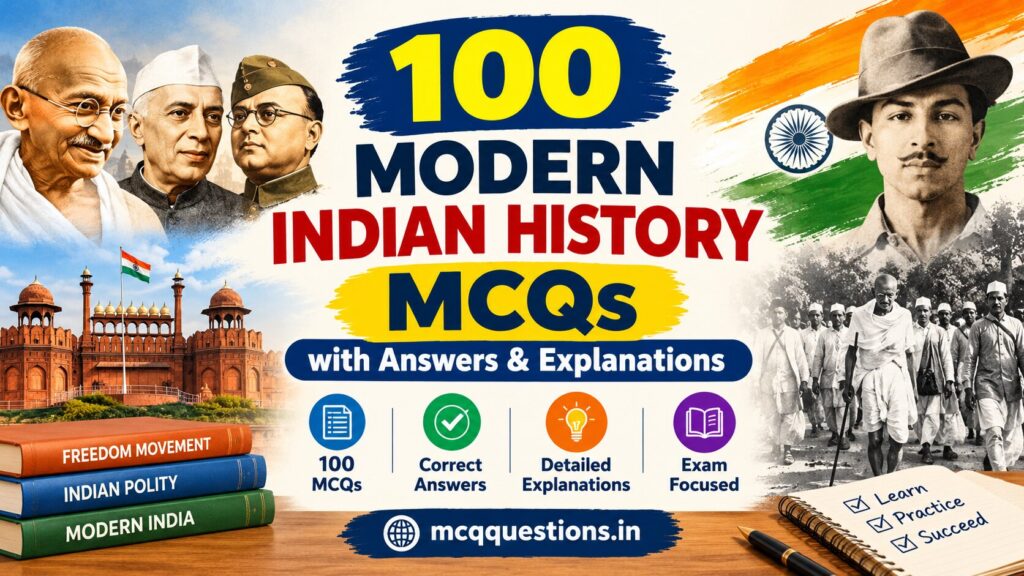
100 Modern Indian History MCQs with Answers & Explanations
Table of Contents
100 Modern Indian History MCQs with Answers and Explanations
For UPSC, SSC, Railway, Banking, State PSC, Defence and other competitive examinations
Modern Indian history covers the arrival of European powers, British expansion, important acts and reforms, the Revolt of 1857, the Indian National Congress, the freedom struggle, revolutionary movements, Gandhian movements, and India’s independence.
These 100 multiple-choice questions include four options, the correct answer, and a concise explanation to help you revise important historical facts.
Section 1: European Arrival and British Expansion
1. Who was the first European to reach India by sea around the Cape of Good Hope?
A) Christopher Columbus B) Vasco da Gama C) Ferdinand Magellan D) Marco Polo
Correct Answer: B) Vasco da Gama
Explanation: Vasco da Gama, a Portuguese explorer, reached Calicut on the Malabar Coast in 1498, opening a direct sea route between Europe and India.
2. In which year was the English East India Company established?
A) 1498 B) 1556 C) 1600 D) 1664
Correct Answer: C) 1600
Explanation: The English East India Company was established on 31 December 1600 under a royal charter granted by Queen Elizabeth I.
3. The Battle of Plassey was fought in which year?
A) 1757 B) 1764 C) 1773 D) 1784
Correct Answer: A) 1757
Explanation: The Battle of Plassey was fought on 23 June 1757 between the forces of Siraj ud-Daulah and the East India Company led by Robert Clive. The victory strengthened British political power in Bengal.
4. Who was the Nawab of Bengal during the Battle of Plassey?
A) Mir Qasim B) Alivardi Khan C) Siraj ud-Daulah D) Mir Jafar
Correct Answer: C) Siraj ud-Daulah
Explanation: Siraj ud-Daulah was the last independent Nawab of Bengal before the establishment of British political dominance in the region.
5. The Battle of Buxar was fought in which year?
A) 1757 B) 1761 C) 1764 D) 1772
Correct Answer: C) 1764
Explanation: The Battle of Buxar was fought on 22 October 1764. The Company defeated the combined forces of Mir Qasim, Shuja-ud-Daulah, and Mughal emperor Shah Alam II.
6. Who introduced the Permanent Settlement in Bengal in 1793?
A) Lord Wellesley B) Lord Cornwallis C) Lord Dalhousie D) Warren Hastings
Correct Answer: B) Lord Cornwallis
Explanation: Lord Cornwallis introduced the Permanent Settlement in 1793. It fixed the land revenue payable by zamindars to the British government in Bengal and certain adjoining areas.
7. Who introduced the Subsidiary Alliance system?
A) Lord Wellesley B) Lord Curzon C) Lord Ripon D) Lord Canning
Correct Answer: A) Lord Wellesley
Explanation: Lord Wellesley used the Subsidiary Alliance to expand British influence over Indian princely states. Rulers accepting it generally had to maintain British troops and surrender significant control over their foreign affairs.
8. Who is associated with the introduction of the Doctrine of Lapse?
A) Lord William Bentinck B) Lord Dalhousie C) Lord Hastings D) Lord Minto
Correct Answer: B) Lord Dalhousie
Explanation: Lord Dalhousie extensively applied the Doctrine of Lapse during the 1840s and 1850s. Under this policy, the British annexed certain states when their rulers died without a recognised natural male heir.
9. Which Indian state was annexed by the British on the grounds of alleged misgovernment in 1856?
A) Jhansi B) Satara C) Awadh D) Nagpur
Correct Answer: C) Awadh
Explanation: The British annexed Awadh in 1856, citing alleged misgovernment under Nawab Wajid Ali Shah. The annexation created widespread resentment among the ruling elite, soldiers, and landholders.
10. Who was the first Governor-General of Bengal under the Regulating Act of 1773?
A) Robert Clive B) Warren Hastings C) Lord Cornwallis D) Lord Wellesley
Correct Answer: B) Warren Hastings
Explanation: Warren Hastings became the first Governor-General of Bengal in 1773 under the Regulating Act, which marked an important step in British parliamentary oversight of the East India Company.
Section 2: British Administration and Constitutional Developments
11. Which Act first established parliamentary control over the East India Company’s affairs in India?
A) Pitt’s India Act, 1784 B) Regulating Act, 1773 C) Charter Act, 1813 D) Government of India Act, 1858
Correct Answer: B) Regulating Act, 1773
Explanation: The Regulating Act of 1773 was the first major British parliamentary measure to regulate the Company’s administration in India.
12. Which Act transferred the government of India from the East India Company to the British Crown?
A) Charter Act, 1833 B) Indian Councils Act, 1861 C) Government of India Act, 1858 D) Indian Councils Act, 1892
Correct Answer: C) Government of India Act, 1858
Explanation: Following the Revolt of 1857, the Government of India Act, 1858 ended Company rule and transferred administration to the British Crown.
13. Who became the first Viceroy of India?
A) Lord Dalhousie B) Lord Canning C) Lord Ripon D) Lord Curzon
Correct Answer: B) Lord Canning
Explanation: Lord Canning became the first Viceroy after the transfer of power to the Crown in 1858. He had also served as Governor-General during the Revolt of 1857.
14. Which Act designated the Governor-General of Bengal as the Governor-General of India?
A) Charter Act, 1833 B) Charter Act, 1813 C) Indian Councils Act, 1909 D) Government of India Act, 1935
Correct Answer: A) Charter Act, 1833
Explanation: The Charter Act of 1833 centralised legislative authority and designated the Governor-General of Bengal as the Governor-General of India. Lord William Bentinck became the first to hold this title.
15. Which Act introduced separate electorates for Muslims in British India?
A) Indian Councils Act, 1892 B) Indian Councils Act, 1909 C) Government of India Act, 1919 D) Government of India Act, 1935
Correct Answer: B) Indian Councils Act, 1909
Explanation: Also known as the Morley–Minto Reforms, the Indian Councils Act of 1909 introduced separate electorates for Muslims.
16. The Montagu–Chelmsford Reforms were implemented through which Act?
A) Indian Councils Act, 1909 B) Government of India Act, 1919 C) Government of India Act, 1935 D) Indian Independence Act, 1947
Correct Answer: B) Government of India Act, 1919
Explanation: The Government of India Act, 1919 introduced dyarchy in the provinces, dividing certain provincial subjects between elected Indian ministers and executive councillors.
17. Which Act provided for provincial autonomy in British India?
A) Charter Act, 1853 B) Government of India Act, 1858 C) Government of India Act, 1919 D) Government of India Act, 1935
Correct Answer: D) Government of India Act, 1935
Explanation: The Government of India Act, 1935 introduced provincial autonomy and proposed an all-India federation, although the proposed federation never came into operation.
18. Who was the first Indian to become a member of the British House of Commons?
A) Dadabhai Naoroji B) Gopal Krishna Gokhale C) Surendranath Banerjee D) Bal Gangadhar Tilak
Correct Answer: A) Dadabhai Naoroji
Explanation: Dadabhai Naoroji was elected as a Liberal MP for Finsbury Central in 1892. He used his position to raise issues concerning British rule in India.
19. Who founded the Indian National Congress in 1885 with the help of Indian leaders?
A) Lord Ripon B) A. O. Hume C) W. C. Bonnerjee D) Allan Octavian Fraser
Correct Answer: B) A. O. Hume
Explanation: A. O. Hume, a retired British civil servant, played a key role in founding the Indian National Congress. W. C. Bonnerjee presided over its first session.
20. Where was the first session of the Indian National Congress held?
A) Calcutta B) Madras C) Bombay D) Allahabad
Correct Answer: C) Bombay
Explanation: The first session of the Indian National Congress took place in Bombay in December 1885, with W. C. Bonnerjee as its president.
Section 3: Social and Religious Reform Movements
21. Who founded the Brahmo Sabha in 1828, later known as the Brahmo Samaj?
A) Swami Vivekananda B) Raja Ram Mohan Roy C) Swami Dayanand Saraswati D) Ishwar Chandra Vidyasagar
Correct Answer: B) Raja Ram Mohan Roy
Explanation: Raja Ram Mohan Roy founded the Brahmo Sabha in 1828. The movement promoted religious reform, rational thinking, and opposition to social practices such as sati.
22. Who played a leading role in the abolition of sati in 1829?
A) Lord Curzon B) Lord William Bentinck C) Lord Dalhousie D) Lord Ripon
Correct Answer: B) Lord William Bentinck
Explanation: Governor-General Lord William Bentinck prohibited sati in the Bengal Presidency in 1829, supported by reformers including Raja Ram Mohan Roy.
23. Who was the leading campaigner for the Hindu Widows’ Remarriage Act of 1856?
A) Ishwar Chandra Vidyasagar B) Bankim Chandra Chattopadhyay C) Keshab Chandra Sen D) Jyotirao Phule
Correct Answer: A) Ishwar Chandra Vidyasagar
Explanation: Ishwar Chandra Vidyasagar campaigned for widow remarriage and helped build support for the Hindu Widows’ Remarriage Act, passed in 1856.
24. Who founded the Arya Samaj in 1875?
A) Ramakrishna Paramahamsa B) Swami Dayanand Saraswati C) Swami Vivekananda D) Annie Besant
Correct Answer: B) Swami Dayanand Saraswati
Explanation: Swami Dayanand Saraswati founded the Arya Samaj in Bombay in 1875. The organisation advocated a return to the authority of the Vedas and opposed several prevailing social and religious practices.
25. Who founded the Ramakrishna Mission in 1897?
A) Raja Ram Mohan Roy B) Swami Vivekananda C) Sri Aurobindo D) Rabindranath Tagore
Correct Answer: B) Swami Vivekananda
Explanation: Swami Vivekananda established the Ramakrishna Mission in 1897 to promote spiritual education, social service, and practical expressions of Vedanta.
26. Who founded the Satyashodhak Samaj in 1873?
A) Jyotirao Phule B) B. R. Ambedkar C) Gopal Hari Deshmukh D) M. G. Ranade
Correct Answer: A) Jyotirao Phule
Explanation: Jyotirao Phule founded the Satyashodhak Samaj to challenge caste discrimination, social inequality, and the domination of privileged social groups.
27. Who was the founder of the Aligarh Movement?
A) Maulana Abul Kalam Azad B) Sir Syed Ahmad Khan C) Muhammad Ali Jinnah D) Hakim Ajmal Khan
Correct Answer: B) Sir Syed Ahmad Khan
Explanation: Sir Syed Ahmad Khan promoted modern scientific education among Indian Muslims. His educational efforts led to the establishment of the Muhammadan Anglo-Oriental College in 1875, which later became Aligarh Muslim University.
28. Who founded the Theosophical Society in India’s historical reform context as its prominent Indian-based leader?
A) Annie Besant B) Sarojini Naidu C) Madam Bhikaji Cama D) Sister Nivedita
Correct Answer: A) Annie Besant
Explanation: The Theosophical Society was founded in New York in 1875 by Helena P. Blavatsky, Henry S. Olcott, and others. Annie Besant later became one of its most influential leaders in India and promoted education and Indian self-government.
29. Who founded the Prarthana Samaj in Bombay in 1867?
A) Atmaram Pandurang B) Swami Dayanand Saraswati C) Keshab Chandra Sen D) Jyotirao Phule
Correct Answer: A) Atmaram Pandurang
Explanation: Atmaram Pandurang founded the Prarthana Samaj in Bombay in 1867. It advocated religious reform, widow remarriage, and improvements in women’s education.
30. Who established the Servants of India Society in 1905?
A) Bal Gangadhar Tilak B) Gopal Krishna Gokhale C) Lala Lajpat Rai D) Dadabhai Naoroji
Correct Answer: B) Gopal Krishna Gokhale
Explanation: Gopal Krishna Gokhale established the Servants of India Society in 1905 to train people for public service and social reform.
Section 4: The Revolt of 1857
31. What was the immediate military trigger of the Revolt of 1857?
A) Introduction of English education B) Heavy land revenue C) Controversy over greased rifle cartridges D) Abolition of princely states
Correct Answer: C) Controversy over greased rifle cartridges
Explanation: The new Enfield rifle cartridges were believed to be greased with cow and pig fat, offending both Hindu and Muslim soldiers. This became the immediate trigger for the uprising.
32. Who was the Mughal emperor during the Revolt of 1857?
A) Akbar II B) Bahadur Shah Zafar C) Shah Alam II D) Farrukhsiyar
Correct Answer: B) Bahadur Shah Zafar
Explanation: Bahadur Shah Zafar, the last Mughal emperor, was declared the symbolic leader of the rebellion. After its suppression, the British exiled him to Rangoon.
33. Who led the uprising in Kanpur during the Revolt of 1857?
A) Nana Sahib B) Kunwar Singh C) Begum Hazrat Mahal D) Khan Bahadur Khan
Correct Answer: A) Nana Sahib
Explanation: Nana Sahib emerged as a major leader of the rebellion in Kanpur, with Tantia Tope serving as one of his important military associates.
34. Who led the Revolt of 1857 in Jhansi?
A) Begum Hazrat Mahal B) Rani Lakshmibai C) Rani Durgavati D) Rani Chennamma
Correct Answer: B) Rani Lakshmibai
Explanation: Rani Lakshmibai became one of the most celebrated leaders of the uprising. She fought British forces and died in battle near Gwalior in June 1858.
35. Who led the rebellion in Awadh, particularly Lucknow?
A) Begum Hazrat Mahal B) Rani Lakshmibai C) Annie Besant D) Sarojini Naidu
Correct Answer: A) Begum Hazrat Mahal
Explanation: Begum Hazrat Mahal led resistance against British authority in Awadh on behalf of her son, Birjis Qadr.
36. Who was the prominent leader of the Revolt of 1857 in Bihar?
A) Kunwar Singh B) Mangal Pandey C) Nana Sahib D) Tatya Tope
Correct Answer: A) Kunwar Singh
Explanation: Kunwar Singh, a zamindar from Jagdishpur, led the uprising in Bihar despite being in his late seventies.
37. Mangal Pandey was associated with which military station?
A) Meerut B) Barrackpore C) Kanpur D) Lucknow
Correct Answer: B) Barrackpore
Explanation: Mangal Pandey was a sepoy of the 34th Bengal Native Infantry at Barrackpore. He attacked British officers in March 1857 and was executed in April.
38. On which date did the major uprising begin at Meerut?
A) 29 March 1857 B) 10 May 1857 C) 15 August 1857 D) 1 November 1858
Correct Answer: B) 10 May 1857
Explanation: The major uprising at Meerut began on 10 May 1857. Rebel soldiers subsequently marched to Delhi and declared Bahadur Shah Zafar their leader.
39. Which British official was Governor-General during the Revolt of 1857?
A) Lord Canning B) Lord Dalhousie C) Lord Ripon D) Lord Curzon
Correct Answer: A) Lord Canning
Explanation: Lord Canning was Governor-General during the rebellion and became the first Viceroy of India after the Crown assumed direct rule in 1858.
40. Which proclamation announced Queen Victoria’s new policy towards India in 1858?
A) Ilbert Bill B) Queen Victoria’s Proclamation C) August Offer D) Cripps Proposal
Correct Answer: B) Queen Victoria’s Proclamation
Explanation: Issued on 1 November 1858, the proclamation announced Crown rule, promised non-interference in religious matters, and stated that Indian princes’ rights would be respected subject to British supremacy.
Section 5: Rise of Indian Nationalism and Early Congress
41. Who was the first president of the Indian National Congress?
A) Dadabhai Naoroji B) W. C. Bonnerjee C) A. O. Hume D) Surendranath Banerjee
Correct Answer: B) W. C. Bonnerjee
Explanation: Womesh Chunder Bonnerjee presided over the first Congress session held in Bombay in December 1885.
42. Who is popularly known as the Grand Old Man of India?
A) Gopal Krishna Gokhale B) Dadabhai Naoroji C) Mahatma Gandhi D) Lala Lajpat Rai
Correct Answer: B) Dadabhai Naoroji
Explanation: Dadabhai Naoroji earned this title through his long career in public life and his efforts to expose the economic effects of British rule.
43. Who formulated the Drain of Wealth theory?
A) Dadabhai Naoroji B) Lord Curzon C) Motilal Nehru D) Bhagat Singh
Correct Answer: A) Dadabhai Naoroji
Explanation: Dadabhai Naoroji argued that wealth was continuously transferred from India to Britain through payments, salaries, profits, and other mechanisms, contributing to India’s poverty.
44. Who were popularly known as Lal-Bal-Pal?
A) Lala Lajpat Rai, Bal Gangadhar Tilak, Bipin Chandra Pal B) Lala Hardayal, Baldev Singh, Patel C) Lal Bahadur Shastri, Bal Gangadhar Tilak, Patel D) Lala Lajpat Rai, Bhagat Singh, Bipin Chandra Pal
Correct Answer: A) Lala Lajpat Rai, Bal Gangadhar Tilak, Bipin Chandra Pal
Explanation: These three leaders represented assertive nationalism and advocated methods such as Swadeshi, boycott, and national education.
45. Who popularised the slogan “Swaraj is my birthright and I shall have it”?
A) Mahatma Gandhi B) Bal Gangadhar Tilak C) Jawaharlal Nehru D) Subhas Chandra Bose
Correct Answer: B) Bal Gangadhar Tilak
Explanation: Bal Gangadhar Tilak popularised this slogan to express the demand for self-government and helped mobilise nationalist sentiment.
46. In which year was Bengal partitioned by Lord Curzon?
A) 1903 B) 1905 C) 1907 D) 1911
Correct Answer: B) 1905
Explanation: The partition of Bengal took effect on 16 October 1905. It triggered widespread opposition and strengthened the Swadeshi and boycott movements.
47. In which year was the All-India Muslim League founded?
A) 1885 B) 1905 C) 1906 D) 1916
Correct Answer: C) 1906
Explanation: The All-India Muslim League was founded in Dhaka in December 1906 to represent Muslim political interests in British India.
48. The Surat Split in the Indian National Congress took place in which year?
A) 1905 B) 1906 C) 1907 D) 1909
Correct Answer: C) 1907
Explanation: The Congress split at Surat in 1907 amid disagreements between the Moderates and Extremists over leadership, political methods, and the pace of the nationalist movement.
49. Who was the first woman president of the Indian National Congress?
A) Sarojini Naidu B) Annie Besant C) Vijayalakshmi Pandit D) Sucheta Kripalani
Correct Answer: B) Annie Besant
Explanation: Annie Besant became the first woman president of the Indian National Congress in 1917. Sarojini Naidu became the first Indian woman to preside over the Congress in 1925.
50. Who presided over the 1929 Lahore session of the Indian National Congress?
A) Mahatma Gandhi B) Jawaharlal Nehru C) Subhas Chandra Bose D) Vallabhbhai Patel
Correct Answer: B) Jawaharlal Nehru
Explanation: Jawaharlal Nehru presided over the Lahore session of 1929, where the Congress adopted Purna Swaraj, or complete independence, as its goal.
Section 6: Gandhian Era and Mass Movements
51. In which year did Mahatma Gandhi return to India from South Africa?
A) 1905 B) 1911 C) 1915 D) 1919
Correct Answer: C) 1915
Explanation: Gandhi returned to India in January 1915 after developing his methods of satyagraha in South Africa.
52. Which was Gandhi’s first major satyagraha in India?
A) Kheda Satyagraha B) Champaran Satyagraha C) Bardoli Satyagraha D) Salt Satyagraha
Correct Answer: B) Champaran Satyagraha
Explanation: The Champaran Satyagraha of 1917 supported indigo cultivators who faced exploitative plantation arrangements in Bihar. It marked Gandhi’s first major satyagraha in India.
53. The Kheda Satyagraha of 1918 took place in which present-day state?
A) Maharashtra B) Gujarat C) Bihar D) Uttar Pradesh
Correct Answer: B) Gujarat
Explanation: Peasants in Kheda, Gujarat, demanded relief from land revenue because crop failure had severely affected their ability to pay taxes. Gandhi and Vallabhbhai Patel supported the movement.
54. The Ahmedabad Mill Strike of 1918 was associated with which group?
A) Plantation workers B) Textile mill workers C) Railway workers D) Indigo cultivators
Correct Answer: B) Textile mill workers
Explanation: Gandhi intervened in a dispute between textile mill workers and mill owners over wages in Ahmedabad. The movement demonstrated his use of non-violent pressure in labour disputes.
55. The Rowlatt Act was passed in which year?
A) 1909 B) 1917 C) 1919 D) 1922
Correct Answer: C) 1919
Explanation: The Rowlatt Act allowed detention without trial under specified circumstances, provoking widespread opposition and a nationwide protest campaign.
56. Where did the Jallianwala Bagh massacre take place?
A) Lahore B) Amritsar C) Delhi D) Kanpur
Correct Answer: B) Amritsar
Explanation: On 13 April 1919, troops under Brigadier-General Reginald Dyer fired on a gathering at Jallianwala Bagh in Amritsar, killing and injuring many people.
57. In which year did the Non-Cooperation Movement begin?
A) 1917 B) 1919 C) 1920 D) 1930
Correct Answer: C) 1920
Explanation: Gandhi launched the Non-Cooperation Movement in 1920, encouraging Indians to withdraw cooperation from British institutions and reject foreign goods.
58. Why did Gandhi withdraw the Non-Cooperation Movement in 1922?
A) The Simon Commission arrived B) The Chauri Chaura incident occurred C) The Gandhi-Irwin Pact was signed D) The Cabinet Mission arrived
Correct Answer: B) The Chauri Chaura incident occurred
Explanation: Protesters set fire to a police station at Chauri Chaura in February 1922, killing policemen. Gandhi suspended the movement because it had turned violent.
59. Who led the Bardoli Satyagraha of 1928?
A) Jawaharlal Nehru B) Vallabhbhai Patel C) Subhas Chandra Bose D) C. R. Das
Correct Answer: B) Vallabhbhai Patel
Explanation: Vallabhbhai Patel led peasants in Bardoli, Gujarat, against increased land revenue assessments. The successful campaign helped popularise the title “Sardar” for Patel.
60. The Dandi March of 1930 was launched to protest against which British policy?
A) The Vernacular Press Act B) The salt tax and salt monopoly C) The Permanent Settlement D) The partition of Bengal
Correct Answer: B) The salt tax and salt monopoly
Explanation: Gandhi began the Dandi March on 12 March 1930 and reached Dandi on 6 April, where he broke the salt law. The action launched a major phase of the Civil Disobedience Movement.
61. The Civil Disobedience Movement began in which year?
A) 1920 B) 1922 C) 1930 D) 1942
Correct Answer: C) 1930
Explanation: The movement began with the salt-law campaign and expanded into boycotts, refusal to pay certain taxes, and other forms of non-violent resistance.
62. Who signed the Gandhi-Irwin Pact with Mahatma Gandhi in 1931?
A) Lord Curzon B) Lord Irwin C) Lord Mountbatten D) Lord Wavell
Correct Answer: B) Lord Irwin
Explanation: The pact was signed in March 1931 between Gandhi and Viceroy Lord Irwin. Gandhi agreed to suspend the Civil Disobedience Movement and attend the Second Round Table Conference.
63. At which Round Table Conference did Gandhi participate as the Congress representative?
A) First B) Second C) Third D) All three
Correct Answer: B) Second
Explanation: Gandhi attended the Second Round Table Conference in London in 1931 as the representative of the Indian National Congress.
64. Who announced the Communal Award in 1932?
A) Winston Churchill B) Ramsay MacDonald C) Clement Attlee D) Lord Irwin
Correct Answer: B) Ramsay MacDonald
Explanation: British Prime Minister Ramsay MacDonald announced the Communal Award in August 1932, providing separate electorates for various communities, including the Depressed Classes.
65. The Poona Pact of 1932 was signed between Mahatma Gandhi and whom?
A) Muhammad Ali Jinnah B) B. R. Ambedkar C) Jawaharlal Nehru D) Subhas Chandra Bose
Correct Answer: B) B. R. Ambedkar
Explanation: The Poona Pact replaced the separate-electorate provision for the Depressed Classes with reserved seats in joint electorates, increasing their reserved representation in provincial legislatures.
66. In which year was the Quit India Movement launched?
A) 1935 B) 1939 C) 1940 D) 1942
Correct Answer: D) 1942
Explanation: The Congress launched the Quit India Movement in August 1942, demanding an end to British rule. Gandhi gave the famous call “Do or Die.”
67. Who gave the slogan “Do or Die” during the Quit India Movement?
A) Jawaharlal Nehru B) Mahatma Gandhi C) Subhas Chandra Bose D) Bhagat Singh
Correct Answer: B) Mahatma Gandhi
Explanation: Gandhi used the phrase during his address to the All India Congress Committee in Bombay on 8 August 1942.
68. Who was the first Indian woman to become president of the Indian National Congress?
A) Annie Besant B) Sarojini Naidu C) Aruna Asaf Ali D) Kamaladevi Chattopadhyay
Correct Answer: B) Sarojini Naidu
Explanation: Sarojini Naidu presided over the 1925 Congress session at Kanpur, becoming the first Indian woman to hold the office.
69. Who hoisted the Indian national flag at Gowalia Tank Maidan during the Quit India Movement?
A) Aruna Asaf Ali B) Sarojini Naidu C) Kasturba Gandhi D) Sucheta Kripalani
Correct Answer: A) Aruna Asaf Ali
Explanation: Aruna Asaf Ali hoisted the Congress flag at Gowalia Tank Maidan in Bombay on 9 August 1942, becoming an important symbol of the Quit India Movement.
70. Who led the parallel government known as Prati Sarkar in Satara during the Quit India period?
A) Nana Patil B) Jayaprakash Narayan C) Ram Manohar Lohia D) Achyut Patwardhan
Correct Answer: A) Nana Patil
Explanation: Nana Patil was a leading figure in the Prati Sarkar movement in Satara, Maharashtra. It challenged British authority and developed local administrative structures.
Section 7: Revolutionary Nationalism
71. Who founded the Hindustan Republican Association in 1924?
A) Ram Prasad Bismil and fellow revolutionaries B) Mahatma Gandhi C) Gopal Krishna Gokhale D) Dadabhai Naoroji
Correct Answer: A) Ram Prasad Bismil and fellow revolutionaries
Explanation: The Hindustan Republican Association was established in 1924 by revolutionaries including Ram Prasad Bismil, Sachindra Nath Sanyal, and Jogesh Chandra Chatterjee. It later became the Hindustan Socialist Republican Association.
72. Who was associated with the Kakori train action of 1925?
A) Ram Prasad Bismil B) Lord Curzon C) Lord Ripon D) W. C. Bonnerjee
Correct Answer: A) Ram Prasad Bismil
Explanation: Ram Prasad Bismil was a leading revolutionary involved in the Kakori train action of 9 August 1925, which targeted government treasury funds carried on a train.
73. Who threw bombs in the Central Legislative Assembly in 1929 along with Batukeshwar Dutt?
A) Chandrashekhar Azad B) Bhagat Singh C) Ram Prasad Bismil D) Ashfaqulla Khan
Correct Answer: B) Bhagat Singh
Explanation: Bhagat Singh and Batukeshwar Dutt threw non-lethal bombs in the Central Legislative Assembly on 8 April 1929 to protest repressive legislation. They remained at the scene and were arrested.
74. Who was the mentor of the revolutionary Bhagat Singh and a prominent HSRA figure?
A) Chandrashekhar Azad B) Dadabhai Naoroji C) C. Rajagopalachari D) Motilal Nehru
Correct Answer: A) Chandrashekhar Azad
Explanation: Chandrashekhar Azad was a prominent revolutionary leader and member of the Hindustan Socialist Republican Association. He helped guide younger revolutionaries, including Bhagat Singh.
75. Bhagat Singh, Rajguru, and Sukhdev were executed in which year?
A) 1928 B) 1929 C) 1931 D) 1935
Correct Answer: C) 1931
Explanation: The three revolutionaries were executed on 23 March 1931 in Lahore Central Jail for their roles in revolutionary activities against British rule.
76. Who founded the Ghadar Party in 1913 with other expatriate Indian revolutionaries?
A) Lala Hardayal B) Lala Lajpat Rai C) Madan Mohan Malaviya D) Bipin Chandra Pal
Correct Answer: A) Lala Hardayal
Explanation: Lala Hardayal was a leading organiser of the Ghadar movement, which emerged among expatriate Indians, especially in North America, and sought to overthrow British rule.
77. Who was the first president of the Indian National Army in its original formation during World War II?
A) Subhas Chandra Bose B) Mohan Singh C) Rash Behari Bose D) Shah Nawaz Khan
Correct Answer: B) Mohan Singh
Explanation: Mohan Singh organised the first Indian National Army in Southeast Asia in 1942 with support from Japan. Subhas Chandra Bose later reorganised and led the INA from 1943.
78. Who founded the Forward Bloc in 1939?
A) Jawaharlal Nehru B) Subhas Chandra Bose C) Vallabhbhai Patel D) C. Rajagopalachari
Correct Answer: B) Subhas Chandra Bose
Explanation: Subhas Chandra Bose established the Forward Bloc in 1939 after resigning as Congress president amid differences with the Congress leadership.
79. Who gave the slogan “Give me blood, and I shall give you freedom”?
A) Mahatma Gandhi B) Subhas Chandra Bose C) Bhagat Singh D) Jawaharlal Nehru
Correct Answer: B) Subhas Chandra Bose
Explanation: Subhas Chandra Bose used this famous appeal to inspire Indians to support the struggle for independence through the Indian National Army.
80. Which song became the famous rallying cry of the Indian National Army?
A) Sare Jahan Se Achha B) Kadam Kadam Badhaye Ja C) Vande Mataram D) Jana Gana Mana
Correct Answer: B) Kadam Kadam Badhaye Ja
Explanation: “Kadam Kadam Badhaye Ja” became a well-known marching song of the Indian National Army and remains associated with Indian military tradition.
Section 8: Important Events Leading to Independence
81. Who was the last Viceroy of British India?
A) Lord Wavell B) Lord Mountbatten C) Lord Linlithgow D) Lord Canning
Correct Answer: B) Lord Mountbatten
Explanation: Lord Mountbatten served as the last Viceroy of British India and oversaw the transfer of power in August 1947.
82. In which year did the Cabinet Mission arrive in India?
A) 1942 B) 1945 C) 1946 D) 1947
Correct Answer: C) 1946
Explanation: The Cabinet Mission arrived in 1946 to discuss the transfer of power and propose a constitutional framework for an independent India.
83. Who announced the August Offer of 1940?
A) Lord Linlithgow B) Lord Mountbatten C) Lord Wavell D) Lord Irwin
Correct Answer: A) Lord Linlithgow
Explanation: Viceroy Lord Linlithgow announced the August Offer in 1940, proposing constitutional concessions and greater Indian participation in government during World War II.
84. Who proposed the Cripps Mission in 1942?
A) Stafford Cripps B) Clement Attlee C) Winston Churchill D) Lord Mountbatten
Correct Answer: A) Stafford Cripps
Explanation: Sir Stafford Cripps came to India in March 1942 with proposals for constitutional changes after World War II. The proposals were rejected by major Indian political groups.
85. Which plan provided the basis for the partition and transfer of power in 1947?
A) Wavell Plan B) Mountbatten Plan C) Cripps Proposal D) August Offer
Correct Answer: B) Mountbatten Plan
Explanation: Announced on 3 June 1947, the Mountbatten Plan accepted the partition of British India and laid out the process for transferring power to India and Pakistan.
86. The Indian Independence Act received royal assent in which year?
A) 1942 B) 1945 C) 1947 D) 1950
Correct Answer: C) 1947
Explanation: The British Parliament passed the Indian Independence Act in July 1947. It created the independent Dominions of India and Pakistan, effective from August 1947.
87. On which date did India become independent?
A) 26 January 1930 B) 15 August 1947 C) 26 January 1950 D) 9 August 1942
Correct Answer: B) 15 August 1947
Explanation: India became an independent Dominion on 15 August 1947. It became a republic on 26 January 1950 when the Constitution came into force.
88. Who was the first Prime Minister of independent India?
A) Sardar Vallabhbhai Patel B) Jawaharlal Nehru C) Rajendra Prasad D) C. Rajagopalachari
Correct Answer: B) Jawaharlal Nehru
Explanation: Jawaharlal Nehru became India’s first Prime Minister in August 1947 and led the government during the country’s early years of independence.
89. Who was the first Indian Governor-General of independent India?
A) Lord Mountbatten B) C. Rajagopalachari C) Dr. Rajendra Prasad D) Jawaharlal Nehru
Correct Answer: B) C. Rajagopalachari
Explanation: C. Rajagopalachari succeeded Lord Mountbatten in June 1948 and became the first and only Indian Governor-General of independent India.
90. Who was the chairman of the Drafting Committee of the Constituent Assembly?
A) Jawaharlal Nehru B) B. R. Ambedkar C) Rajendra Prasad D) Sardar Patel
Correct Answer: B) B. R. Ambedkar
Explanation: Dr. B. R. Ambedkar chaired the Drafting Committee established in August 1947. The Constitution was adopted on 26 November 1949 and came into force on 26 January 1950.
Section 9: Newspapers, Books, Slogans and Organisations
91. Who founded the newspaper Kesari in 1881 with associates?
A) Bal Gangadhar Tilak B) Mahatma Gandhi C) Dadabhai Naoroji D) Surendranath Banerjee
Correct Answer: A) Bal Gangadhar Tilak
Explanation: Bal Gangadhar Tilak helped establish Kesari, a Marathi newspaper, and The Mahratta, an English newspaper. Both supported nationalist political awareness.
92. Who wrote the novel Anandamath?
A) Rabindranath Tagore B) Bankim Chandra Chattopadhyay C) Sarat Chandra Chattopadhyay D) Dinabandhu Mitra
Correct Answer: B) Bankim Chandra Chattopadhyay
Explanation: Bankim Chandra Chattopadhyay wrote Anandamath, published in the 1880s. The novel contains the song “Vande Mataram,” which became an important nationalist anthem.
93. Who wrote Hind Swaraj in 1909?
A) Jawaharlal Nehru B) Mahatma Gandhi C) Subhas Chandra Bose D) Lala Lajpat Rai
Correct Answer: B) Mahatma Gandhi
Explanation: Gandhi wrote Hind Swaraj in 1909. The work presents his views on self-rule, modern civilisation, and the methods of political resistance.
94. Who founded the newspaper Young India as a prominent vehicle for nationalist ideas under Gandhi’s editorship?
A) Mahatma Gandhi B) Annie Besant C) Gopal Krishna Gokhale D) Bhagat Singh
Correct Answer: A) Mahatma Gandhi
Explanation: Gandhi edited Young India, using it to communicate his political philosophy, explain non-violent resistance, and mobilise support for the freedom movement.
95. Who founded the newspaper The Hindu in 1878 with fellow associates?
A) G. Subramania Iyer B) Raja Ram Mohan Roy C) Madan Mohan Malaviya D) Motilal Nehru
Correct Answer: A) G. Subramania Iyer
Explanation: G. Subramania Iyer was a key founder of The Hindu, which began as a newspaper in Madras in 1878 and developed into an influential publication.
96. Who wrote The Discovery of India?
A) Mahatma Gandhi B) Jawaharlal Nehru C) Rabindranath Tagore D) Sardar Vallabhbhai Patel
Correct Answer: B) Jawaharlal Nehru
Explanation: Jawaharlal Nehru wrote The Discovery of India while imprisoned at Ahmednagar Fort during 1944. The book explores India’s history, culture, and civilisational development.
97. Who founded the Banaras Hindu University with the support of other educationists and national leaders?
A) Madan Mohan Malaviya B) Ishwar Chandra Vidyasagar C) Syed Ahmad Khan D) Gopal Krishna Gokhale
Correct Answer: A) Madan Mohan Malaviya
Explanation: Madan Mohan Malaviya was a principal founder of Banaras Hindu University, which was established in 1916 to promote higher education in India.
98. Who founded the newspaper Al-Hilal in 1912?
A) Maulana Abul Kalam Azad B) Muhammad Ali Jinnah C) Sir Syed Ahmad Khan D) Liaquat Ali Khan
Correct Answer: A) Maulana Abul Kalam Azad
Explanation: Maulana Abul Kalam Azad founded Al-Hilal, an Urdu newspaper that promoted anti-colonial nationalism. The British authorities later restricted its publication.
99. Who composed the song Vande Mataram?
A) Rabindranath Tagore B) Bankim Chandra Chattopadhyay C) Muhammad Iqbal D) Sarojini Naidu
Correct Answer: B) Bankim Chandra Chattopadhyay
Explanation: Bankim Chandra Chattopadhyay composed “Vande Mataram.” It appeared in Anandamath and became a powerful symbol of Indian nationalism.
100. Who was the first president of independent India’s Constituent Assembly?
A) B. R. Ambedkar B) Jawaharlal Nehru C) Dr. Rajendra Prasad D) Sachchidananda Sinha
Correct Answer: D) Sachchidananda Sinha
Explanation: Sachchidananda Sinha served as the temporary chairman of the Constituent Assembly at its first meeting on 9 December 1946. Dr. Rajendra Prasad was subsequently elected its permanent president.
Quick Revision: Important Years in Modern Indian History
| Year | Important event |
| 1757 | Battle of Plassey |
| 1764 | Battle of Buxar |
| 1773 | Regulating Act |
| 1793 | Permanent Settlement |
| 1829 | Abolition of sati in the Bengal Presidency |
| 1857 | Revolt of 1857 |
| 1858 | Beginning of direct Crown rule |
| 1885 | Foundation of the Indian National Congress |
| 1905 | Partition of Bengal |
| 1906 | Foundation of the Muslim League |
| 1907 | Surat Split |
| 1915 | Gandhi returns to India |
| 1917 | Champaran Satyagraha |
| 1919 | Rowlatt Act and Jallianwala Bagh massacre |
| 1920 | Non-Cooperation Movement |
| 1922 | Chauri Chaura incident and withdrawal of Non-Cooperation |
| 1927 | Appointment of the Simon Commission |
| 1929 | Lahore Congress and Purna Swaraj resolution |
| 1930 | Dandi March and Civil Disobedience Movement |
| 1931 | Gandhi-Irwin Pact |
| 1932 | Poona Pact |
| 1935 | Government of India Act |
| 1942 | Quit India Movement |
| 1946 | Cabinet Mission |
| 1947 | Indian independence |
| 1950 | Constitution comes into force |
Practice strategy
- First attempt all 100 questions without looking at the answers.
- Revise the years, leaders, organisations, and constitutional acts separately.
- Pay special attention to the differences between the Non-Cooperation Movement, Civil Disobedience Movement, and Quit India Movement.
- Reattempt incorrectly answered questions after 24 hours.
YOU CAN ALSO VISIT: