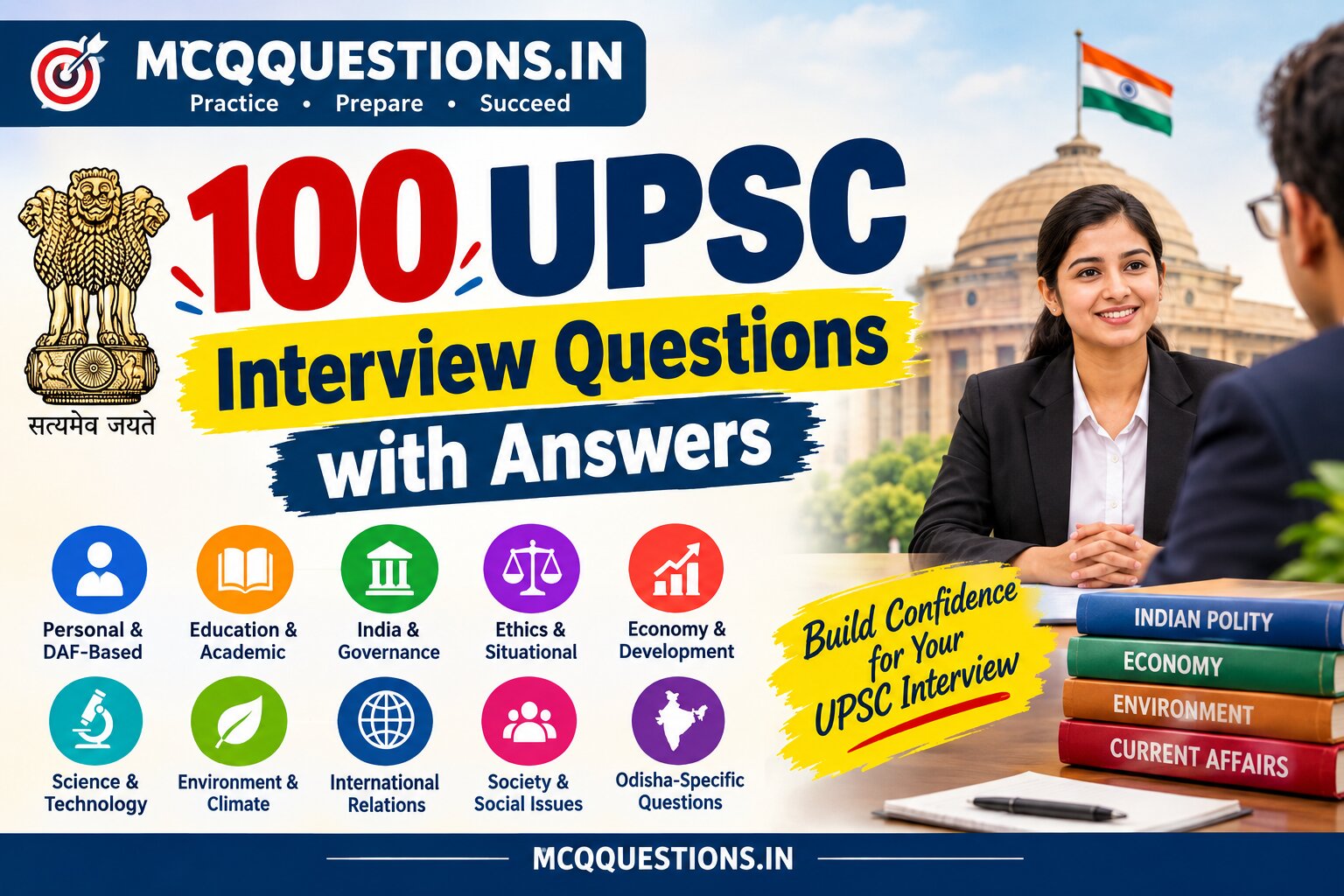
Here is a set of 100 UPSC Civil Services Interview Questions with concise model answers. These are practice answers, not guaranteed questions from any UPSC interview board. As I am from Odisha, some questions have been made from our state.
100 UPSC Interview Questions with Answers
Table of Contents
A. Personal & DAF-Based Questions
1. Tell us about yourself.
Answer: I am a disciplined and curious person who values learning, responsibility, and public service. My academic and personal experiences have developed my analytical thinking and taught me the importance of teamwork and empathy. I aspire to use these qualities in public administration.
2. Why do you want to join the civil services?
Answer: Civil services provide an opportunity to work directly on public problems and contribute to policy implementation. I am particularly attracted to the combination of responsibility, problem-solving, and public service.
3. Why do you want to become an IAS officer?
Answer: The IAS offers broad exposure to administration, development, disaster management, and implementation of government programmes. It provides an opportunity to work at different levels of governance and understand problems from the grassroots upward.
4. Why should we select you?
Answer: I would not claim that I am better than other candidates. However, I believe my willingness to learn, sense of responsibility, analytical approach, and commitment to public service can help me perform effectively.
5. What are your strengths?
Answer: My major strengths are patience, willingness to learn, analytical thinking, and the ability to remain focused when dealing with difficult tasks.
6. What is your biggest weakness?
Answer: I sometimes spend too much time examining different possibilities before making a decision. I am working on balancing thorough analysis with timely decision-making.
7. What is your definition of success?
Answer: Success means achieving meaningful objectives while maintaining integrity and creating positive value for others. It is not limited to position, wealth, or recognition.
8. What motivates you?
Answer: Learning new things, solving meaningful problems, and seeing tangible improvements resulting from one’s efforts are strong sources of motivation for me.
9. What does integrity mean to you?
Answer: Integrity means maintaining consistency between one’s principles, words, and actions, especially when there is no external pressure or supervision.
10. What would you do if you were not selected this year?
Answer: I would objectively evaluate my performance, identify areas for improvement, and decide whether another attempt is appropriate. The experience itself would provide valuable lessons.
B. Education & Academic Background
11. Why did you choose your graduation subject?
Answer: I chose it because of my interest in the subject and its relevance to my academic and professional development. It also helped develop analytical and structured thinking.
12. How will your academic background help you as an administrator?
Answer: Academic training develops the ability to understand evidence, analyze problems, evaluate alternatives, and communicate conclusions clearly—all of which are useful in administration.
13. What is the difference between knowledge and wisdom?
Answer: Knowledge is the understanding of facts and concepts, while wisdom involves applying knowledge appropriately based on experience, context, and sound judgment.
14. Should education primarily focus on employment?
Answer: Employment is important, but education should have broader objectives, including critical thinking, ethical development, citizenship, creativity, and social responsibility.
15. What changes would you suggest in higher education?
Answer: Greater emphasis could be placed on multidisciplinary learning, research, practical exposure, employability skills, digital learning, and stronger links between institutions and industry.
C. India & Governance
16. What is good governance?
Answer: Good governance involves transparency, accountability, responsiveness, participation, rule of law, efficiency, and equity in delivering public services.
17. What is the biggest challenge before Indian administration?
Answer: India faces multiple challenges, including effective implementation, regional disparities, urbanization, resource constraints, and coordination across different levels of government.
18. What is cooperative federalism?
Answer: Cooperative federalism refers to the Centre and states working together within their constitutional responsibilities to achieve common national and developmental objectives.
19. What is the importance of local government?
Answer: Local governments are closest to citizens and are therefore important for participatory governance, local planning, service delivery, and identifying grassroots priorities.
20. Why is decentralization important?
Answer: Decentralization brings decision-making closer to citizens, allows policies to reflect local conditions, and can improve accountability and responsiveness.
21. What is the role of a District Magistrate?
Answer: The District Magistrate has important responsibilities involving coordination of district administration, maintenance of public order, disaster management, implementation of government programmes, and interaction with citizens and departments.
22. What is the difference between government and governance?
Answer: Government refers primarily to formal institutions and authorities, whereas governance encompasses the broader processes through which government, citizens, civil society, and other stakeholders collectively address public issues.
23. Why is accountability important in public administration?
Answer: Accountability ensures that public officials are answerable for their decisions and use of public resources. It strengthens trust and discourages misuse of authority.
24. What is transparency?
Answer: Transparency means making relevant governmental decisions, procedures, and information accessible to citizens, subject to legitimate requirements of confidentiality and national security.
25. Can excessive transparency create problems?
Answer: Transparency must be balanced with privacy, security, confidentiality, and effective decision-making. Therefore, transparency should be meaningful but not absolute.
D. Ethics & Situational Questions
26. What is the difference between ethics and morality?
Answer: Morality generally refers to principles or beliefs about right and wrong, while ethics often involves systematic reasoning about appropriate conduct and professional responsibilities.
27. What would you do if your senior asked you to do something illegal?
Answer: I would respectfully point out the legal and administrative concerns. If necessary, I would document the matter and follow the appropriate institutional and legal mechanisms.
28. What would you do if your friend violated a law?
Answer: Friendship should not override the rule of law. I would encourage the person to follow the legal process and would not misuse official authority to provide improper assistance.
29. Can an officer be compassionate and strict at the same time?
Answer: Yes. Compassion concerns understanding people’s circumstances, while firmness concerns enforcing legitimate rules. Effective administration requires balancing both.
30. What is conflict of interest?
Answer: A conflict of interest occurs when personal interests could improperly influence, or appear to influence, one’s official responsibilities.
31. How would you handle political pressure?
Answer: I would respectfully engage with elected representatives, understand legitimate public concerns, and ensure that administrative decisions remain consistent with law, rules, and public interest.
32. What would you do if a poor person encroached on government land?
Answer: I would first understand the circumstances and applicable law. Any action should follow due process while also examining lawful rehabilitation or alternative arrangements where government policy permits.
33. What is empathy in administration?
Answer: Empathy is the ability to understand people’s circumstances and perspectives. It helps administrators design and implement decisions with greater sensitivity to citizens’ actual needs.
34. What is emotional intelligence?
Answer: Emotional intelligence is the ability to understand and manage one’s emotions while recognizing and appropriately responding to the emotions of others.
35. Is honesty enough for an administrator?
Answer: Honesty is essential but not sufficient. An effective administrator also needs competence, empathy, judgment, communication skills, accountability, and the ability to make timely decisions.
E. Economy & Development
36. What is inclusive growth?
Answer: Inclusive growth means economic growth whose benefits and opportunities reach broad sections of society, including disadvantaged and marginalized groups.
37. Why is unemployment a concern?
Answer: Unemployment reduces household income and economic security and can result in underutilization of human resources. Sustainable employment generation therefore requires attention to skills, investment, productivity, and labour-intensive sectors.
38. What is inflation?
Answer: Inflation is a sustained increase in the general price level of goods and services, which reduces the purchasing power of money.
39. Why is food inflation particularly important in India?
Answer: Food occupies a significant share of expenditure for many households. Food price increases can therefore disproportionately affect lower-income families.
40. What is fiscal deficit?
Answer: Fiscal deficit represents the government’s total expenditure exceeding its receipts excluding borrowings, indicating the amount that needs to be financed through borrowing.
41. What is monetary policy?
Answer: Monetary policy refers to actions undertaken by the central bank to influence money, credit, and financial conditions with objectives such as price stability and supporting sustainable economic activity.
42. Why are MSMEs important?
Answer: MSMEs contribute significantly to employment, entrepreneurship, local economic activity, supply chains, and exports. Strengthening their access to finance, technology, skills, and markets can support broad-based development.
43. What is the informal economy?
Answer: It consists broadly of economic activities and workers that operate outside or partly outside formal regulatory, taxation, and social-security systems.
44. What is financial inclusion?
Answer: Financial inclusion means ensuring that individuals and businesses can access and effectively use affordable financial services such as banking, payments, credit, insurance, and savings.
45. Can GDP alone measure development?
Answer: No. GDP measures economic output but does not fully capture distribution, health, education, environmental sustainability, quality of life, or other dimensions of human development.
F. Science, Technology & AI
46. What is artificial intelligence?
Answer: Artificial intelligence refers to computational systems designed to perform tasks that typically require capabilities associated with human intelligence, such as recognizing patterns, making predictions, or processing language.
47. How can AI help public administration?
Answer: AI can support areas such as document processing, fraud detection, service delivery, forecasting, resource allocation, and citizen support, provided that appropriate safeguards and human oversight exist.
48. What are the risks of AI?
Answer: Major concerns include bias, privacy risks, misinformation, cybersecurity threats, job displacement, lack of transparency, and inappropriate reliance on automated decisions.
49. Should AI decisions be completely autonomous in government?
Answer: For high-impact decisions, human oversight, accountability, explainability, and mechanisms for appeal are important. The appropriate level of automation should depend on the nature and consequences of the decision.
50. What is the digital divide?
Answer: The digital divide refers to unequal access to digital devices, internet connectivity, digital skills, and the ability to effectively use digital services.
51. How can India bridge the digital divide?
Answer: Measures include affordable connectivity, reliable infrastructure, digital literacy, accessible public digital services, local-language content, and support for people with limited digital skills.
52. What is cybersecurity?
Answer: Cybersecurity involves protecting digital systems, networks, devices, and information from unauthorized access, disruption, damage, or misuse.
53. What is the importance of data privacy?
Answer: Data privacy protects individuals from inappropriate collection, use, disclosure, or misuse of their personal information and strengthens trust in digital systems.
54. Can technology replace civil servants?
Answer: Technology can automate certain repetitive tasks, but public administration also requires judgment, accountability, empathy, negotiation, and understanding of social contexts. Technology is therefore better viewed as an administrative tool rather than a complete substitute.
55. What is the importance of scientific temper?
Answer: Scientific temper encourages evidence-based reasoning, questioning, experimentation, and openness to revising beliefs when reliable evidence changes.
G. Environment & Climate
56. What is climate change?
Answer: Climate change refers to long-term changes in climate patterns. Current global warming is primarily associated with increased concentrations of greenhouse gases from human activities.
57. What is sustainable development?
Answer: Sustainable development seeks to meet present needs while preserving the ability of future generations to meet their needs, balancing economic, social, and environmental considerations.
58. What is the difference between mitigation and adaptation?
Answer: Mitigation seeks to reduce the causes of climate change, such as greenhouse-gas emissions. Adaptation seeks to reduce vulnerability to the impacts of climate change.
59. Why are forests important?
Answer: Forests support biodiversity, regulate ecosystems, store carbon, protect soil and water resources, and provide livelihoods and ecosystem services.
60. How can cities become more sustainable?
Answer: Cities can improve public transport, waste management, water efficiency, green spaces, energy efficiency, urban planning, and climate-resilient infrastructure.
H. International Relations
61. What is India’s foreign-policy priority?
Answer: India’s foreign policy seeks to protect national interests while pursuing security, economic development, strategic autonomy, international cooperation, and constructive engagement with other countries.
62. What is strategic autonomy?
Answer: Strategic autonomy means maintaining the ability to make independent foreign-policy and security decisions while engaging with multiple partners.
63. Why is the Indian Ocean important for India?
Answer: The Indian Ocean is important for India’s maritime security, trade, energy supplies, connectivity, and relationships with neighbouring and partner countries.
64. Why are neighbouring countries important to India?
Answer: Geography creates strong interdependence in areas such as security, trade, migration, water resources, connectivity, and environmental issues.
65. What is soft power?
Answer: Soft power is the ability to influence others through attraction, culture, values, ideas, diplomacy, and reputation rather than coercion or payment.
66. What is multilateralism?
Answer: Multilateralism involves cooperation among multiple countries through international institutions, agreements, and common frameworks to address shared challenges.
67. What is India’s role in global institutions?
Answer: India participates actively in international institutions and seeks greater representation for developing countries while contributing to discussions on development, security, climate, trade, and global governance.
I. Society & Social Issues
68. What is social justice?
Answer: Social justice involves creating conditions in which individuals and communities have fair opportunities, rights, dignity, and access to essential resources and institutions.
69. Why is women’s participation in the workforce important?
Answer: Greater women’s workforce participation can expand household incomes, economic productivity, individual autonomy, and the overall utilization of human capital.
70. What is demographic dividend?
Answer: A demographic dividend is the potential economic benefit that can arise when the working-age population forms a relatively large share of the population, provided adequate education, skills, health, and employment opportunities exist.
71. What is the challenge of population ageing?
Answer: Ageing increases the need for healthcare, social security, suitable infrastructure, and care systems while potentially reducing the relative size of the working-age population.
72. Why is education important for social development?
Answer: Education improves skills, employment opportunities, social mobility, health awareness, civic participation, and individual capabilities.
73. What is poverty?
Answer: Poverty is multidimensional. It involves inadequate income and can also involve deprivation in nutrition, education, health, housing, sanitation, security, and access to opportunities.
74. How can rural development be improved?
Answer: Rural development requires investment in infrastructure, education, healthcare, irrigation, agricultural productivity, non-farm employment, connectivity, financial access, and local institutions.
75. What is urbanization?
Answer: Urbanization is the increasing concentration of population and economic activity in urban areas. It can create opportunities but also pressures on housing, transport, water, sanitation, and infrastructure.
J. Odisha-Specific Questions
76. What are the major strengths of Odisha?
Answer: Odisha has significant mineral resources, a long coastline, agricultural potential, forests, biodiversity, cultural heritage, and opportunities in manufacturing, tourism, fisheries, and renewable energy.
77. What are some major development challenges in Odisha?
Answer: Challenges include regional disparities, tribal and rural development, disaster vulnerability, infrastructure gaps in some areas, employment generation, and balancing industrial development with environmental protection.
78. Why is Odisha vulnerable to cyclones?
Answer: Odisha’s long coastline and geographical location in the Bay of Bengal expose it to tropical cyclones. Coastal geography and associated storm surges can increase the impact.
79. How can cyclone management in Odisha be improved further?
Answer: Priorities include early warning systems, resilient infrastructure, evacuation preparedness, community awareness, shelter capacity, restoration of livelihoods, and coordination among agencies.
80. What is the importance of Odisha’s tribal communities?
Answer: Tribal communities contribute to Odisha’s cultural diversity and have rich knowledge of forests, biodiversity, traditional practices, and local ecosystems. Development should protect their rights, dignity, livelihoods, and participation.
81. What can be done to improve tribal development?
Answer: Focus should be placed on quality education, healthcare, connectivity, livelihoods, nutrition, skill development, legal rights, and meaningful participation in development decisions.
82. How can Odisha attract more tourism?
Answer: Odisha can strengthen heritage, eco-tourism, coastal, religious, cultural, and adventure tourism while improving connectivity, visitor facilities, destination management, safety, and sustainable practices.
83. How can Odisha create more employment?
Answer: Employment can be expanded through manufacturing, MSMEs, tourism, agriculture and food processing, fisheries, services, renewable energy, logistics, and skill development.
84. What is the importance of Odisha’s coastline?
Answer: The coastline supports ports, fisheries, tourism, trade, ecosystems, and coastal livelihoods while also creating exposure to cyclones, erosion, and other hazards.
85. How can mining and environmental protection be balanced?
Answer: Mining decisions should follow environmental regulations, scientific assessment, rehabilitation requirements, community consultation, responsible resource use, and effective monitoring.
K. Current-Affairs Style Interview Questions
86. Why is misinformation a governance challenge?
Answer: Misinformation can influence public behaviour, create confusion, damage trust, and complicate crisis management. Government communication should therefore be timely, transparent, accessible, and evidence-based.
87. Should social media be regulated?
Answer: Regulation may be necessary to address clearly defined harms, but it should balance public safety with legitimate expression, privacy, transparency, and due process.
88. What is the importance of disaster management?
Answer: Disaster management reduces loss of life and property through prevention, preparedness, mitigation, response, recovery, and resilient reconstruction.
89. Why is water security important?
Answer: Water affects health, agriculture, industry, ecosystems, and livelihoods. Climate variability, groundwater depletion, pollution, and competing demands make integrated water management increasingly important.
90. What is energy security?
Answer: Energy security means ensuring reliable, affordable, and sustainable access to energy while reducing vulnerabilities arising from supply disruptions or excessive dependence on particular sources.
L. Pressure & Personality Questions
91. What would you do if you made a serious administrative mistake?
Answer: I would acknowledge it, assess its consequences, take immediate corrective action, inform the appropriate authority where required, and identify measures to prevent recurrence.
92. How do you handle criticism?
Answer: I try to distinguish useful criticism from unsupported criticism. Constructive criticism can reveal weaknesses and provide an opportunity for improvement.
93. What if your team disagrees with your decision?
Answer: I would listen to their reasoning and examine the evidence. If their arguments reveal a better option, I would change my decision; otherwise, I would explain the rationale and proceed while remaining accountable.
94. What if two communities have conflicting demands?
Answer: I would hear both sides, establish the facts, examine the legal framework and broader public interest, and seek a solution that protects rights while minimizing avoidable conflict.
95. What if your subordinate is more knowledgeable than you?
Answer: I would consider that an organizational strength. An administrator does not need to know everything personally; the important responsibility is to utilize expertise effectively and make accountable decisions.
96. What makes a good leader?
Answer: A good leader combines integrity, clarity of purpose, empathy, communication, accountability, decision-making ability, and the capacity to build an effective team.
97. Is failure important?
Answer: Failure can be valuable when it is analyzed honestly. It can reveal weaknesses, improve resilience, and help a person make better decisions in the future.
98. What is your idea of an ideal civil servant?
Answer: An ideal civil servant should be constitutional in outlook, impartial, ethical, competent, accessible, accountable, empathetic, and committed to delivering public services effectively.
99. What would you do on your first day as a District Magistrate?
Answer: I would first understand the district through available data and interaction with officers and citizens. I would identify immediate priorities, review critical services and vulnerabilities, and establish clear mechanisms for coordination and public grievance redressal.
100. Finally, what does public service mean to you?
Answer: Public service means using authority and professional abilities responsibly to protect constitutional values, deliver services fairly, solve public problems, and improve people’s lives while remaining accountable to the law and citizens.
100 UPSC Interview Questions with Answers
Also Read:
